The 14th public iteration of the Hamas-run Gaza Health Ministry’s (MOH) death toll list, dated to May 7, 2026 and containing 72,835 entries, was released quietly on July 5 by Iraq Body Count. Long analysis of data quality, demographics, unknowns, and post-ceasefire trends. 🧵
פרסמנו הערב:
מנסור עבאס העביר לראשי גוש השינוי מסר ברור לפיו הוא וחברי מפלגתו יצביעו בעד חקיקה בטחונית בכנסת. עד חודש פברואר יש צורך לחדש הוראות שעה שנוגעות בין היתר למעצרי מחבלים, בעבר התקשו ברע"מ בהצבעות מהסוג הזה.
מטעמו של עבאס לא נמסרה תגובה
Yashar announces a coalition agreement with Yisrael Beitenu while Democrats announce they are suspending negotiations with Yashar. The latter is probably a pressure tactic or symbolic, but upshot is that the odds of a Change Bloc-UTJ government (Lieberman's preference) with outside support from Ra'am are rising. All remains speculative and negotiations can collapse at any moment, but it's worth considering the implications of such a government.
Some advantages:
- The investiture vote would be (assuming the Change Bloc stays unified) at least 63 yes votes without relying on the Joint List -- an unbeatable margin.
- With Abbas' comments today that Ra'am will support key security legislation (like renewing the regulations for the West Bank, the bill that finally brought down the Bennett-Lapid government) and the general malleability of UTJ outside of its core issues (draft, subsidies, religion+state), such a government could probably win budget votes and survive for longer than the pure 48-seat Change Bloc option Eisenkot has floated. That opens the door to progress on a whole host of other issues.
- This government would also be able to move closer to U.S. demands on advancing the 20-point plan in Gaza and cracking down on Jewish extremist violence in the West Bank.
Some disadvantages:
- Partnering with UTJ will mean a full reversal of the Change Bloc's drive (highly important to their voters) to implement the Haredi draft, possibly including a compromise less strict than the bill Likud was formulating in the previous Knesset. This reversal will also extend to commitments on changing the subsidy structure to Haredi society and religion-state issues.
- In the short term, that would deeply upset the Change Bloc's base, even if it is offset by progress elsewhere. In the medium- to long-term, it either implements an insufficient solution or kicks the can down the road on one of Israel's near-existential challenges.
- Relying on UTJ (in the coalition) and Ra'am (outside the coalition) means leaning on two parties who practice non-Zionist, fundamentally extractive politics and will likely cooperate with each other to do so. That is not unique (in the current government, the Haredi parties do the same thing and the far-right parties practice Zionist but extractive politics), but is a problem to the extent it will affect tough but necessary policy choices.
Some roadblocks:
- The Supreme Court: The court is likely to reject any measure which does not result in meaningful conscription of the majority of Haredim, as it did under the current government. That is complicating/preventing the sort of hard guarantees about specific legislation or policy that UTJ is demanding in exchange for joining a coalition.
- Change Bloc voters: Some polling shows the UTJ option has majority support among Change Bloc voters whose top priority is bringing down Netanyahu. However, the specific policy concessions (draft, subsidies, religion and state) remain highly unpopular, and their bite would deepen over time. That would be less likely to strengthen the Netanyahu bloc than new strongly anti-Haredi or pro-service formations in the style of Reservists-Economy or Amcha Israel in future elections, which could shake up the political map.
Some personal thoughts:
- It is hard to countenance such a mainstream Israeli opinion (that most Haredim should be drafted) being ignored by both major Zionist political blocs--politics is always an unpleasant business, but mainstream Israelis will likely feel deeply disillusioned if this comes to pass.
- This sort of contortionist act to form a government reflects the Netanyahu distortion in Israeli politics: since 2019, the country has been politically stuck largely due to one man's actions (agree or disagree with them). Now, there is a significant and growing argument that to continue with Netanyahu involved with leading Israel is to risk a major and irreversible deterioration in ties with the U.S., let alone the rest of the West. That creates razor-sharp tradeoffs both between internal and external issues and within the domestic sphere: allow further erosion of Israeli institutions and forgo a proper October 7 investigation, or let the Haredi challenge grow through further delays?
- Israel's demographic-economic-social challenge with the Haredim cries out for resolution, and will only get harder with time. Perhaps there is an argument that through engagement the Change Bloc can aid integrationist currents in Haredi society -- but I have my doubts.
I wrote about Israel's ability to handle an end to direct U.S. security assistance back in May. In short, Israel can absorb an end to foreign military financing (FMF), but will need to reckon with the fiscal and economic challenge of semi-permanently increased defense spending. This sharpens the existing challenges with Israel's top-heavy economy, budgetary priorities, and integration of socio-economically disadvantaged populations. Israeli procurement patterns were already diversifying after October 7 and will continue to do so, though marquee purchases of fighter jets and such are going to continue. Finally, the real question isn't about what happens to FMF, but to arms sales and the broader security relationship. 🧵
Serious and seriously underrated challenge and cost of the IDF's constant combat mission since October 7: maintenance and repair of a vast array of equipment and platforms, not just the vehicle data reported here by Yedioth Ahronoth. That's separate from replacing lost/destroyed assets or making new purchases.
It would be helpful to know, as a point of comparison, what the typical share of serviceable tanks/APCs is during peacetime, but I'd be very surprised if it was close to 70%.
I mentioned this in passing earlier this year when writing about medium-term pressures on the Israeli defense budget in relation to a tapering of American aid (right).
Yedioth Ahronoth: https://t.co/nyfOgjim4Y
Times of Israel: https://t.co/8MSdRh5ttB
MOD (IDF casualties): https://t.co/4XkCmHRnbE
Haaretz: https://t.co/TO2qf67KPW
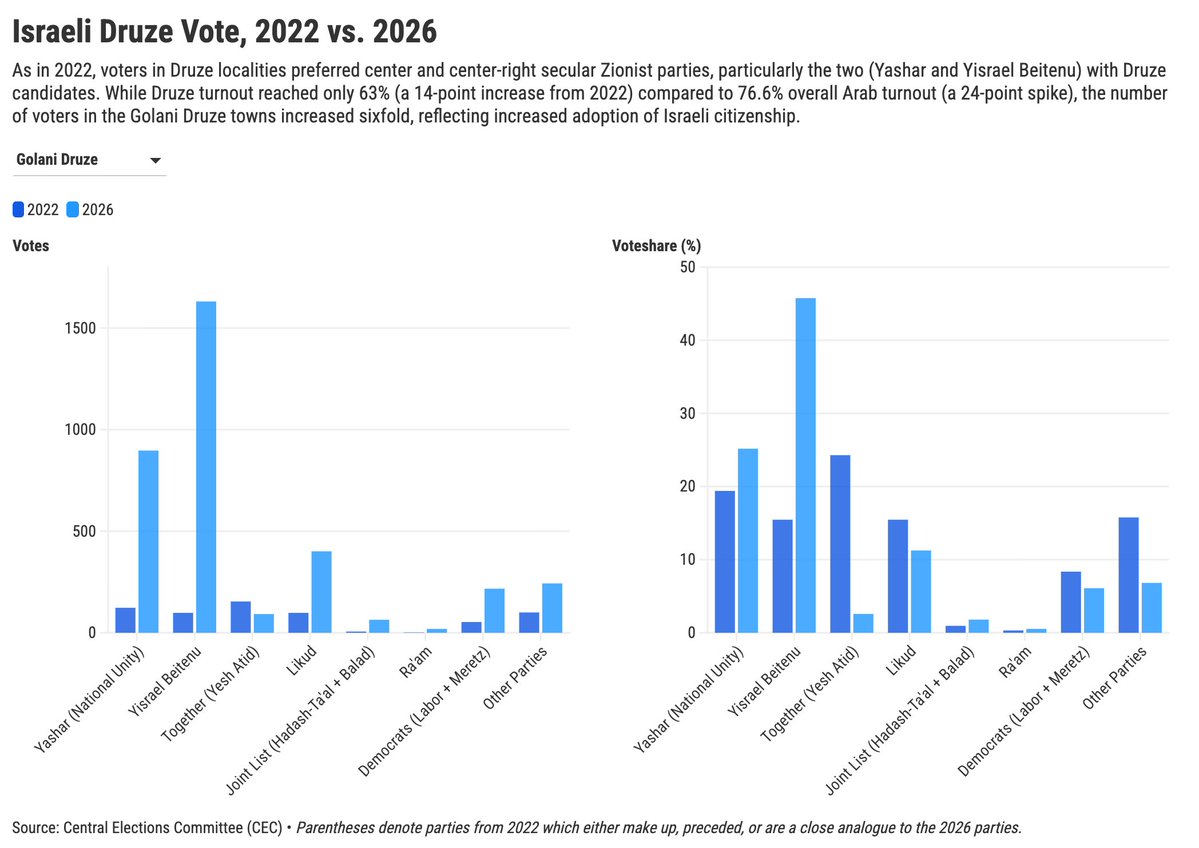
The Israeli Druze vote between 2022 and 2026: the share of the vote for Change Bloc parties stayed almost the same (down from 62.6% to 61.2%), but the distribution changed: Yashar took National Unity's leading spot, and Druze votes switched from Labor/Meretz (Democrats) and Yesh Atid (Together) to Yashar and Yisrael Beitenu. Not coincidentally, those two parties were the only ones to place Druze candidates in realistic positions this election.
Arab parties took another 20% of the vote, with some of that vote coming from the Christian and Muslim Arab minorities in several majority-Druze towns. Likud, which once won much of the Druze vote but dropped off sharply in the past decade, won 14.5%. Over 80% of Druze voted for major anti-Netanyahu parties, similar to 2022.
Turnout also increased less than every other Arab sub-group (14% vs. 24% overall), and was nearly 16 points the national average at 63.1%.
Among Golani Druze, the number of voters increased nearly sixfold and broke heavily for Yashar and Yisrael Beitenu (mostly the latter). Turnout also increased by 21% from 23% to 44%, closer to the national average. This reflects increasing adoption of Israeli citizenship among the Syrian Druze in those towns and greater engagement with the state, with both trends driven by their post-October 7 experience and the slaughter of Druze across the border in Syria following the fall of the Assad regime.
@42applesenergy It'll have to go into committee for discussions (didn't see an assignment yet), but then will need to pass the later readings in the plenum like any other bill. Unlikely that it would be allowed to pass, i think.
Three repeal bills approved for a preliminary reading in the Knesset today:
- Repeal of Judicial Selection Committee law (2 bills): passed 63-47 and 62-46 with 10 and 12 absences
- Repeal of AG division law: passed 63-47 with 10 absences
- Repeal of the Communications law: passed 63-49 with 8 absences
Also passed on for a preliminary reading: Likud MK Ofir Katz's bill to take away parliamentary rights from MKs who do not call Hamas a terrorist group. Intended to target MKs from the Arab parties, the bill passed 48-0 with 72 absences as the entire opposition (67 MKs) boycotted the vote. 5 Netanyahu bloc MKs missed the vote, including two loud proponents: Otzma MK Tali Gotliv (who missed all votes this morning) and Likud MK Almog Cohen, who was ejected from the plenum for heckling Yashar MK Shaul Meridor during his speech responding to the bill.
@42applesenergy As far as I understand, just a simple majority -- it's affecting Section 16 of Basic Law: The Knesset, which does not have a higher specified threshold.
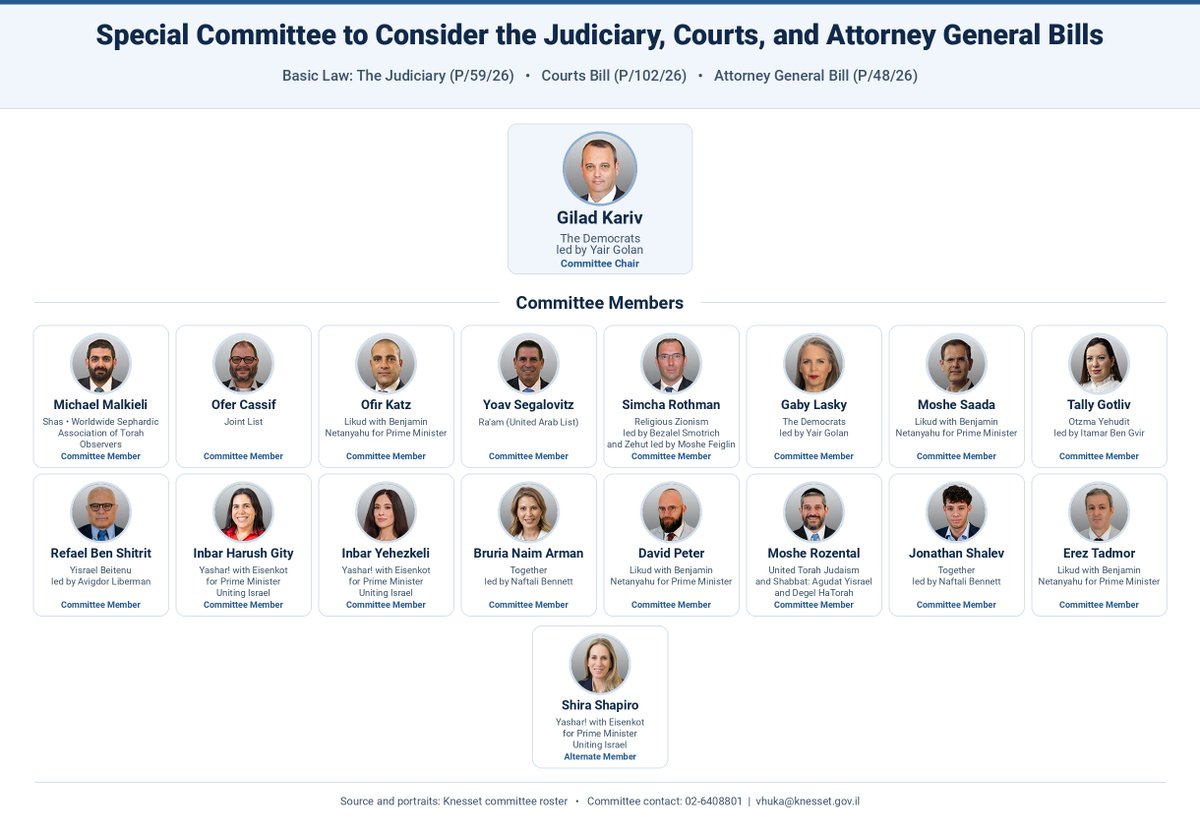
The Arrangements Committee approved two subcommittees which will handle these repeal efforts: one led by Democrats MK Gilad Kariv to address the judicial overhaul bills, and one led by Together MK Meirav Ben Ari to address the Communications Law.
Three repeal bills approved for a preliminary reading in the Knesset today:
- Repeal of Judicial Selection Committee law (2 bills): passed 63-47 and 62-46 with 10 and 12 absences
- Repeal of AG division law: passed 63-47 with 10 absences
- Repeal of the Communications law: passed 63-49 with 8 absences
Also passed on for a preliminary reading: Likud MK Ofir Katz's bill to take away parliamentary rights from MKs who do not call Hamas a terrorist group. Intended to target MKs from the Arab parties, the bill passed 48-0 with 72 absences as the entire opposition (67 MKs) boycotted the vote. 5 Netanyahu bloc MKs missed the vote, including two loud proponents: Otzma MK Tali Gotliv (who missed all votes this morning) and Likud MK Almog Cohen, who was ejected from the plenum for heckling Yashar MK Shaul Meridor during his speech responding to the bill.
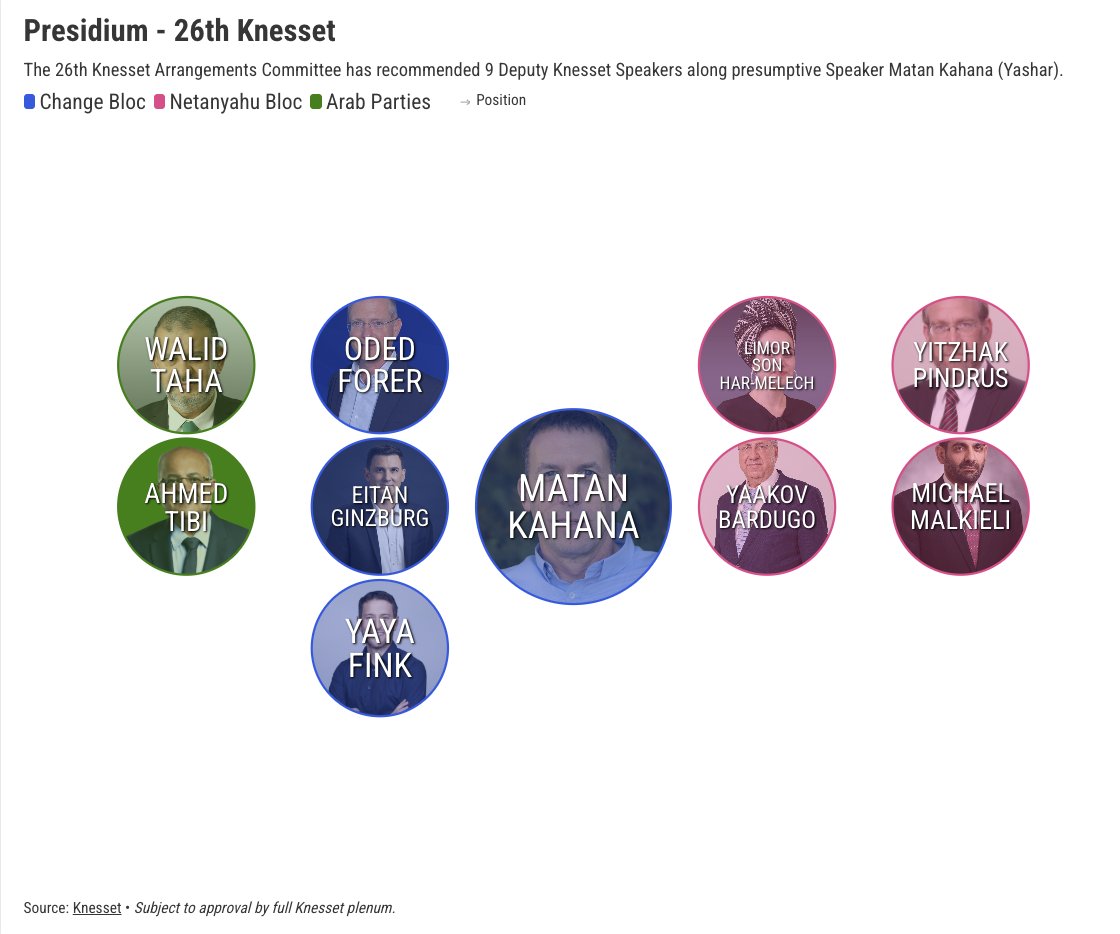
No surprises: with most MKs having gone home, a 38-15 vote approves the 9 deputy Knesset speakers. Because only Religious Zionism-Zehut does not have a representative here and all voted against (six MKs total), 9 MKs voted against one of their own party members becoming a deputy speaker: Otzma Yehudit (7), as well as Yossi Taieb and Yinon Azoulay of Shas, I believe.
For those wondering, that does mean that Otzma MK Limor Son Har-Melech voted against herself.
The Knesset will move to voting on 9 nominated deputy speakers after a 40-minute recess. If all elected (likely), the new Knesset Presidium would look like this.
Further breakdown of the Speaker vote for Kahana:
- 66 for (all from Change bloc/Arab parties)
- 49 abstentions (all from Netanyahu bloc parties)
5 MKs were not present in the plenum:
- 3 from UTJ (Yaakov Asher (Degel HaTorah), Moshe Rozental (Degel HaTorah), Elyakim Shtark (Chomat Torah Israel)
- 1 from Likud: Nir Barkat
- 1 from Ra'am: Yasser Hujeirat
MK Matan Kahana (Yashar) has been elected the next Speaker of the Knesset with 66 votes in favor, including from Ra'am and the Joint List. Ofir Katz received 52 votes in favor.
The Knesset will move to voting on 9 nominated deputy speakers after a 40-minute recess. If all elected (likely), the new Knesset Presidium would look like this.