The most merciful thing in the world is the inability of the human mind to correlate all its contents. (HP Lovecraft)
My RTs can be: Agree/Take note!/LOL
Este es el mejor video que vi en mucho tiempo.
Soldados israelíes se hacen pasar por terroristas de Hamás en EEUU y comienzan a detallar con orgullo las atrocidades del 7 de octubre a personas que apoyan a Hamás.
Miren las reacciones, es imperdible.
On 15 June 1940, Lavrentiy Beria returned from the Kremlin and wrote in his diary: "Koba [Stalin] has made the final decision on the Baltics. Like it or not, they must be sovietised. They will have to be moved."
One year later, they were.
14 June 1941. One night. 15,424 people deported from Latvia. 5,263 arrested and torn from their families. More than 650 later executed. Over 3,400 dead from starvation and disease. More than 1,400 dead in exile.
Today we remember them. And we correct the record - because it is still being falsified.
The most persistent myth: that deportation lists were drawn up by local informants, neighbours settling scores. It is false. Every list was prepared by the Cheka - the Soviet secret police. Every deportation order bears a Cheka officer's signature. The operation was directed personally by the deputy Soviet security commissar in Moscow. This myth has been spread deliberately to shift responsibility from the Kremlin and dissolve a centrally planned imperial crime into a fog of local grievance.
Today Russia is running the same system in Ukraine. Since 2022, approximately 4.7 million Ukrainians have been forcibly displaced. Ukrainian children abducted, handed to Russian families, stripped of their identity. The ICC has issued an arrest warrant for Putin on exactly these charges.
14 June is not only a day of remembrance. It is the line between truth and lies. We are not defending a victim's narrative. We are defending the facts - naming the crime, the occupation, and those responsible. That is not weakness. That is the only honest response to those who would rewrite history until the aggressor looks like a liberator.
I held a meeting with Latvian Defense Minister Raivis Melnis, who is visiting Ukraine on his first trip abroad since taking office.
We discussed the implementation of the Drone Deal signed between our countries this week. Through this format, in particular, we will be able to share with Latvia our expertise in air defense. Ukraine is always ready to help friends who have stood with us since the very beginning of Russia’s aggression. And, importantly, we share the same understanding: security challenges arise because Russia refuses to end its war through diplomacy.
We also discussed opportunities to finance joint projects under SAFE and cooperation within the European Union, NATO, and the Joint Expeditionary Force (JEF). I thank Latvia and all the Latvian people for their support!
NATO's Nordic and Baltic intel just dropped the receipts: fresh satellite shots show Moscow frantically pouring concrete near your borders. New barracks for thousands, ammo dumps, staging grounds, the works. Pechenga ten kilometers from Norway, Petrozavodsk and Sapyorny hugging Finland, Luga, Baltiysk in Kaliningrad, Kirillovskoye, Kandalaksha. Finnish army chief says the force posture opposite Finland alone will jump from 20k to 80k once the concrete cures.
This is not some abstract exercise. This is Moscow doing what Moscow does: preparing the next front while the last one is still bleeding it dry. They cannot even crawl fifty kilometers west of Donetsk in eleven years without losing more meat than the villages ever held. Yet here they are, building capacity to threaten the Baltic states and Scandinavia the moment they think the West blinks.
And the West is still sleepwalking. Every delay, every "peace" whisper, every politician pretending sanctions and strong language will substitute for actual deterrence simply feeds the imperial machine. Putin does not respond to lectures. He responds to superior force and the credible promise that using it will bankrupt him. Arming Ukraine is not charity, it is the cheapest insurance policy Europe has ever been offered. For the price of a few percent of defense budgets we keep the Russian army attrited, its best cadres turned into fertilizer outside Avdiivka and Vuhledar, its logistics shredded by domestic Ukrainian strikes that cost pennies compared to what they destroy.
The alternative is waiting until those new barracks are full and the next hybrid probe turns hot on NATO soil. Then the bill comes due in blood and in trillions, not billions. History already ran this experiment in the 1930s. The only thing "strategic patience" achieved was giving the aggressor better starting positions.
Moscow is an imperial project, not a normal state with normal concerns. Its ruling caste understands only strength. So stop pretending otherwise. Accelerate every weapons program, every drone line, every sanction that actually bites. Close the skies over western Ukraine with NATO air if you must. Turn the frozen Russian assets into shells and interceptors yesterday. Invest in Ukrainian interceptor production that has already proven it can defend a continent.
Because if you do not, those shiny new bases will not stay empty for long. And the next border Moscow tests will not be ours. It will be yours. The math is brutal, the evidence is in orbit, and the only remaining variable is whether European capitals finally grow a spine before the concrete dries.
No, sweetie.
Donetsk was a city of a million roses when its own Ukrainian flag flew above it.
Back then, it was also the fastest-growing and most rapidly prospering city in Ukraine -- home to what was the finest regional airport in Eastern Europe, one of the world's best football stadiums, a state-of-the-art railway terminal, and one of the cleanest, best-maintained cities in the region.
Its elites were running Kyiv, and every time I visited Donetsk as a student, riding the famous trolleybus Route No. 2 through the city, I was amazed by how many new office buildings were appearing, how much money was flowing into the city, and how many international companies were opening their doors there.
Fifteen years ago, to us kids from Donbas, Donetsk felt like the center of the universe because it had everything one could possibly dream of. It was a young city of universities and libraries, where the overwhelming majority of boys and girls from across Donbas went to study, including those from my own small hometown an hour away by bus.
Names like Liverpool or Detroit Rock City may mean nothing to you, but our Ukrainian Donetsk was a city of great rock clubs and unforgettable concerts. We traveled there to see Western bands perform.
We bought rock merchandise at the legendary Right House store near Krytyi Market. Scorpions, Rihanna, and Beyoncé performed at the famous Donbass Arena. Schoolchildren from across Donbas were bused in to watch Shakhtar Donetsk matches. The city even had a famous monument to The Beatles.
It was a city where we sang songs on guitars in its beautifully maintained parks and along the Kalmius embankment before heading out to buy the famous "green Donetsk burgers." Our older friends moved there after graduation, formed rock bands, recorded full albums, and held wedding celebrations in the squares around Donbas Arena. We traveled there to visit the legendary Radio Market in search of films, music, and books.
And then you arrived.
And you turned the wealthiest, most prosperous Ukrainian city into a piece of shit.
You deceived many of its people with sweet promises of Russian oil-fueled prosperity broadcast from television screens, but what you brought instead was war.
You transformed a thriving city into a criminal wasteland ruled by ethnic gangs from Russia, into a kingdom of Stalinist terror straight out of the 1930s, complete with torture chambers in the infamous Izolyatsia prison camp. You turned the magnificent Donetsk Airport into lifeless gray rubble, while the vast stands of Donbas Arena have spent a second decade slowly being reclaimed by weeds instead of hosting Champions League finals and Metallica concerts.
You swept away an entire generation of the city's men through your forced mobilization and threw them against Ukrainian machine guns until there were barely enough people left to keep basic municipal services running. Because of you, prosperous Donetsk became a withered desert without reliable water, because your war destroyed the canal system that carried water from the Siverskyi Donets River into Donbas. For years now, people have lived with chronic water shortages and have been reduced shitting into plastic bags forever.
You dragged Donetsk back like seventy years in time. You turned it into a depressed backwater, devoid of hope and future. Even ten years ago, tens of thousands of people, the most active, the most talented, the most entrepreneurial, fled the city and found refuge in Kyiv and elsewhere in Ukraine. Many of them still remember our Donetsk with tears in their eyes, the Donetsk that existed before the arrival of the "Russian World."
You transformed it into something that even my pro-Russian acquaintances are shocked to see when they return after years of occupation.
It was you who trampled the million roses of our Ukrainian Donetsk into shit beneath the tracks of your tanks and the boots of your death troops, turning them into a foul swamp of death and despair.
And that stain will forever remain on the conscience of fascist Russia, which brings nothing but destruction, decay, and death wherever it goes.
«Мы меняем их систему, где им хорошо живется. Зачем мы им?»
Российский полковник СВР в отставке Андрей Безруков поясняет главную цель войны с Украиной - вломиться в страну, где людям хорошо живется, и испортить им жизнь.
Вся суть русского мира в этом заявлении.
This is a noteworthy development. I want to remark two things:
1) After Trump was elected, the US came in fast and hard trying to force Ukraine into a surrender. Based on the erroneous perception that the US was the only party that could ensure Ukraine's survival, they immediately cut their support to near zero with the expectation that this would make the Ukrainian war effort unsustainable, allowing the US to dictate the terms of Ukraine's surrender. That would serve to reaffirm American power abroad and have the neat side effect of greatly enriching Trump and his cronies in the process. This course of action was widely supported by the US political sphere and a set of business elites. It was, however, badly mistaken. The US cutting back its support did not force Ukraine to surrender. Instead, Europe picked up the tab, Ukraine kept on fighting and the US was increasingly side lined as a major player in this war.
2) However, not only did US support prove not nearly as pivotal as we were made believe; it turns out to have been counterproductive. All that three years of American support resulted in was a Russia that was slowly grinding it's way through Ukraine. That was, according to the US commentariat, a result of Ukrainian incompetence, European complacency and generally just sheer inevitability. If the US can't fix the situation, nobody can. But now, 1.5 years after the US cut it's support, Ukraine is killing more Russians than ever, striking the Russian war machine deep in the rear and even driving Russian forces back in places. Ukraine fared better when it was opposed by the US than when it was supported by the US. This is bad not only for US influence in Ukraine but also in the wider world, heavily undermining one of the core narratives that underpin American global influence. After all, why should anyone accept the strings that usually come attached with US meddling if it will only make things worse for you?
The US now trying to get behind a winning horse after having miscalculated so dearly is not a result of newly found resolve and rediscovered moral integrity but a panicked attempt to salvage what is left to be salvaged. Should Ukraine bring this war to a charitable end while the US continues to stand on the sides, the damage to American global reputation and influence would be immense. The smarter Americans have understood this and that is how this situation must be interpreted.
Considering my partial Polish roots, I’ve spent a long time thinking about what to write regarding the Ukrainian-Polish scandal, and the crisis in our relations as a whole. But I doubt I could ever say it better than Oleksandr Zinchenko. We have a lot of work ahead of us, and much can be said about the solutions, but we must remember the core truth - without Poland, Ukraine will be weaker, and without Ukraine, so will Poland. 👇
Why is the Polish right-wing turning hostile? Historian Oleksandr Zinchenko argues that it’s not about past UPA history - it’s about fear of Ukraine’s rising geopolitical power. The Polish right realizes that Russia is losing, and they are terrified of Ukraine’s growing agency. Poland is currently acting as a "Traumaland" - making past fears and historical scars the cornerstone of its national identity instead of processing them.
To overcome this crisis and stop mutual re-traumatization, Zinchenko proposes a comprehensive 7-step roadmap for reconciliation:
1. A Liturgy of Mutual Forgiveness - Ukraine should invite the next President of Poland to Kyiv for a joint prayer service at the historic St. Sophia Cathedral. The cornerstone of this spiritual reconciliation must be the powerful formula: "We forgive and ask for forgiveness."
2. Acknowledging Geopolitical Errors - The Polish leadership needs to declare that opposing Ukrainian independence in 1918-1921 was the single greatest mistake in our shared history. That division cost Ukraine millions of lives under Soviet rule, cost Poland hundreds of thousands, and directly led to Poland losing its own statehood in 1939. When we stand apart, we both fall.
3.Humanizing All Victims - We must stop dividing historical pain. A joint declaration should state: "All victims of our tragic past are neither strictly Polish nor Ukrainian - they are ours, they are human." Every act of ethnic cleansing committed in the 20th century by either side must be unconditionally condemned. The tragic deaths of children in Sahryn are no different from those in Wola Ostrowiecka.
4. Breaking the 80-Year Memorial Taboo - Both Presidents must jointly lay flowers at the historical conflict sites - specifically in Sahryn (Poland) and Ostrówki / Wola Ostrowiecka (Ukraine). Despite decades of Ukrainian urgings, no Polish president in over 80 years has taken this step. This historical omission must be corrected.
5. De-anonymizing the Tragedy - We need to move from abstract numbers to human faces. Ukraine and Poland should cooperate to research and publish a complete, nominal list of every single victim of the bilateral conflict, printed in both languages. Every individual must be remembered by name.
6. Agreeing to Disagree on National Pantheons - We must accept that our national heroes will never be the same. Poland must recognize that Ukrainian heroes are not Polish, and Ukraine must recognize that Polish heroes are not Ukrainian. Ukraine will not challenge the legacy of Piłsudski or Dmowski (who allied with Bolsheviks against Ukrainian statehood), and Poland must stop targeting those who fought for Ukraine's independence. We both fought for our freedom. We both won it. Period.
7. Ironclad Mutual Security Guarantees - A new strategic paradigm: Ukraine, possessing the most battle-hardened and powerful military on the European continent, will legally guarantee and actively defend Poland’s sovereignty. In return, Poland, as a major European power, will unconditionally support Ukraine’s integration and its diplomatic efforts for a just, lasting peace.
Ukraine has conquered its own existential fears on the battlefield. Now, we are strong enough to help Poland overcome its historical anxieties. By executing this roadmap, both nations can finally shed the baggage of the 20th century and build an unbreakable, equal alliance for the future.
🇺🇦🤝🇵🇱
It’s painful to realize that the moment the Russian missile hit, someone’s life stopped even though everything froze in place: furniture still standing, food still in the fridge, napkins left on the table…
and yet the people are gone. The children are gone. Killed by Russia.
📍Kyiv, Ukraine
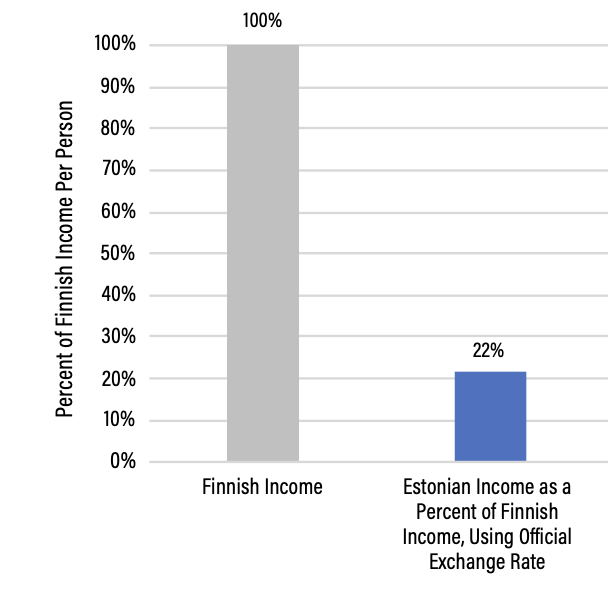
The GDP comparison shows what they took from our economy. Here's what russians took that can't go in a spreadsheet.
Start with what Estonia was in 1939: a functioning European democracy, fifteen years old, with its own constitution, parliament, currency, university, literature, and officer corps. A small country that had built its institutions from scratch and was making it work. That is the thing they set out to destroy. Systematically. With lists.
June 14, 1941. They came at night, because they always came at night.
Around 10,000 Estonians were loaded into cattle cars in a single coordinated operation — executed across the country in hours. The method was deliberate: men were separated from their families at the freight-car doors. Men to labour camps in Siberia. Women, children, the elderly to "special settlements" — places with no infrastructure, no food, no medicine, dropped there and left. Most of the men were dead within eighteen months.
The people they took were not criminals. They were the Estonian state. Officers who had served in the Republic's military. Civil servants. Judges. Teachers. Farmers who owned land. Politicians. Their families.
Eight years later they came back for more.
March 25–28, 1949. Operation Priboi. In 72 hours, roughly 20,700 Estonians were deported — around 90,000 across the three Baltic states. The targets this time were farmers who refused to join collective farms, and families of men who had joined the Forest Brothers resistance. Again: children were in those cars. Grandmothers. Newborns.
Meanwhile, some 70,000 Estonians had already fled to Sweden and the West in 1944 rather than face the second Soviet occupation — most of them educated, professional, the people who run a country. The leadership class was gone. What remained was being systematically removed.
By 1950, Estonia had lost between a fifth and a quarter of its entire pre-war population. You cannot rebuild an officer corps, a judicial culture, an academic tradition, from nothing, in ten years. That damage ran deep and ran long.
And while Estonians were being emptied out, the replacement was being shipped in.
Soviet resettlement was not coincidental migration — it was policy. Factories were built specifically to draw Russian workers. Housing was allocated. Russian was imposed as the language of administration, of higher education, of any career worth having. The message was explicit: assimilate or be left behind. By 1989, ethnic Estonians were 61% of their own country. Latvians were 52% of Latvia. Nations that had been 85–90% of their own homelands in 1934 had been diluted to bare majorities — in two generations, by design.
This is the population Moscow is now presenting to the International Court of Justice as a persecuted minority. People who moved to Estonia under a Soviet resettlement programme specifically engineered to erase Estonians.
The occupation created the imbalance. The occupation ended. We are now expected to answer for the imbalance in The Hague.
We remember who came in those cattle cars. We remember who came after. And we know exactly what both groups were sent here to do. 🇪🇪🇱🇻🇱🇹
The Saint Petersburg International Economic Forum of 2026 (SPIEF 2026) in Russia has started with a very fiery keynote speech by the Ukrainian surprise guests.
People keep asking what the Soviet occupation actually cost the Baltic states. You don't have to imagine it. There's a control group, and it's sitting right across the gulf.
In 1938 — the last full year before the war — Estonia and Finland had essentially the same GDP per capita. Two small nations, same sea, neighboring languages, the same starting line. By some rankings Estonia was even slightly ahead. Heritage FoundationX
Then history split in two.
Finland fought the Winter War and kept its independence. Estonia was occupied, annexed, and folded into a planned economy. Same decade, opposite roads.
Fifty years later:
🇫🇮 Finland — ~$24,000 per person (1992)
🇪🇪 Estonia — ~$2,800
An eightfold gap — from an identical starting point. Not because Finns worked harder. Not because Estonians were less capable. One country was free to build. The other was told what to build, for whom, and at what loss.
The wages say it even more cleanly: in 1938 Estonian purchasing power was just 4% below Finland's; by 1988 it was 42% below. That cliff is the occupation, drawn in numbers.
And here's the part that ends the argument. Set free for a single generation, Estonia has already clawed back to roughly four-fifths of Finnish income. A gap that took 50 years to open is closing in 30. That's the proof it was never about us — it was the system imposed on us.
There's a cost that never shows up in GDP, either. No occupation means no cattle cars to Siberia. No murdered and exiled intelligentsia. No decades of settlers moved in to outnumber the natives — which means the very "Russian-speaking minority" Moscow is now parading before the ICJ wouldn't exist at anything like that scale. The grievance Russia is litigating is one it manufactured itself.
So no — we don't wonder what we lost. We can see it from the ferry.
And free at last, it's what we're finally becoming again. 🇪🇪🇱🇻🇱🇹
За минулу добу (01.06.2026) противник на всіх напрямках орієнтовно втратив:
особовий склад ❌ 1 440
танки 💥 3
бойові бронемашини 💥 7
артилерійські системи 💥 75
РСЗВ 💥 1
засоби ППО 💥 1
НРК 💥 14
авто-техніка💥517
У понеділок кількість бойових зіткнень зменшилась.



![RihardsKols's tweet photo. On 15 June 1940, Lavrentiy Beria returned from the Kremlin and wrote in his diary: "Koba [Stalin] has made the final decision on the Baltics. Like it or not, they must be sovietised. They will have to be moved."
One year later, they were.
14 June 1941. One night. 15,424 people deported from Latvia. 5,263 arrested and torn from their families. More than 650 later executed. Over 3,400 dead from starvation and disease. More than 1,400 dead in exile.
Today we remember them. And we correct the record - because it is still being falsified.
The most persistent myth: that deportation lists were drawn up by local informants, neighbours settling scores. It is false. Every list was prepared by the Cheka - the Soviet secret police. Every deportation order bears a Cheka officer's signature. The operation was directed personally by the deputy Soviet security commissar in Moscow. This myth has been spread deliberately to shift responsibility from the Kremlin and dissolve a centrally planned imperial crime into a fog of local grievance.
Today Russia is running the same system in Ukraine. Since 2022, approximately 4.7 million Ukrainians have been forcibly displaced. Ukrainian children abducted, handed to Russian families, stripped of their identity. The ICC has issued an arrest warrant for Putin on exactly these charges.
14 June is not only a day of remembrance. It is the line between truth and lies. We are not defending a victim's narrative. We are defending the facts - naming the crime, the occupation, and those responsible. That is not weakness. That is the only honest response to those who would rewrite history until the aggressor looks like a liberator.](https://pbs.twimg.com/media/HKt2qYBW4AAEFOs.jpg)