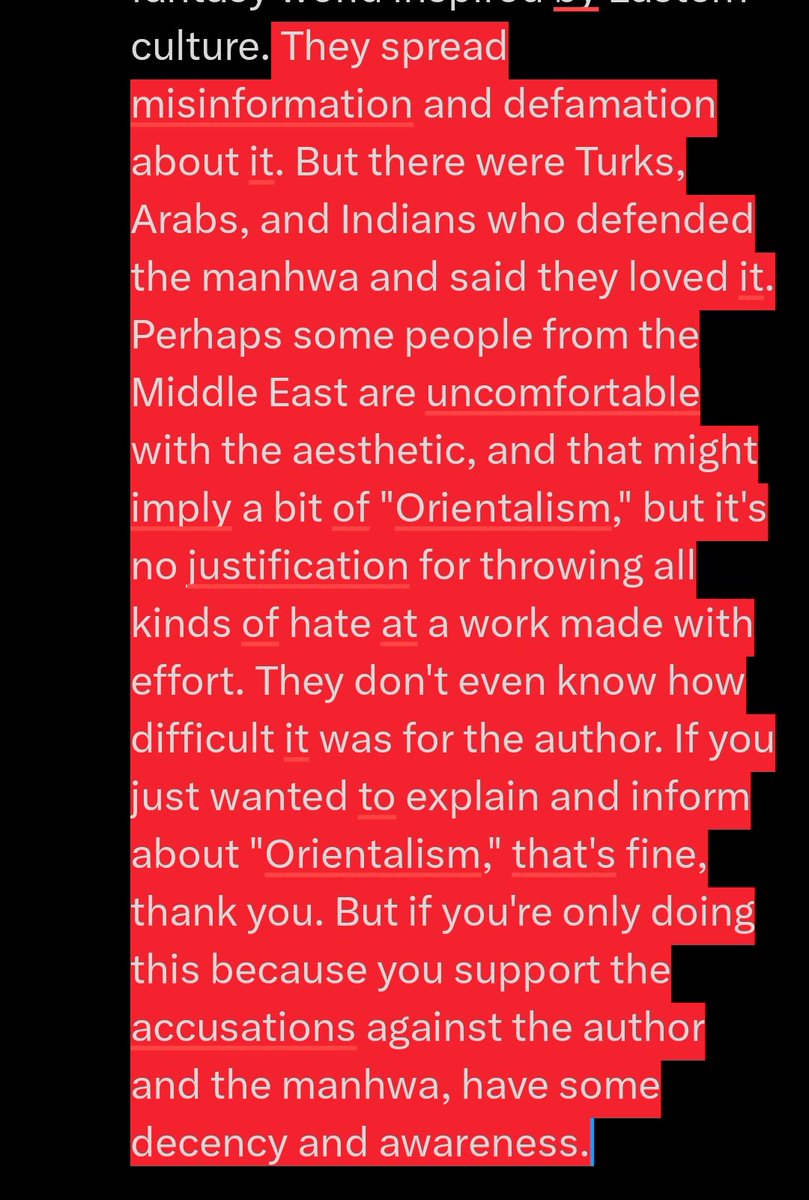
@sinbethemoon@XxpetalC@twincest101@tamaescence In my screenshot, it explain a lot about the "Orientalism" that people accuse the manhwa of, the post is longer. People are looking for an excuse to censor and promote harassment of an author who literally just created a fictional fantasy world inspired by Oriental cultures.
He visto a varios usuarios turcos expresar que no sienten indignación alguna por el "orientalismo" de esta obra
¿Quienes son los de complejo de salvador blanco aquí?
Al cesar lo que es del cesar
Ya se canceló la obra de jaxx porque tocó un tema sensible de la historia de estados unidos
Dejen de joder a otros autores por tomar temas "sensibles" de otros países que no son el suyo y que les valga verga jajajaja
@manhwareadera@sabjooning@shurakasbigtoe Arabs and South Asians have every right to express their opinions. And an opinion or criticism is fine as long as it doesn't promote harassment and hatred, which is the main problem in this whole controversy. I have also seen how others spread misinformation and defame the works
Otra gringa estúpida queriendo sentirse superior moralmente. Entonces esas escenas en las novelas turcas donde las concuninas le bailaban al sultán también son misoginia según esta ridícula. Ve a cancelar esas novelas hechas por los mismos turcos entonces
@sabjooning@manhwareadera@shurakasbigtoe People say that it is common in Orientalism to mix Hindu and Arab cultures. But that's purely aesthetic; the other characteristics of Orientalism don't appear in the manhwa. I saw Indian and Arab users say they loved Bwat's works; Americans shouldn't speak for other cultures
Bro, es Corea de Joseon 😭 Ahí la piel bronceada = campesino que chamba en el sol, piel pálida = noble que no sale. Es clasismo histórico, no colorismo tipo gringo
Y Yao sí tiene nombre, historia y es el "tigre" del título. No lo doman como mascota, ambos se salvan entre ellos
Y si empezamos nosotros también la caza de brujas sobre este tipo de cuentas? Con suerte ellos mismos se cierran la cuenta después de recibir mucho "amor" de la comunidad.
Ya que no tienen vergüenza que reciban de su propia medicina
@iansmanager@Kisaki_Lau Si quieren acosar y mandar mensajes de muerte a un racista, hágalo con su presidente, una persona REAL que afecto gente REAL
Que son esas mamadas de acosar gente real por ficción
@Dahouken NO, I'm kinda asexual. I will never put my self in their place and imagine my self sleeping with someone. Eww nope. But I like watching other people/characters (NOT ME MYSELF AND I).
@XxpetalC@twincest101@tamaescence So what if he's dark-skinned? Nobody's portraying Shuraka as a mockery or parody of dark-skinned people. You're the racist one. Do you want Shuraka to be white? That makes you racist not accepting his skin color.
@XxpetalC@twincest101@tamaescence What Orientalism? Eastern culture isn't "Orientalism," it's simply culture. Look up the word "Orientalism," and then analyze the manhwa you're criticizing. There's no Orientalism in it whatsoever. If you haven't read the manhwa, don't speak.
One thing I genuinely don’t understand is this: if the claim is that Arnata is portrayed through orientalist stereotypes as an inferior, irrational, or uncivilized place, just like the definition shown in your own Wikipedia screenshot, where exactly does the story portray that?
Arnata is literally presented as one of the most powerful nations in this fantasy world. It’s rich in natural resources, politically influential, and feared by other kingdoms. Shuraka himself is the Emperor, and he’s consistently portrayed as intelligent, capable, respected, and powerful.
In fact, the contrast between Arnata and Leracal isn’t about one being “better” because of race. It’s about geography and worldbuilding. Leracal is a frozen northern kingdom with snow-covered landscapes, while Arnata is a warm southern nation with lush forests, abundant resources, and a completely different climate.
Even Tei describes that contrast. Arnata isn’t portrayed as poor, backward, or dependent on Leracal. If anything, it’s the opposite: Arnata is the stronger kingdom, and the political alliance exists precisely because of Arnata’s power and influence.
Blossoms of the White Night is also a fantasy story. It has magic, fictional kingdoms, mythical creatures, and an entirely fictional political system. Like many fantasy works, it may draw inspiration from real cultures or historical periods, but inspiration alone is not the same as portraying those cultures as inferior.
The same applies to the harem. In the present timeline of the story, it’s not portrayed as something to glorify mistreatment. Shuraka inherited it from the previous emperor, but instead of continuing those practices, he protects the women living there, treats them with respect, and allows them to live peacefully. The story deliberately gives that concept a different direction rather than repeating historical abuse.
If someone believes certain inspirations were handled poorly, that’s a completely valid discussion to have. But I don’t think it’s fair to ignore what the story actually shows. Based on what we’ve seen, Arnata is not portrayed as an inferior civilization. It’s portrayed as a prosperous, powerful nation whose people are treated with dignity and respect.
Again. Not with this author. Not with this story.
If we’re going to talk about racism, let’s first talk about what racism actually is.
Racism is about discriminating against, prejudging, or portraying someone as inherently inferior because of their race or skin color.
That’s why I think two completely different conversations are being mixed together.
One is discussing how a fantasy story draws inspiration from real cultures or historical periods. That’s a valid discussion, and everyone is free to have it.
A completely different conversation is claiming a story is racist simply because it features a dark-skinned protagonist and a lighter-skinned love interest.
Looking at Blossoms of the White Night, I simply don’t see Shuraka being portrayed as inferior because of his skin color. On the contrary, he is one of the most powerful people in his world. He becomes Emperor, and throughout the story he is intelligent, respected, admired, and feared.
Even the difference in skin tones makes sense within the world’s own logic. Shuraka comes from a warm southern region, while Tei comes from a snowy northern land. Their appearances fit the environments they were raised in. That’s worldbuilding.
Another point that keeps getting overlooked is that there isn’t a “white savior” trope here. Neither character exists to “save” the other. They protect each other, grow together, and change each other’s lives. At no point does the story suggest that one has more value because of their skin color or social status.
People have also brought up the harem, so let’s talk about that.
Yes, a harem exists in the story. But the way it’s portrayed in the current timeline of the manhwa is completely different. The former emperor treated it one way. Shuraka doesn’t. He gives those women a safe place to live, treats them with dignity and respect, and never sees them as people to possess.
So even if the author drew inspiration from a historical institution, she also changed the role it plays within the story. Rather than repeating how it traditionally functioned, she presents a ruler who chooses a different path.
And let’s not forget something important: Blossoms of the White Night is a fantasy story. It isn’t presented as a historical documentary or a literal representation of one specific empire, religion, or culture. It includes fictional kingdoms, monsters, and an entirely fictional world.
Could it be inspired by real cultures or historical periods? Absolutely. Many fantasy stories are. But inspiration and literal representation are not the same thing.
And here’s what I keep asking myself:
If the dark-skinned protagonist is never portrayed as less intelligent, less capable, less worthy, or less human because of his skin color… then where is the racial discrimination within the story?
And if a historical element like the harem isn’t glorified but instead is reinterpreted in a way that gives it a completely different role, shouldn’t that also be part of the conversation?
I also think we should be careful not to treat skin color alone as automatic proof of racism.
Because if every story featuring a dark-skinned protagonist and a lighter-skinned love interest is immediately labeled racist without first looking at how the characters are actually written, then we’re reaching conclusions before the story itself supports them.
For me, stories should be judged by what they actually show, not by assumptions made before the story itself makes those claims.
@XxpetalC@twincest101@tamaescence Besides, the manhwa doesn't romanticize Orientalism; there's no slavery, racism, or colonization whatsoever. Shuraka is portrayed as a tyrant. You're definitely creating imaginary enemies.
@KeitaSakamoto_@LandyChabl82859@esquizo_vero La verdad comprendo tu frustración y soy lectora BL. Pero también hay Gays, lesbianas y bisexuales en la comunidad BL, hay autores gays que han hecho obras BL. También me ha frustrado ver cómo fetichizan a los gays algunas fujoshis, pero el BL es para todos, la comunidad BL no