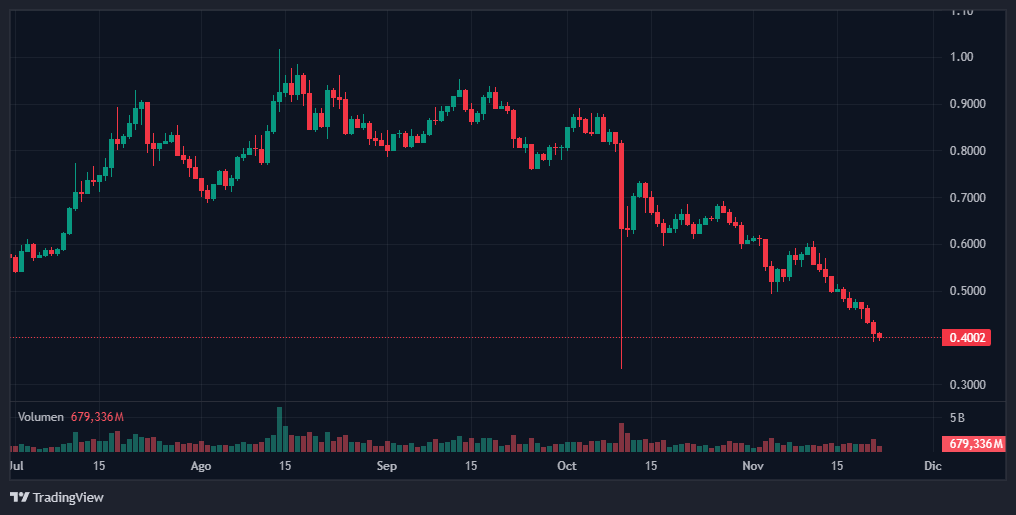
10 reasons why solana:9cRCn9rGT8V2imeM2BaKs13yhMEais3ruM3rPvTGpump will be bigger than $PUMP:
1. Every cycle has one person who defines the meta. This cycle it’s @blknoiz06, he has been one of the most influential people in CT and he's the most influential person now
2. The only people who can move markets with a single tweet are @blknoiz06 and @elonmusk
3. $PUMP has a platform while solana:9cRCn9rGT8V2imeM2BaKs13yhMEais3ruM3rPvTGpump is making people believe in something
4. solana:a3W4qutoEJA4232T2gwZUfgYJTetr96pU4SJMwppump had an incredible run, but it's nothing compared with solana:9cRCn9rGT8V2imeM2BaKs13yhMEais3ruM3rPvTGpump
5. Everyone faded WIF. Nobody wants to fade Ansem twice.
6. Attention is the rarest asset in crypto, and Ansem owns more of it than almost anyone.
7. Ansem is belief.
8. The upside isn’t priced because people still think this is “just another meme.”
9. When CT finally accepts the thesis, the move is already over.
10. The most obvious trade is usually the one everyone overthinks, listings are coming, its just a matter of time.
Bigger than $PUMP.
Past WhiteWhale.
Only one man can pull this off.
DYOR NFA
It’s not a coincidence that everywhere you look people are yelling USD1 Szn and throwing their ☝️’s up.
This didn’t happen overnight — it was meticulously planned, built, and manifested day after day.
Those who didn’t believe may want to grab an umbrella.
🦅☝️
Pumpfun’s numbers tell an uncomfortable story.
They raised $1.3B at a $4B FDV, became the top revenue protocol on Solana, generated nearly $1B in under two years, and sold 4.1M SOL (about $741M at the time). The token is now down ~50% from the ICO price.
The team had previously hinted at a large PUMP airdrop, but so far users haven’t seen anything material. The founder has also gone quiet, which is raising eyebrows given the timing of the SOL sales and the drawdown.
Whether intentional or not, it’s shaping up to look like one of the most well-timed exits the space has seen. Business is business, but the optics matter.
Implementing ASM in crypto runtimes is essentially about removing human abstractions between math and metal.
Every blockchain is the same, CPU bound cryptography, non adaptive binaries, and compilers that generate “good enough” code.
The correct approach is deterministic vectorization.
You hand-write kernels for Ed25519, SHA-256, Keccak, and BLAKE3 in AVX2/AVX-512 on x86, NEON on ARM, and later RISC-V V-ext.
All functions execute in constant time; no branches, no data-dependent memory access. You structure everything as contiguous SoA buffers, batch inputs (64–256 at a time), and push them through fused multiply-add ladders using adcx/adox or SVE-wide reductions.
Integration happens at the runtime boundary through a Foreign Function Interface (FFI).
The validator or node client keeps its logic intact, you just replace its cryptographic primitives with drop-in FFI calls to the optimized assembly layer. At startup, the node performs CPU capability discovery (cpuid / auxv), selects the most suitable kernel, and runs a microbenchmark sweep to auto-tune unroll factors, prefetch distances, and scheduling order. Results are cached per model hash, ensuring deterministic performance profiles across deployments.
Validation is non-negotiable. Every kernel is cross-verified against a reference implementation over 10⁶ random vectors, Wycheproof-tested, and ct-audited using valgrind differentials.
The runtime never trusts unverified results, shadow verification stays active until full parity is confirmed. The node reports live metrics (ns/sig, ns/hash, power usage, batch histograms) to a telemetry aggregator that prunes regressions automatically.
This approach fuses low-level assembly determinism with an adaptive runtime feedback loop. A self-optimizing cryptographic core that learns from the hardware it runs on. It’s raw, measurable throughput acceleration, achieved by aligning computation with the physical geometry of the silicon.