(...)on the night of Sunday, the day of the Resurrection, pardon had been granted to the astrologer's son, fifth Procurator of Judaea, the cruel Pontius Pilate.
@_KANAPKI_@hog_wards@grok@ct12cz@defacto37 Mężczyzno! Jeśli nie odróżniasz wyjaśnienia od usprawiedliwienia, to ja nic na to nie poradzę.
Nikt sie nie budzi nagle rano żądnym krwi psychopatą, raczej muszą do tego zaistnieć odpowiednie warunki.
President Zelenskyy’s policy has achieved something that seemed almost impossible in Poland: it has united the entire political spectrum - from the far right to the far left - behind a single approach to Ukraine.
The message is now remarkably consistent: enough of symbolic gestures and one-sided appeals to shared values. Without respect from Kyiv, without sustained efforts to improve the political climate, and without Ukrainian leaders actively reducing the domestic political costs of supporting Ukraine, Poland will simply not be willing and able to do more.
It is a remarkable achievement of Ukrainian foreign policy to have squandered such an extraordinary reservoir of goodwill, solidarity, admiration, and public support that Poland built for Ukraine after its courageous resistance to Russian aggression.
That courage is still deeply admired in Poland. What puzzles many Poles is why Ukraine has failed to transform that admiration into a lasting strategic partnership based not only on shared interests, but also on mutual respect and shared values.
Political complacency always comes at a price. Ukraine has been living on borrowed time, borrowed resources, and borrowed political capital - including the political capital accumulated in Poland. No credit lasts forever.
@pwk As you said yourself "an unstated German State policy has been to keep Poland and Ukraine split apart". So, why would they do anything?
If Poland and Ukraine REALLY got along and cooperated with full trust, none of Western European countries would be overwhelmed with joy.
To nie są pseudohumanistyczne frazesy, tylko stwierdzenie faktów. Nie zamierzam się żreć ze zwykłymi Ukraińcami,a ten przynajmniej się doedukował, zamiast pyszczyć na oślep, jak to robi większość po obu stronach.
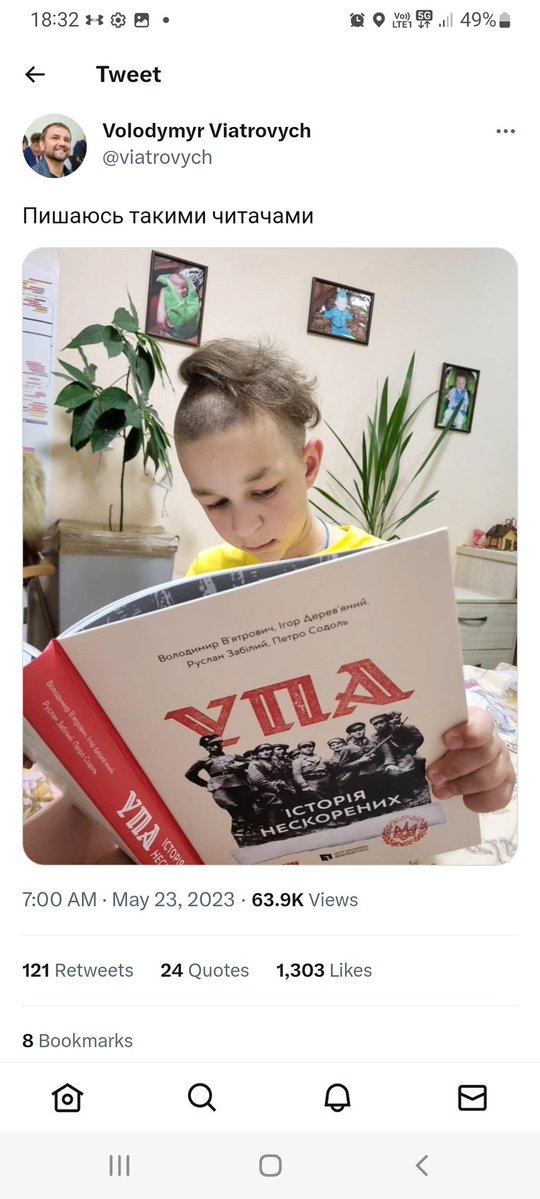
To ich rządy dopuscily do tego, że UPA jest na sztandarach i to dla nich nie powinno być zadnej taryfy ulgowej, czego mam nadzieję dopilnuje nasz rząd.
@hog_wards@_KANAPKI_@grok@ct12cz@defacto37 Yesh, but you're keeping your cool ;-)
Believe me, many here also have little knowledge and understanding of what went on... overlooking the context etc.
On the other hand, my personal opinion is that Ukraine could do much better than UPA flags.
@Dynatron_Power@EmPrzemyslaw@golos_problem A letter of intent had been signed by both parts and the Ukrainan ambassador to Poland confirmed that the cooperation has already started...
How do you expect anyone to treat your country seriously if you go back on your word or outright lie?
It was a dark time. Pre-war Polish policies didn't help; they only added to the tension. Ukraine then went through the horrors of soviet terror and the holodomor.
Extreme suffering can turn victims into perpetrators. People become susceptible to hatred and violence. I think that most people understand that. Coming to terms with history and understanding it, will only make us stronger in the long run.
People are stupid for making fun of you, I think it's a good thing that you wanted to dig into the topic, even if the outcome isn't what you expected.
@Dynatron_Power@EmPrzemyslaw@golos_problem So why did your government initally agree to this exchange? They must have known that they don't have any drone technologies?
@CanadianKobzar I can't imagine getting a boost from knowing thay my grandpa was a sadistic murderer.
Your soldiers either have no idea what the UPA was or they know exactly what it was and still get a boost from it.
Which one is it?
I love Norman Davies (I’ve read most of his books) and I appreciate where he is trying to go with this attempt to build a sort of framework of reconciliation. What better way than giving a bit of "truth" and recognition to each party?
- to the Poles: Volhynia was a genocide (note: how could he say otherwise, having written extensively and in excruciating detail about the "genocide" in at least two of his major books?).
- to the Ukrainians: 90% of UPA had nothing to do with the massacres in Volhynia.
Nice trick, but, for once, I am sorry to say, he appears to act more as a politician than as as the great historian he is.
After all, what does 90% even mean? Where does that number even come from?
Well, if we count the number of civilians murdered by the UPA, the 90% makes clearly a lot of sense. But in reverse. Even by the most conservative estimates (that Norman Davies knows far too well) the UPA murdered at least 80 thousand Poles (Snyder/Motyka) but also tens of thousands of Ukrainians, followed by jews, Checks, Armenians, Roma, Georgians, and Russians. That without even counting the fact that most of the UPA units carrying out the killings were made by the very same units that had previously participated in the deportation of Poles (and other Soviet enemies) in 1939, and to the even more horrific killings of jews in 1941 (and if you have any doubts about this link, please read Timothy Snyder's extensive writing about it).
By contrast, even taking the most "optimistic" estimates in terms of enemy soldiers killed (Polish AK, Soviet partisans and military, Germans, other Ukrainian factions) you won't reach the number of 10 thousand.
So, yes, that 90% makes a lot of sense: 90% of murdered civilians (most often in the most gruesome manner).
But, maybe, what Davis wants to say is that 90% of the UPA members did not participate in the killings. Yet also here the numbers tend to throw out the right opposite. According to all reputable historians, the UPA reached its peak (20 to 40 thousand members) in 1943-44, precisely when most of the civilian killings took place, and rapidly fell in numbers as the Soviets reoccupied Western Ukraine (precisely when the most "glorious" phase of UPA's history begins).
Of course, not all UPA members took part in the murders, but it's hard to see how a very significant part of the organization, if not most of it, did not participate in some way to the mass killings.
There is only a last way of making sense of his 90% claim: time. If we take the history of the organization, we have an initial phase of about 1-3 years of mass civilian killings (1942-44) followed by about 10 years of "glorious" fight for independence (that still left a huge number of murdered civilians, mostly Ukrainians seen as Soviet collaborators).
So, yes, in terms of the lifespan of the organization, Davis can claim that 90% of the UPA had nothing to do with Volhynia (and Eastern Galicia, etc.), but I am not sure that the argument is going to sound convincing to the victims. Or to any one who has in hate organizations that carried out the brutal mass exterminations of civilians.
Bending history to politics is never a nice practice. Especially if done by a venerable historian.
That said: Slava Ukraini. Niech żyje Polska.
@Panchenko_X Oh, so these are the guys responsible for my "bank" calling?
Did they hold Ukrainian passports? Was Ukraine aware of their criminal activity?
Ukraine’s historical problem is that like any nation at war they need historical heroes who fought against the current enemy, which for Ukraine is Russia. But the vast majority of Ukrainians fought on the same side as Russia - in the Soviet Army, or in Russian imperial armies.