Gap Financial is thrilled to announce that Ben Johnson, CFP has been recognized by Money as one of the Best Financial Planners of 2024! #FinancialNews
https://t.co/id5HG2rpBs
On this day in 1968, the New York Stock Exchange, inundated with trading paperwork and struggling to cope with antiquated record-keeping technology, began closing every Wednesday to allow ��back-office” trade processors to catch up with the flood of documents.
OTD in 1980, Texas oil barons Nelson & Herbert Hunt failed spectacularly to corner the silber market. After the brothers drove the price up, new supplies came flooding into the market, catching the Hunts by surprise. In a single day, silver plunged from $21.62 to $10.80 an ounce.
On this day in 1792, Wall Street crashed for the first time. On “Black Monday,” 6% Treasury bonds lost 10% of their value and shares in the Bank of the United States dropped 12%.
On this day in 2020, the World Health Organization declared that the Covid-19 virus was a pandemic. The stock market was way ahead of the WHO and was already in freefall. The S&P 500 lost more than a third of its value in just weeks.
On this day in 2020, with the Covid-19 pandemic unfolding, U.S. stock trading was briefly halted for the first time since 1997 after a tumultuous selloff triggered an automatic curb. The S&P 500 ended the day down 7.6%.
On this day in 2020, the Federal Reserve undertook an emergency rate cut of 0.5 percentage point to combat the economic fallout from the growing Covid-19 pandemic. It was the central bank’s first rate change between scheduled policy meetings since the 2008 financial crisis.
On this day in 1637, “Tulipmania,” one of the first and strangest speculative bubbles, hit its peak in the Netherlands, with the price of the rare Witte Croonen tulip bulb up 2,506% in 33 days.
OTD in 1994, just as investors were pouring billions of dollars into bonds, the Federal Reserve raised short-term interest rates for the first time in five years, and without warning. By year end, the Fed had hiked rates by 2.5%. Treasury bonds had their worst return since 1967.
On this day in 2000, as the internet bubble neared its peak, 17 dot-com companies each spent $73,000 per second for network television ads during Super Bowl XXXIV. At least three went bankrupt in the following year.
OTD in 1980, gold hit a record price of $850 per oz. Gold dealers predicted that the price would hit $1,000 per ounce by July, and Treasury Sec William Miller said, “At the moment, it doesn’t seem an appropriate time to sell our gold.” It was. By 1991 it was below $600 per ounce.
On this day in 1991, the first Persian Gulf war began. The U.S. transformed Operation Desert Shield into Operation Desert Storm by launching its aerial bombardment of Baghdad and Kuwait. Oil prices promptly plunged.
“Far more money has been lost by investors trying to anticipate corrections, or trying to time the market, than has been lost in the corrections themselves.” - Peter Lynch while managing Fidelity Magellan.
On this day in 1903, the airplane age was born at 10:35 a.m. when Orville Wright flew about 10 feet above the frigid sand dunes of Kitty Hawk, N.C., covering a distance of about 120 feet in 12 seconds.
On this day in 1941, following the declaration of war, the New York Stock Exchange suspended trading in all "enemy securities," including 36 issues from Germany, 10 from Japan, nine from Italy, six from Austria, five from Hungary and one from Bulgaria.
In fiscal year 2025, Costco sold over 245 million hotdog combos, over 157 million rotisserie chickens, and enough bath tissue to reach the moon and back over 200 times. $COST
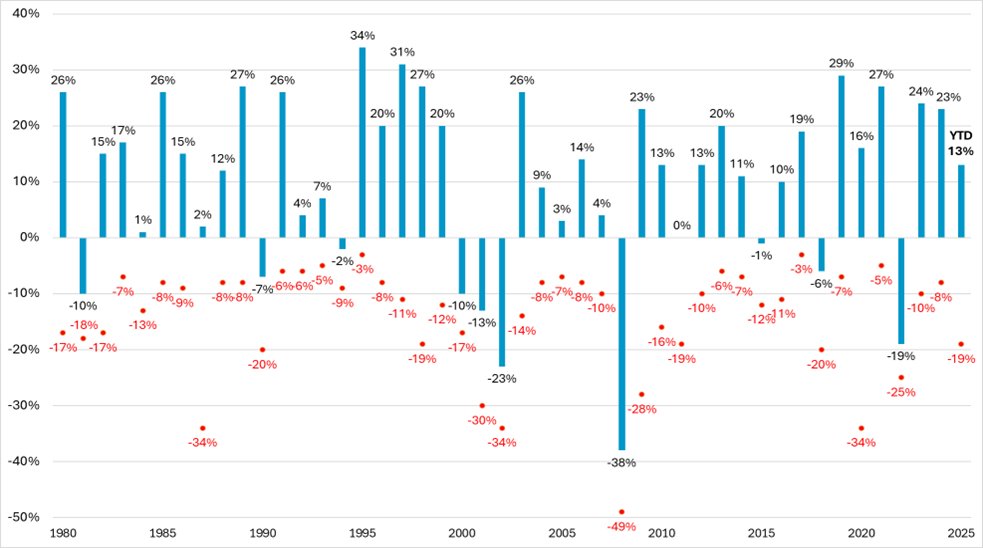
Despite average intra-year drops of -14.1% (in red), annual S&P 500 returns are positive 78% of the time since 1980. (Source: J.P. Morgan Asset Management)
Dating back to mid-April, the S&P 500 has gone 170+ trading days without a 3% pullback — one of the 10 longest stretches since 1953. The rally since April is also just the fifth time the index has gained more than 30% without a 3% pullback in between. (Source: Bespoke)