A record 41% of Americans expect their finances to be worse a year from now, per the University of Michigan’s consumer survey.
That’s well above the peak during the 2008 financial crisis, when 23% expected to be worse off.
Is this better or worse than using BNPL for groceries? That question might be open for debate, but the increasing struggles of the American consumer are not.
https://t.co/PC2dHeXXUG
https://t.co/KmpeIQ8Guf
https://t.co/Gl0dvlMybp
Disheartening and dangerous. US supremacy depends, in part, on dollar dominance. As geopolitical tensions intensify, pressure continues to try and push the dollar away from relevance.
“Resiliency” is increasingly becoming little more than the act of borrowing from tomorrow to meet today’s obligations. The consequences of this, of course, could be catastrophic.
https://t.co/EvFP4EwUrE
https://t.co/Gl0dvlMybp
BNPL is dangerous and a warning sign that the floor is falling out from beneath the consumer.
BNPL for groceries is both chilling and a warning.
https://t.co/PC2dHeYvKe
Americans are buying groceries on installment plans. 1 in 10 use Buy Now, Pay Later for food. Over a third have missed payments.
35% resort to putting groceries on credit cards. Another 1 in 4 struggled to repay grocery debt.
The richest country on Earth? For who?
The reality of the "resilient consumer" is a bit more nuanced than headlines would like to admit, and the fact that many families are being forced to cut back shines a spotlight on many ugly questions that many might wish to leave unanswered.
https://t.co/PC2dHeXXUG
NEW: Yes, American consumers will spend more this holiday season, but there's a "great reallocation of spending" underway.
Middle and lower-income households are cutting back on food as they face higher gas prices, utility costs, and property taxes/insurance.
A new report from Navy Federal Credit Union shows just how much families are trying to cut back on groceries and (somewhat) at restaurants.
https://t.co/RRNqeOHe5l
College is certainly the answer for some who are looking for a rewarding career and financial stability. But it's not the only path toward those goals, a fact which is being made readily apparent by crippling student loan debt and degrees that won't even pay for themselves.
https://t.co/OVxdwynufO
https://t.co/5Baifud1Nt
Copper, trucking, consumer debt, delinquencies, frozen housing market... seems that everything that can even be remotely considered a leading indicator is flashing warning signs.
Will something eventually give? Probably.
But what gives first, and just how far the damage spreads, is a question that remains unanswered and unaddressed.
https://t.co/0YcGMVLMGL
https://t.co/BzK9kjt6Qi
Copper prices are falling fast, and some economists say it’s a warning sign for the US economy, per Business Insider.
Copper traded around $5.48 a pound on Friday. That’s down 17% from its September peak of nearly $6.90, after one of 2025’s hottest rallies on AI and data center demand. David Rosenberg says it was copper’s worst week in about a decade.
Whether AI is angel or devil seems to depend on who's being asked... and, it would seem, whatever mood the markets happen to be in when the question is posed.
https://t.co/gt0w6uzV9H
AI is now the biggest perceived threat to the US financial system, according to the Federal Reserve’s latest survey of market contacts.
87% of respondents named AI as a top risk, up from 50% in the spring. That puts it well ahead of a correction in risk assets (52%), higher long-term interest rates (48%), cyberattacks (43%) and US debt sustainability (43%).
Headlines like these will eventually force higher education institutions to either recognize the laws of supply and demand, or suffer reduced enrollment for degrees that won't even pay for themselves.
https://t.co/V9fgGUHHKR
https://t.co/mi9lG5lgCH
A net 13% of small businesses paid a higher rate on their most recent loan, the highest share since August 2024, per the NFIB’s October survey.
A net 37% plan to raise prices, the most since July 2022.
Taxes jumped to 21% as a top concern, the highest since 2021.
Trucking has been hit especially hard: 221 US trucking companies have filed for bankruptcy so far this year, per Bloomberg.
The popular satirical sentiment "The beatings will continue until morale improves" has its obvious and immediately applicable corollary in inflation. But yields have been increasingly divorced from rate policy over the past year or so, suggesting that either the Fed will make a determined effort to raise rates (and thereby address the inflation that's been ignored for far too long), or the market will do the central bank's job for it.
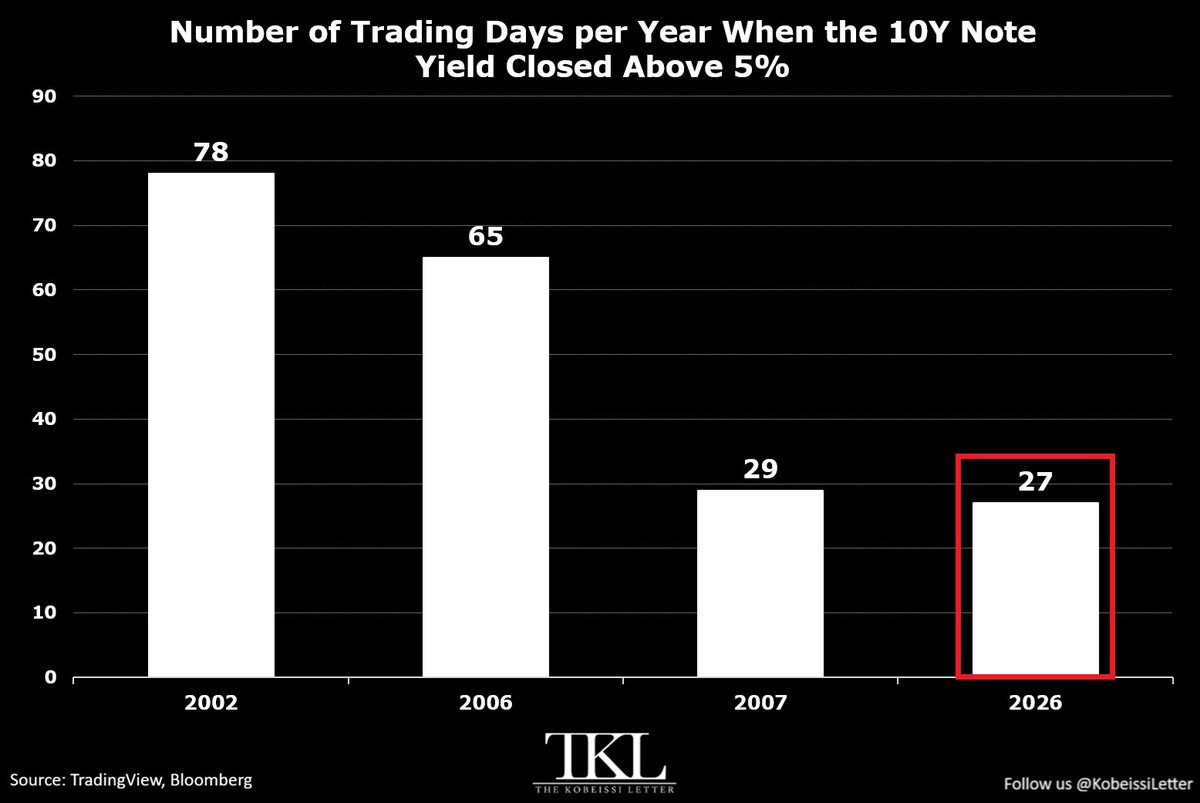
BREAKING: The 10Y Note yield has traded above 5.00% for 27 trading days so far in 2026, the longest streak for any year since 2007.
Last week, the 10Y Note yield surged +29 basis points, moving back above 5.00% and marking its largest weekly increase since April 2025.
The 10Y is now on track for its longest period above 5.00% since 2006, when 65 trading days above this threshold were recorded.
Year-to-date, the 10Y Note yield is up +94 basis points, to 5.10%, after peaking at 5.36% in early October, its highest level since 2002.
This puts the yield on track for its 6th consecutive annual increase.
Higher for longer has become the new normal.
AI might be the future, but even miraculous technology must still be firmly rooted in sound fundamentals if it’s going to survive the harsh reality of the markets.
Anthropic is unprofitable, less than six years old and Wall Street isn’t confident it will meet its long-term obligations. The debt market expects credit-rating firms to rate its bonds as junk, or below investment grade. https://t.co/XMA9sE8ivV
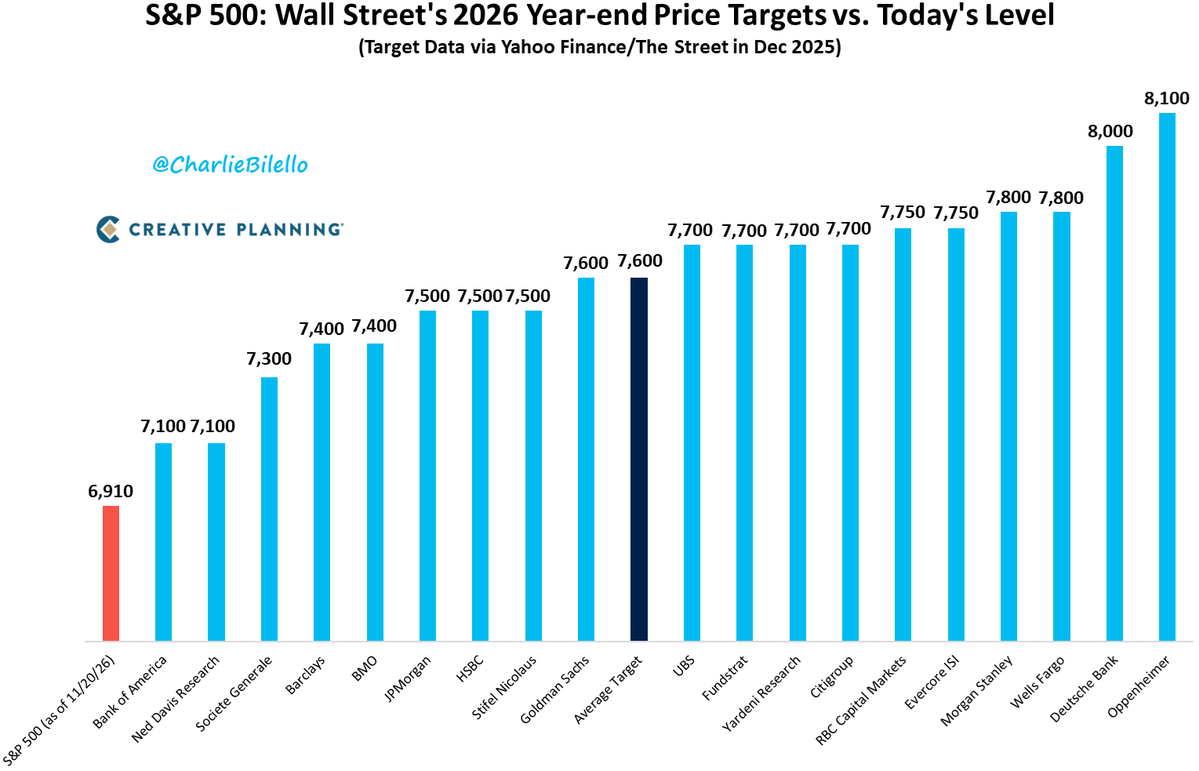
At 6,910 the S&P 500 is now up less than 1% in 2026 and below every major Wall Street firm's price target.
To get to the average target (7,600), the S&P 500 would need to rally 10% by year end.
A big spike in these price increases was obviously due to Covid stimulus. Equal blame can be laid at the feet of lackluster rate policy letting inflation dig in like a tick.
Debt is not a sustainable way to hedge against the growing affordability crisis.
https://t.co/PC2dHeYvKe
https://t.co/KmpeIQ9ejN
https://t.co/Gl0dvlN60X
54% of Americans rely on credit cards to cover essentials, 38% struggle to make debt payments on time, and 33% have missed a bill payment in the past three months, per Achieve.
Turns out that an increasing reliance on debt to make ends meet in the face of red-hot and stubborn inflation isn't a viable long-term option...
https://t.co/PC2dHeXXUG
https://t.co/KmpeIQ8Guf
https://t.co/Gl0dvlMybp