Home
Language
English
Türkçe
Bahasa Indonesia
About
Privacy Policy
Terms of Service
Pricing
Sign In
Download All
Share
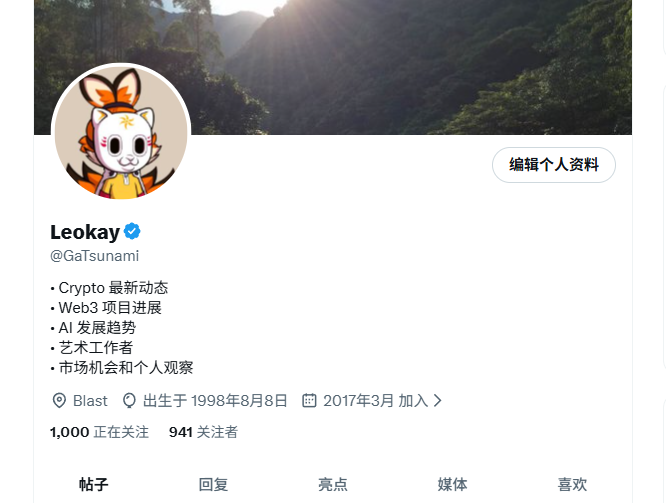
Leokay
@GaTsunami
• Crypto 最新动态 • Web3 项目进展 • AI 发展趋势 • 艺术工作者 • 市场机会和个人观察
Blast
Joined March 2017
1K
Following
964
Followers
1K
Posts
Pinned Tweet
Leokay
@GaTsunami
3 days ago
最近想认识一些更多有趣的人。 这段时间一直在关注 Web3、AI、科技和市场变化,也发现很多有价值的信息,其实都来自不同人的分享和交流。 有时候一个观点、一条信息、一次讨论,可能就会带来新的思路。 平时会关注: • Crypto 最新动态 • Web3 项目进展 • AI 发展趋势 • 市场机会和个人观察 如果你也对这些方向感兴趣,欢迎来聊聊。 不管是做项目、研究市场,还是单纯喜欢探索新东西,都可以交流一下。 希望在这里遇到更多认真分享、有想法的朋友。 一起交流,一起成长 🤝 #Crypto #Web3 #AI #Blockchain #Tech #找啊找啊找朋友 #有关必回 #找蓝朋友
See More
Leokay
@GaTsunami
about 4 hours ago
关注已破1000,可惜粉丝还差一点,收工收工,明日再战啦~ 月亮悄悄升起,星光替你守护今晚的宁静。 人生不必每天都闪闪发光,偶尔停下来休息,也是为了更好地出发。 愿今晚的微风带走疲惫,愿明天醒来依旧心怀希望。 晚安 🌙✨
Leokay
@GaTsunami
about 4 hours ago
@neowang_log
多多互动才是王道
Leokay
@GaTsunami
about 5 hours ago
以前很内向,今天勇敢了一次
GaTsunami's tweet video.
Who to follow
8ritny
@8ritny
Brit(ny) from the block(chain)
Nistu
@Nistu_eth
Games | Collectibles | Decentralization
Forestroll
@MartinkoCabrera
Leokay
@GaTsunami
about 5 hours ago
@gdzj1005
看到的都是盆友~~
Leokay
@GaTsunami
about 5 hours ago
@_umigatari_
ガーガーガー 🦆
Leokay
@GaTsunami
about 5 hours ago
@Kavinyanki
Chúng ta cùng giúp đỡ và đồng hành với nhau, chắc chắn sẽ đi được xa hơn. 🌱
Leokay
@GaTsunami
about 6 hours ago
@freezywf
滴滴抱团取暖
Leokay
@GaTsunami
about 6 hours ago
@Aurra102
广交朋友
Leokay
@GaTsunami
about 6 hours ago
@xxx05224283
有没有新鲜的面孔,互助一下
Leokay
@GaTsunami
about 6 hours ago
@gengzishunli
银光闪闪,太美了
Leokay
@GaTsunami
about 6 hours ago
@zgjncw2024
买吧买吧,应该还能突破高点的
Leokay
@GaTsunami
about 6 hours ago
@chaoxiao
这涨粉速度可以的 赞一个👏
Leokay
@GaTsunami
about 6 hours ago
@McGrady8898
小玩怡情
Leokay
@GaTsunami
about 6 hours ago
@drone8848
主打诚信,见了就回
Leokay
@GaTsunami
about 6 hours ago
@Serenvugl
支持一下姐妹,互帮互助
Leokay
@GaTsunami
about 6 hours ago
@MQQ9999
来啦 朋友们~~
Leokay
@GaTsunami
about 6 hours ago
@meitingting10
太聪明了这方法
Leokay
@GaTsunami
about 6 hours ago
@ericapromo
GM. So beautiful🥰
Leokay
@GaTsunami
about 6 hours ago
@yageleohao
加起来兄弟们
Leokay
@GaTsunami
about 6 hours ago
@Asehunyoyo
太离谱了
Last Seen Users on Sotwe
Murat yozgatli
Seen from
Turkey
Cansu can cifti
Seen from
Turkey
Yasin Özbek
Seen from
Turkey
Handri afriadi
Seen from
Indonesia
護理師💉小美美
Adult Only 🔞 🇬🇭🇳🇬🏳️🌈
porno en Chile
Seen from
Chile
XxX Sexy Angels 🔞
Ashlyn Peaks 🍒
Seen from
United States
听说你喜欢大海
Seen from
Philippines
Trends for you
1
Bregman
Under 10K tweets
2
Staten Island
Under 10K tweets
3
Rodri
Under 10K tweets
4
Purdue
Under 10K tweets
5
Dylan Cease
Under 10K tweets
6
Chris Hansen
Under 10K tweets
7
$TTD
Under 10K tweets
8
Rob Schneider
Under 10K tweets
9
Ernie Clement
Under 10K tweets
10
mRNA
Under 10K tweets
Most Popular Users
1
Elon Musk
@elonmusk
241.2M followers
2
Barack Obama
@barackobama
119.1M followers
3
Cristiano Ronaldo
@cristiano
112.7M followers
4
Donald J. Trump
@realdonaldtrump
111.8M followers
5
Narendra Modi
@narendramodi
107.1M followers
6
Rihanna
@rihanna
98.2M followers
7
NASA
@nasa
92.2M followers
8
Justin Bieber
@justinbieber
91.4M followers
9
KATY PERRY
@katyperry
88.9M followers
10
Taylor Swift
@taylorswift13
82.8M followers
11
Lady Gaga
@ladygaga
74.3M followers
12
Virat Kohli
@imvkohli
71.8M followers
13
Kim Kardashian
@kimkardashian
70.4M followers
14
YouTube
@youtube
68.8M followers
15
Neymar Jr
@neymarjr
64.7M followers
16
Bill Gates
@billgates
64.6M followers
17
The Ellen Show
@theellenshow
62.4M followers
18
Selena Gomez
@selenagomez
62M followers
19
CNN
@cnn
61.8M followers
20
X
@x
60.8M followers
Olivia
Online
✨
⭐
💫