🚨ÚLTIMA HORA: Google Maps acaba de lanzar una gran actualización.
Será LA MAYOR ACTUALIZACIÓN en más de una década.
Aquí tienes 8 funciones impresionantes que te sorprenderán:
🇨🇳 CHINA BROKE THE SKY WITH 11,787 DRONES
Chongqing, China just pulled off the wildest drone light show the world has ever seen.
A jaw-dropping 11,787 drones lit up the night sky, setting a new Guinness World Record.
The drones moved together to create glowing shapes like a giant running kid and swirling clouds above tall buildings.
It looked more like a Pixar dream than something real.
Fireworks could never.
Source: @MarchUnofficial
Jim Fan says NVIDIA trained humanoid robots to walk and move like humans -- zero-shot transfer from simulation to the real world.
10 years of learning, compressed into 2 hours of simulation. Turns out you don’t need a giant model to master motion.
“1.5 million parameters, not billion, to capture the subconscious processing of the human body.”
Big embodiment, small brain.
SCIENTISTS TURNED LIGHT INTO A SUPERSOLID — AND BROKE PHYSICS (AGAIN)
For the first time ever, scientists made light act like a supersolid — meaning it’s somehow solid and flows like a liquid at the same time. (Physics said “rules? never heard of ’em.”)
This could open the door to crazy new tech, wild quantum experiments, and maybe even... teleportation.
Basically, we just unlocked a new cheat code for the universe — and we’re only just getting started.
Source: Nishant Science
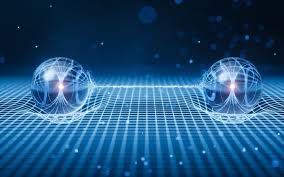
🚨🇫🇷 PHYSICISTS CRACK QUANTUM ENTANGLEMENT
For the first time ever, physicists at France's Institute of Theoretical Physics have fully mapped out the entire set of quantum statistics possible from entangled two-qubit systems—even partially entangled ones.
Victor Barizien and Jean-Daniel Bancal:
"The idea, which is cute but hard to explain, was to describe the statistics from partially entangled states using what we understand of maximally entangled ones."
Their work reshapes quantum device testing, unlocking precise new tools for cryptography, computing, and quantum communications.
Source: Science X
🚨SCIENTISTS DISCOVER EINSTEIN-LIKE PATTERNS IN CHEMISTRY?!
Scientists thought they’d made a mistake—until they realized molecules were naturally forming never-repeating patterns, just like the famous einstein tiling problem in math.
Using tris(tetrahelicenebenzene) (t[4]HB) on a silver surface, researchers expected a normal crystal structure.
Instead, the chiral molecules—like left and right hands—refused to stack neatly, forcing them into spiral-like, aperiodic arrangements.
Even wilder?
Every experiment produced a different pattern.
This strange molecular dance could revolutionize materials science.
The unpredictable yet dense packing could change how electrons move, leading to breakthroughs in quantum computing, sensors, and next-gen materials.
Source: SciTech Daily
🚨QUANTUM LEAP: SCIENTISTS UNLEASH LIGHT IN 37 DIMENSIONS
Get ready to have your understanding of reality stretched because researchers have just achieved something outstanding in the realm of quantum physics: they've created photons that exist in 37 dimensions at once.
The team manipulated coherent light to showcase these paradoxical behaviors, pushing the envelope of quantum weirdness even further than before.
The revelation comes a century after quantum theory was first proposed, hinting that we've only scratched the surface of what quantum mechanics has to offer.
From ultra-secure communication channels to the next generation of quantum computers, this leap into 37-dimensional light could be the key to unlocking technologies that are currently beyond our wildest imaginations.
Source: Popular Mechanics
“Quantum Experiment Reveals Light Exists in Dozens of Dimensions”
This discovery suggest that “information” could be carried across dimensions on photons! https://t.co/QDfkGku140
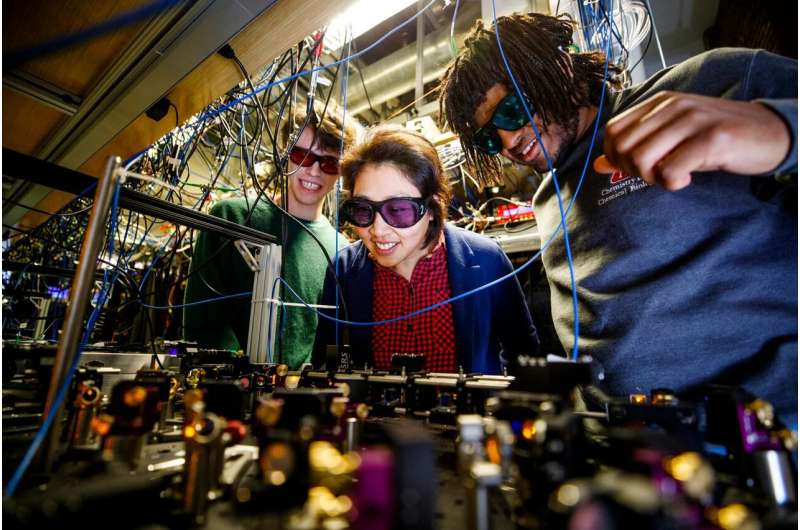
🚨 MOLECULES ENTER THE QUANTUM GAME—FINALLY!
After 20+ years of “Can we make molecules work in quantum computing?”, Harvard scientists said:
Hold my optical tweezers.
Using ultra-cold sodium-cesium (NaCs) molecules, they built an iSWAP gate—a key quantum circuit—creating a two-qubit Bell state with 94% accuracy.
Molecules, once deemed too chaotic and unstable for quantum ops, just stepped into the big leagues.
Molecules’ rich internal structure could unlock speeds and possibilities beyond what current quantum tech (trapped ions, neutral atoms, superconducting circuits) can achieve.
Think medical breakthroughs, financial modeling, and solving problems today’s computers can barely dream of.
Next-gen quantum computing might be brought to you by… molecules in laser traps.
Science is wild.
Source: Phys . org



![MarioNawfal's tweet photo. 🚨SCIENTISTS DISCOVER EINSTEIN-LIKE PATTERNS IN CHEMISTRY?!
Scientists thought they’d made a mistake—until they realized molecules were naturally forming never-repeating patterns, just like the famous einstein tiling problem in math.
Using tris(tetrahelicenebenzene) (t[4]HB) on a silver surface, researchers expected a normal crystal structure.
Instead, the chiral molecules—like left and right hands—refused to stack neatly, forcing them into spiral-like, aperiodic arrangements.
Even wilder?
Every experiment produced a different pattern.
This strange molecular dance could revolutionize materials science.
The unpredictable yet dense packing could change how electrons move, leading to breakthroughs in quantum computing, sensors, and next-gen materials.
Source: SciTech Daily](https://pbs.twimg.com/media/GkEQDanX0AAMi0L.png)
![MarioNawfal's tweet photo. 🚨SCIENTISTS DISCOVER EINSTEIN-LIKE PATTERNS IN CHEMISTRY?!
Scientists thought they’d made a mistake—until they realized molecules were naturally forming never-repeating patterns, just like the famous einstein tiling problem in math.
Using tris(tetrahelicenebenzene) (t[4]HB) on a silver surface, researchers expected a normal crystal structure.
Instead, the chiral molecules—like left and right hands—refused to stack neatly, forcing them into spiral-like, aperiodic arrangements.
Even wilder?
Every experiment produced a different pattern.
This strange molecular dance could revolutionize materials science.
The unpredictable yet dense packing could change how electrons move, leading to breakthroughs in quantum computing, sensors, and next-gen materials.
Source: SciTech Daily](https://pbs.twimg.com/media/GkEQBJ9XkAA9mKO.png)
![MarioNawfal's tweet photo. 🚨SCIENTISTS DISCOVER EINSTEIN-LIKE PATTERNS IN CHEMISTRY?!
Scientists thought they’d made a mistake—until they realized molecules were naturally forming never-repeating patterns, just like the famous einstein tiling problem in math.
Using tris(tetrahelicenebenzene) (t[4]HB) on a silver surface, researchers expected a normal crystal structure.
Instead, the chiral molecules—like left and right hands—refused to stack neatly, forcing them into spiral-like, aperiodic arrangements.
Even wilder?
Every experiment produced a different pattern.
This strange molecular dance could revolutionize materials science.
The unpredictable yet dense packing could change how electrons move, leading to breakthroughs in quantum computing, sensors, and next-gen materials.
Source: SciTech Daily](https://pbs.twimg.com/media/GkEP_GfXgAAZZlK.png)



![MarioNawfal's tweet photo. 🚨SCIENTISTS DISCOVER EINSTEIN-LIKE PATTERNS IN CHEMISTRY?!
Scientists thought they’d made a mistake—until they realized molecules were naturally forming never-repeating patterns, just like the famous einstein tiling problem in math.
Using tris(tetrahelicenebenzene) (t[4]HB) on a silver surface, researchers expected a normal crystal structure.
Instead, the chiral molecules—like left and right hands—refused to stack neatly, forcing them into spiral-like, aperiodic arrangements.
Even wilder?
Every experiment produced a different pattern.
This strange molecular dance could revolutionize materials science.
The unpredictable yet dense packing could change how electrons move, leading to breakthroughs in quantum computing, sensors, and next-gen materials.
Source: SciTech Daily](https://pbs.twimg.com/media/GkEQFGbWsAAwviF.png)


