A man shows how differently his mother treats him and his unemployed brother.
He has a govt job, so she gives him more food and serves it in a bowl.
His unemployed brother gets less food, served on a simple plate 😳
Not every mother loves you unconditionally.
The truth is, money matters. So focus on earning. Because even your own family will judge you by how much money you make 💔
The alcohol industry has lost approximately $830 billion in market value over the past four years, largely because of a clear shift among Generation Z toward lower alcohol consumption and sobriety.
This decline has hit the sector about four times harder than the 2008 financial crisis, indicating that the long period of rapid, volume-driven growth in beer, wine, and spirits has ended.
A Bloomberg index that tracks roughly 50 of the world’s largest alcohol companies has fallen 46 percent from its peak in June 2021. Major firms including Diageo, Pernod Ricard, and Rémy Cointreau have seen their share prices drop to the lowest levels in a decade.
Analysts describe the change as a lasting structural shift rather than a temporary economic downturn. In the United States, recent surveys show that alcohol consumption has reached its lowest point since record-keeping began in 1939, with only 54 percent of adults reporting that they drink. For the first time, a majority of Americans view even moderate drinking as harmful, a view reinforced by public-health warnings that link alcohol to several types of cancer.
In response, large drinks companies are adapting rather than resisting the trend. Firms such as Diageo and Moët Hennessy have begun acquiring or investing in premium non-alcoholic spirits and wines in an effort to serve a growing wellness-focused market that prioritizes clarity and health over intoxication.
[Bloomberg reporting on the global alcohol sector’s market performance and consumer trends (2021–2025 data)]
He's Tukaram Mundhe, a 2005-batch IAS from Maharashtra.
Over the last few weeks, you might have heard his name. That is because he was recently appointed Commissioner of State’s Food and Drug Administration (FDA). Since taking charge, the FDA has been on an absolute warpath, raiding illegal, fake, synthetic, and adulterated products. From synthetic milk networks and adulterated paneer to illegal gutkha and unhygienic eateries, nothing has escaped his radar.
Mundhe has made it clear that even the most famous names will not get a free pass. His department shocked Mumbai by suspending the food licenses of iconic establishments, such as the 73-year-old Marine Drive ice cream parlor K. Rustom & Co., alongside famous eateries like Shalimar Hospitality, Noor Mohammadi Hotel, and Rahmaniya Restaurant, after surprise inspections uncovered severe hygiene violations, including live pests and expired ingredients.
Such is the fear of his crackdowns that, just two days ago, dairy farmers were caught on video spilling hundreds of liters of synthetic milk after rumors of an impending FDA raid spread.
This is his 25th transfer in a 21-year career, a testament to his refusal to bend to political pressure. It makes you wonder: if just one IAS officer can bring about so much change, where would our country be if every bureaucrat were as uncompromising and proactive as him?
"She saved a stranger’s child with $15. Decades later, she discovered why he had been searching for her.
In 1982, a Kenyan boy named Chris Mburu stood on the brink of losing everything. He was the brightest student in his rural district, studying by lamplight inside an earthen house without electricity. But his family could not afford his school fees. Without help, his education would end — along with any chance of escaping a life spent picking coffee in the fields.
Meanwhile, across the world in Sweden, an 80-year-old kindergarten teacher named Hilde Back came across a notice for a child sponsorship program. She chose a name from a list: Chris Mburu, Kenya. She began sending $15 every school term. There was no recognition, no expectation of gratitude — just a quiet decision to help a child she believed she would never meet.
That small amount changed everything.
Chris stayed in school. Over time, he and Hilde exchanged letters. She asked about his teachers, his studies, and his dreams. Through her words, he realized she wasn’t just part of an organization. She was a real person who believed in him. And he never forgot her.
Chris eventually graduated at the top of his law class at the University of Nairobi. He later earned a Fulbright scholarship to Harvard. He went on to become a United Nations human rights lawyer, helping prosecute genocide and crimes against humanity around the world.
Yet one thing always weighed on his heart. He had never properly thanked the woman who made his journey possible. In truth, he barely knew who she was.
In 2001, Chris founded a scholarship program for children like himself — talented students from poor families whose potential might otherwise be lost. He asked the Swedish Ambassador in Kenya to help him locate his mysterious sponsor so he could name the foundation after her.
They found her. Hilde Back. Still alive. Still living quietly in Sweden.
Chris traveled to meet her for the first time. He expected to meet a wealthy philanthropist. Instead, he found a humble, warm woman living simply — genuinely surprised that anyone considered her actions remarkable.
Then filmmaker Jennifer Arnold began documenting their reunion. During her research, she uncovered something Hilde had never told Chris.
Hilde Back had not been born in Sweden. She was born in Nazi Germany in 1922 to a Jewish family. At sixteen, when Hitler’s Nuremberg Laws banned Jewish children from attending school, strangers helped smuggle her to Sweden. Her parents stayed behind because Sweden’s refugee policies did not allow older Jews to enter. Both were later sent to concentration camps. Her father died there. Her mother disappeared, never to be heard from again.
Hilde survived the Holocaust because strangers helped her escape. She lost her own education because of who she was.
Fifty years later, she quietly paid for the education of a child across the world — a child who would grow up to fight the same hatred that destroyed her family.
When Chris learned her story, he wept. Hilde, meanwhile, had no idea that the boy she sponsored had devoted his life to prosecuting genocide.
In 2003, Hilde traveled to Kenya for the inauguration of the Hilde Back Education Fund. The entire village welcomed her as an honorary elder. In 2012, she returned again to celebrate her 90th birthday, surrounded by hundreds of children whose futures had been transformed through her generosity.
Hilde Back passed away on January 13, 2021, at the age of 98.
Today, the Hilde Back Education Fund has supported nearly 1,000 Kenyan children in continuing their education. Many have graduated from universities around the world. Many now give back — mentoring younger students and contributing monthly donations to support the next generation.
One woman. Fifteen dollars. One child.
That child created a foundation. That foundation changed hundreds of lives. And those lives continue to change others.
How I would do creator coins
We've seen about 10 years of people trying to do content incentivization in crypto, from early-stage platforms like Bihu and Steemit, to BitClout in 2021, to Zora, to tipping features inside of decentralized social, and more. So far, I think we have not been very successful, and I think this is because the problem is fundamentally hard.
First, my view of what the problem is. A major difference between doing "creator incentives" in the 00s vs doing them today, is that in the 00s, a primary problem was having not enough content at all. In the 20s, there's plenty of content, AI can generate an entire metaverse full of it for like $10. The problem is quality. And so your goal is not *incentivizing content*, it's *surfacing good content*.
Personally, I think that the most successful example of creator incentives we've seen is Substack. To see why, take a look at the top 10:
https://t.co/duaCaGNYXp
https://t.co/y1F9Td0Y52
https://t.co/xEMt8pIK74
Now, you may disagree with many of these authors. But I have no doubt that:
1. They are on the whole high quality, and contribute positively to the discussion
2. They are mostly people who would not have been elevated without Substack's presence
So Substack is genuinely surfacing high quality and pluralism.
Now, we can compare to creator coin projects. I don't want to pick on a single one, because I think there's a failure mode of the entire category.
For example:
Top Zora creator coins: https://t.co/238cqf2bX1
BitClout: https://t.co/0jVmotkpFw
Basically, the top 10 are people who already have very high social status, and who are often impressive but primarily for reasons other than the content they create.
At the core, Substack is a simple subscription service: you pay $N per month, and you get to see the person's articles. But a big part of Substack's success is that they did not just set the mechanism and forget. Their launch process was very hands-on, deliberately seeding the platform with high-quality creators, based on a very particular vision of what kind of high-quality intellectual environment they wanted to foster, including giving selected people revenue guarantees.
So now, let's get to one idea that I think could work (of course, coming up with new ideas is inherently a more speculative project than criticizing existing ones, and more prone to error).
Create a DAO, that is *not* token-based. Instead, the inspiration should be Protocol Guild: there are N members, and they can (anonymously) vote new members in and out. If N gets above ~200, consider auto-splitting it.
Importantly, do _not_ try to make the DAO universal or even industry-wide. Instead, embrace the opinionatedness. Be okay with having a dominant type of content (long-form writing, music, short-form video, long-form video, fiction, educational...), and be okay with having a dominant style (eg. country or region of origin, political viewpoint, if within crypto which projects you're most friendly to...). Hand-pick the initial membership set, in order to maximize its alignment with the desired style.
The goal is to have a group that is larger than one creator and can accumulate a public brand and collectively bargain to seek revenue opportunities, but at the same time small enough that internal governance is tractable.
Now, here is where the tokens come in. In general, one of my hypotheses this decade is that a large portion of effective governance mechanisms will all have the form factor of "large number of people and bots participating in a prediction market, with the output oracle being a diverse set of people optimized for mission alignment and capture resistance". In this case, what we do is: anyone can become a creator and create a creator coin, and then, if they get admitted to a creator DAO, a portion of their proceeds from the DAO are used to burn their creator coins.
This way, the token speculators are NOT participating in a recursive-speculation attention game backed only by itself. Instead, they are specifically being predictors of what new creators the high-value creator DAOs will be willing to accept. At the same time, they also provide a valuable service to the creator DAOs: they are helping surface promising creators for the DAOs to choose from.
So the ultimate decider of who rises and falls is not speculators, but high-value content creators (we make the assumption that good creators are also good judges of quality, which seems often true). Individual speculators can stay in the game and thrive to the extent that they do a good job of predicting the creator DAOs' actions.
In India, human trolls are a lot cheaper than bots
Unlike USA, cheap and vulgar comments under your govt critical posts are from real people, jobless young Indians, mostly from BIMARU region
*Innovative trolls are paid as much as 50k per month.
If you really become the student of crypto market in a way where you figured out your North Star : it could be anything TA, Onchain, Fundamentals, Sentiments..
it could put you in the position where you get plenty of time to figure out what you truly want in life: your expenses could be taken care by some of the trades you could spot every month, and you actually need 3/4 good trades every month to manage your expenses specially when you live a simple life, having no debts on head.
Now the problem with most of us is that we are so influenced by social media lifestyle which always made us feel so inferior that we try to earn more in least time possible eventually losing an opportunity of a life time to gain the freedom of time which could be used to look inside, and find out why we are here, what’s our purpose of life..
and once you get a clue about your purpose, believe me your life would be completely transformed after that, you will become fearless, you will have immense courage, you will have unique lens on everything you see around you..
and life will become so beautiful afterwords even in those times when it looks everything is shattering around you..
you will connect to the source, the source will take care of you like it always did but now you could feel that in every moment.. you get that chance in crypto.. crypto can enable self discovery.. don’t waste this opportunity of lifetime.
Yogi Adityanath sent more than 5,600 people to work as Daily wage construction workers in Israel & he was proud of it
Now, when Iran is B@mbing Israel, what about their safety? Why isn't he talking about them? 🤐 #IranIsraelConflict
📌 लिक्विडिटी एक ऐसी चीज है जिस पर एक्सचेंजस की नजर रहती है। अगर आपके पास लिक्विडिटी की सही जानकारी है तो आप इस बाजार में बहुत कुछ बना सकते हैं���
@kingfisher_btc एक ऐसा प्रोजेक्ट जहाँ पर आपको 15-16 तरह के चार्ट मिल जाते हैं जिसके आधार पर आप निर्णय ले सकते हैं।
👇
https://t.co/RyBZzu2avU
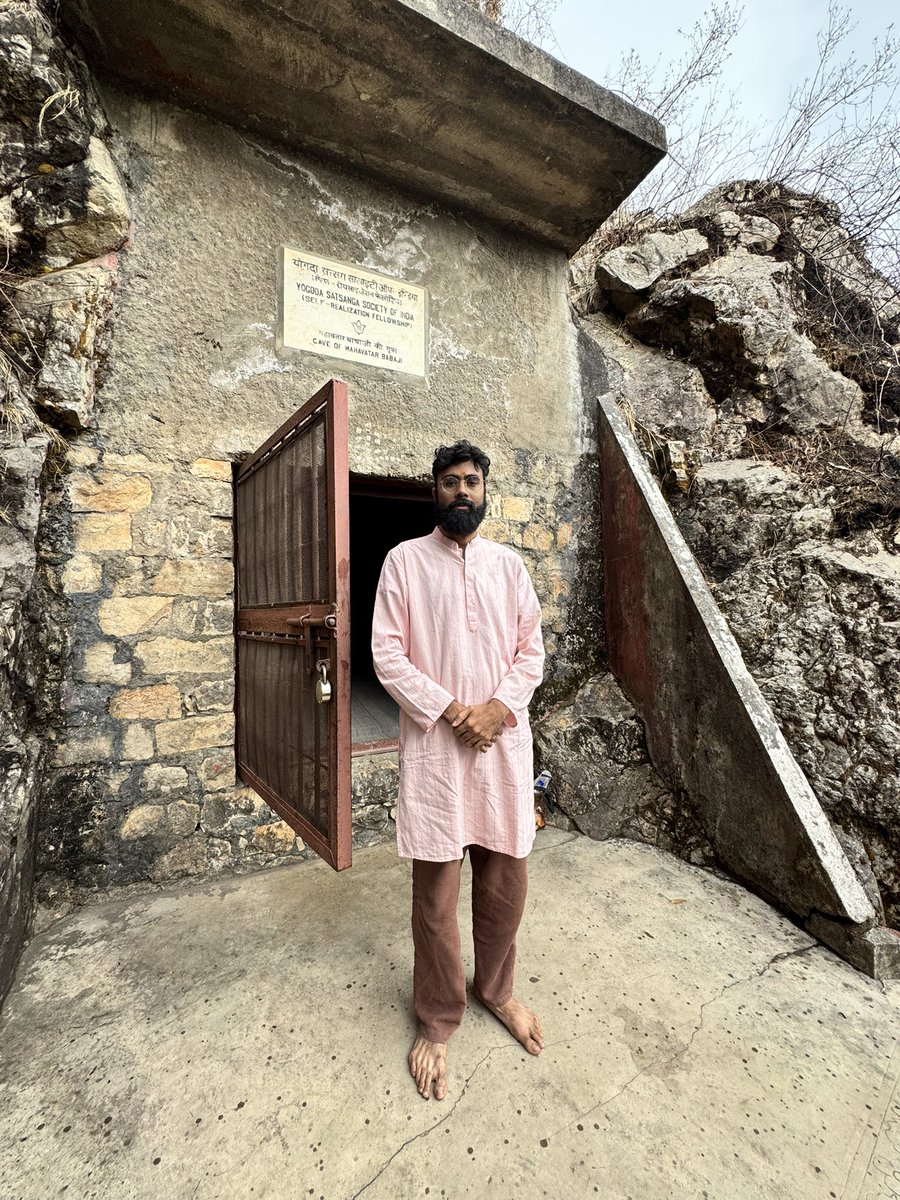
A Visit to Mahavatar Babaji’s Cave..
I first heard about Mahavatar Babaji — the formless, immortal yogi believed to reside in the Kumaon range of the Himalayas — back in 2013 during my study of Indian mystics.
The moment I came across his name, something stirred within me. The stories I read online were otherworldly. They spoke of a being untouched by time, ageless and radiant, guiding souls through subtle whispers, unseen but deeply felt by those attuned to the spiritual path.
Babaji’s presence is most famously mentioned in Autobiography of a Yogi by Paramahansa Yogananda.
In the book, Yogananda writes about Babaji as a living Himalayan master who has maintained a youthful form for centuries.
He is said to have revived the ancient science of Kriya Yoga — a powerful spiritual discipline aimed at accelerating spiritual evolution — from a hidden cave near Ranikhet in Uttarakhand.
There are even mysterious accounts suggesting that Jesus, during his so-called “lost years,” visited India and met Mahavatar Babaji. These threads, mythic yet magnetic, planted a deep yearning within me to one day visit this sacred cave — a place still resonating with the vibrations of an awakened master.
Time passed. Life moved on. But the desire never left. Twelve years later, just a few days ago, I finally got the chance.
We began our trek to Babaji’s cave with quiet excitement.
The trail was about 3 kms long, winding through a dense forest. The deeper we went, the more silence engulfed us. Not just the silence of the woods — but an inner stillness, like nature itself was whispering secrets to those who dared listen.
Midway through the trek, we lost our way. The signs of the trail vanished. We stood at a point where all paths seemed to disappear. We backtracked, confused, only to later find that the path had been there all along — wide and clear.
We simply hadn’t seen it. It was baffling. How could we miss what was right in front of us? Was it our eyes? Our minds? Or was something else at play?
Eventually, we reached the cave — a modest opening in the mountainside, yet vibrating with a strange stillness. A couple of meditators sat inside, absorbed in deep silence.
There was barely any room left, but my friend and I somehow managed to squeeze in. We closed our eyes and tried to meditate, but something felt unsettled.
As if the cave was still holding its secrets tightly. After a few minutes, we stepped outside. That’s when it began to rain.
One by one, the others in the cave came out and left, perhaps deterred by the weather. And suddenly, there we were — just the two of us, alone in the cave.
We had no umbrellas, and the rain grew heavier. So we stepped back inside, now with the entire space to ourselves. And something shifted. The moment we sat down again, the silence thickened — not heavy, but deep, like a blanket drawn over the restless mind.
The air inside the cave felt charged — as if Babaji’s presence still lingered, unseen yet palpable.
This time, meditation came effortlessly. Thoughts faded. A sense of expansion grew from within — not the dramatic kind, but subtle and profound.
As if we were not sitting in a cave, but floating inside a sacred womb of the earth, embraced by an energy far beyond words.
Time disappeared.
An hour passed like a moment. It was blissful, serene, and deeply humbling.
Reflecting back, it’s clear — if we hadn’t lost our way, if we hadn’t missed the path, if we had come earlier — we would’ve never had that private, mystical moment inside the cave. It was as if the universe orchestrated everything: the detour, the rainfall, the departure of others — all to prepare the space for us.
And in that quiet space, I felt something I had only read about — the silent gaze of an immortal yogi, a presence beyond time, still watching, still guiding, still waiting for sincere seekers to arrive.
If there is one cave in the world where one must sit and meditate at least once in a lifetime, this is it.