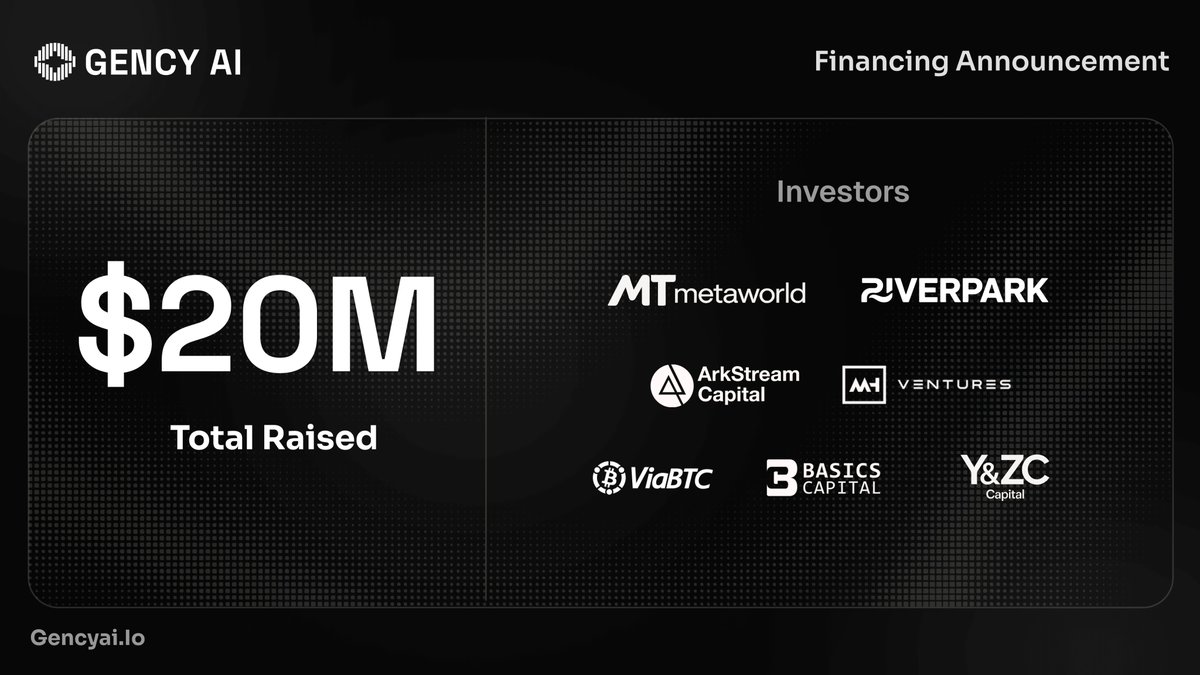
Gency AI has raised $20M to accelerate the development of a sovereign advertising network powered by AI and blockchain consensus.
The round was backed by Y&ZC Capital, MTmetaworld Holdings, Riverpark, ArkStream, MH Ventures, ViaBTC, Basics Capital, and others.
We’re building a future where digital advertising runs on verifiable execution, automated settlement, and privacy-preserving infrastructure.
Learn more: https://t.co/v4F6UwomID
If an AI agent can act on a campaign, the people behind it should be able to define the boundaries.
Gency AI is designing for permissions to be part of the workflow.
Advertisers and publishers: if an AI agent made a campaign decision for you, what would you want to see afterwards 🤔the reasoning, the permissions or the outcome? 💭
Food for thought.
Gency AI is building toward an ad economy where agentic AI boundaries and permissions matter.
Faster campaigns are exciting. Yet, clearer accountability is exciting too.
Wouldn't you want an AI advertising agent to explain before making a decision on your behalf? ��
Faster campaigns are exciting.
Clearer accountability is exciting too.
What would you want an AI advertising agent to explain before making a decision on your behalf? 💬
An agent might be able to launch a campaign in seconds. That doesn’t make questions about consent and accountability disappear. 👀
At Gency AI, we’re designing for those questions from the very start, making sure your agentic ad workflow can be tracked and monitored.
An AI agent can make an ad decision in seconds. But can the people involved understand what it was allowed to do? We are building toward advertising infrastructure where permissions are part of the process. 📊
Better objectives can lead to a more accountable ad economy.
As AI agents take a bigger role in advertising, speed won't be enough. Trust needs to keep up.
At @GENCY_AI, we're building toward a network where permissions, proof and settlement are directly part of the infrastructure. ⚡ #AgenticAI
AI agents will turn clicks into actions.
The trust layer decides whether those actions can scale.
Identity. Permission. Proof. Settlement.
That is the infrastructure of the agentic economy. ⚡
#AgenticAI
Agents need wallets, but they also need guardrails.
The best agent experiences will feel simple to the user while making every important action traceable behind the scenes.
Let's be real: an AI agent optimizing on broken conversion tracking just reaches the wrong answer faster.
Google, Amazon, PubMatic all shipped agentic buying this year.
Agents scale whatever they run on. Feed them verified receipts (VUR), not guesses.
94% of big brands' money still lands on made-for-advertising junk sites. Six months after ANA's alarm, nothing moved.
You bought a steak. It showed up as one slider bite — after 7 middlemen each took a cut.
VUR: pay only for what's real.
Consolidated ad spend turns 54% of every dollar into valid impressions.
Fragmented chains? Just 32% — the worst lose over two-thirds before a human ever sees the ad.
That's not inefficiency. It's a hidden tax, 7 middlemen skimming the toll. PSG settles direct.
Bots ate $63B of ad spend in 2025. Juniper says fraud breaks $100B in 2026 — AI botnets that scroll, hesitate, fake being human.
Over 20% of programmatic display is invalid traffic.
How much of your bill was for bots? VUR only pays on real conversions.
The first wave of AI content rewarded volume.
Today, audiences have more content competing for attention than ever before, and distribution alone is no longer enough to stand out.
Creators, brands, and platforms are all facing the same challenge.
How do you demonstrate that engagement is genuine?
In an environment defined by abundance, proof becomes part of the product.
Digital advertising continues to fragment across channels, formats, and supply paths.
CTV, mobile, social, and programmatic ecosystems now operate with overlapping but non-identical measurement standards.
As fragmentation increases, aggregated reporting becomes less representative of actual user behavior.
Consistency of verification becomes more important than consistency of reporting.
Programmatic advertising now accounts for over 90 percent of digital display transactions.
Campaigns launch faster, optimization happens continuously, and decisions increasingly rely on automation.
The more complex the system becomes, the more important transparency becomes.
Advertisers still need confidence that budgets flow where they are intended to go and outcomes reflect genuine engagement.
Visibility remains a core part of performance.
Stop blaming your ad creatives.
9 times out of 10, the creative isn't failing—your attribution is just broken. You can't "optimize" a campaign when your dashboard is feeding you bad data.
Fix the data layer first: https://t.co/XWji1sN2Nl
Brands will drop millions on a World Cup campaign, only to measure the results with guesswork and conflicting dashboards.
It makes zero sense. When the stakes are that high, the industry needs verifiable proof, not "estimated reach."
Explore Gency: https://t.co/XWji1sMuXN
The advertising industry is hilarious.
Frontend: AI, machine learning, millisecond bidding.
Backend: 3 Excel sheets, 17 email threads, and someone saying "let me double-check the numbers."
Feels like that part of the stack deserves an upgrade too.
https://t.co/XWji1sN2Nl
Everyone keeps talking about AI agents buying ads.
Almost nobody is talking about what those agents are optimizing for. If the training signal comes from platform-reported metrics, you don't get autonomous intelligence. You get automated bias.
The next generation of advertising won't be defined by smarter agents.
It'll be defined by better ground truth.