In our new issue, Abolaji Mustapha examines ESL classes in Nigerian primary & secondary schools, finding girls showed more gender awareness & negotiated their takeaway from textbooks, while boys aligned with “normal” renderings of their gender identity. Watch the video abstract!
Our new special issue spotlights how gender & sexual diversity are constructed in educational media worldwide. From Uruguay to Nigeria & Saudi Arabia, it showcases innovative research on diversity in language learning across geopolitical contexts. Watch the guest editors' video!
This issue is not limited to examining representations of gender in educational media, but also looks at learners, teachers, as well as textbook authors, and their gender perceptions.
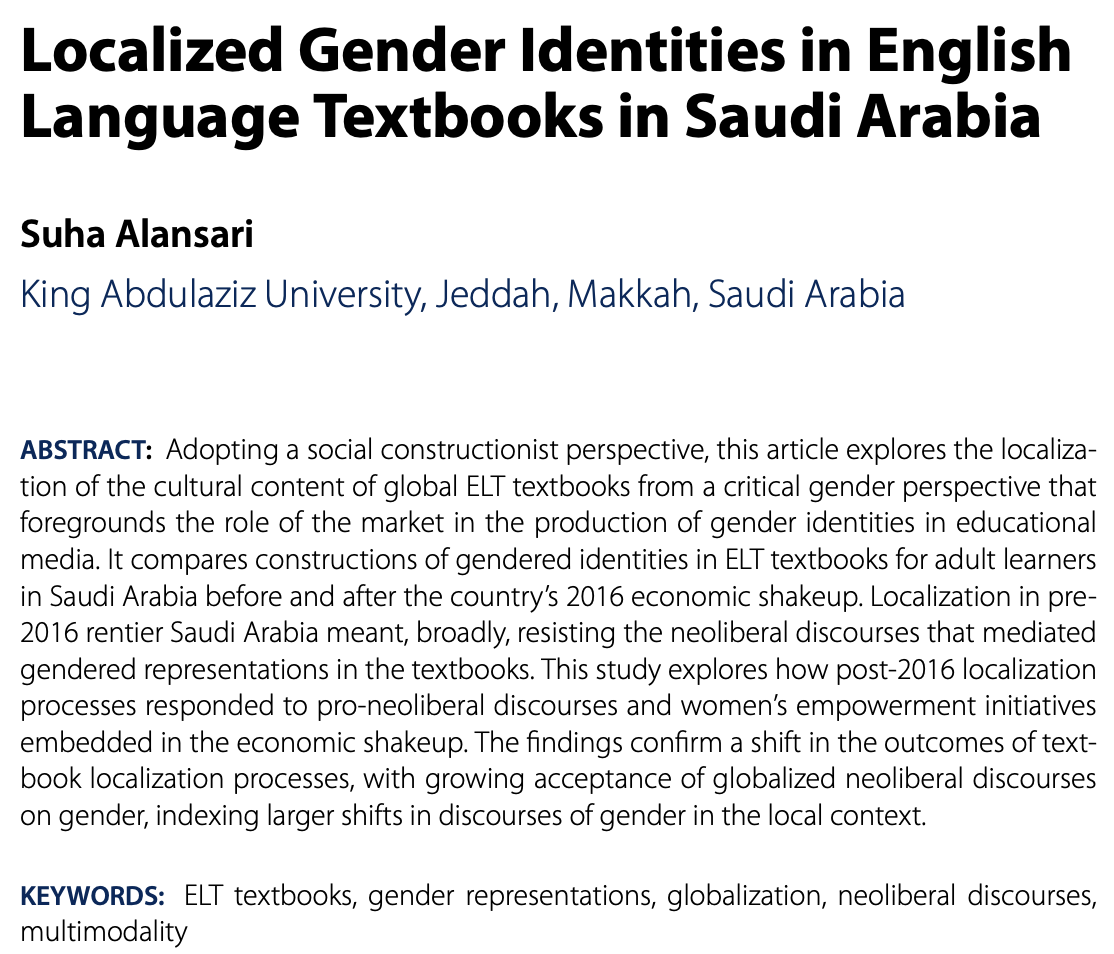
Out now! Suha Alansari's new article compares constructions of gendered identities in ELT textbooks for adult learners in Saudi Arabia before & after the 2016 economic shakeup, finding the texts responded to pro-neoliberal discourses and women's empowerment initiatives
methodologically innovative research on the meaning, production, and usage of gender and sexuality in educational media in diverse geopolitical contexts ranging from Uruguay, Saudi Arabia, & Nigeria to the Netherlands and Belgium. Access it here: https://t.co/lbJVgBl9RM (2/2)
Our new special issue "Gender and Sexual Diversity in Language Education: Approaches to Educational Media" is out now! Guest edited by Dietha Koster & Christine Ott, the issue links the research field of gender & sexual diversity in language education with theoretically and (1/2)
The editors reflect on stubbornness not as rigidity, but as an ethical & affective commitment to persist, to refuse erasure, & to continue imagining otherwise in inhospitable times. Read the piece here: https://t.co/lbJVgBkC2e (3/3)
New issue out now! 19.3 is especially meaningful to us, as it marks the final issue of the journal under the coeditorship of Kira Hall, Mie Hiramoto, and Rodrigo Borba, bringing to a close six years of collective editorial work. The issue features a farewell editorial with (1/3)
an anticipatory retrospective. Rather than offering a simple backward glance, it reflects on the orientations, commitments & affects that shaped the journal during these years, foregrounding stubbornness as a trans-queer-feminist mode of scholarly &political future-making. (2/3)
In our latest issue, Alexandra Krendel examines the language of r/MensLib, a community dedicated to discussing men's issues in a profeminist manner on the content aggregation site Reddit. 1/3
The language of profeminist men is relatively under-researched compared to that of antifeminist men, and so this article explores the salient topics of r/MensLib, the specific language used within the community and how r/MensLib orient themselves to feminism. 2/3
Issue 19.2 out now! In their new article, Wiksten, Jonsson, & Franzén examine the language of Muslim teen girls in a multiethnic youth club in Sweden, finding their humorous interaction challenges stereotypes of the humorless Muslim and the nonlaughing feminist (1/4)
and Walter & Long explore German nonbinary pronoun usage and discourse on Twitter, finding that neopronouns have neither stabilized around norms of usage nor has any singular neopronoun risen to prominence over others (4/4)