Automation in trading sounds easy — until you realize you’re also automating mistakes.
A bot doesn’t remove risk.
It removes hesitation.
And that’s exactly why badly built automation can be more dangerous than manual trading.
If the logic is weak, the execution is still fast.
If the settings are wrong, the losses are still automated.
If the system isn’t tested properly, speed only makes the damage bigger.
That’s why real trading automation is not just about “running a bot.”
It’s about logic, risk control, testing, adaptation and knowing what should never be automated blindly.
Automation is powerful.
But only when the system behind it deserves that power.
Most trading bots stop at execution. I’m building the system before execution.
Right now, the AI optimizer is already working at a basic level — it can test configurations, compare outcomes, and move toward stronger setups.
At the moment, the biggest fight is the UI.
The logic is starting to come together, but I want the interface to match the level of the system behind it.
This is no longer about building “just a bot.”
It’s turning into a full environment for designing, testing and optimizing trading strategies in one place.
Still early. Still messy. Still improving.
But it’s moving.
I started by learning charts, testing ideas, and trying to understand how the market really works.
Today, I’m already at the stage of building my own system, not just a single bot.
I’m creating a Python-based tool designed to build, test, and optimize strategies in one place — from logic, to parameters, to result analysis and further development.
This is the point where you stop only using other people’s tools and start building your own.
And that’s exactly what I’m focused on right now.
Currently working on the optimizer.
Instead of guessing parameters, I test many different configurations.
The goal is not to find something that looks perfect on a chart, but something that makes sense mathematically.
Many iterations, but each version becomes more stable.
A bot has one advantage over humans:
no hesitation no emotional decisions no panic exits no impulsive trades
It simply executes the logic it was designed to follow.
That’s why I’m more interested in building
From the outside, a trading bot looks simple.
In reality it consists of many parts:
data collection strategy logic historical testing realistic simulation conditions exchange communication via API stability in cloud environment
A single small error can stop the entire system.
Most of the work is improving details.
At some point TradingView strategies were no longer enough.
I wanted more control over: data logic testing execution behavior
That’s when I started building bots directly in Python.
More work, but much more flexibility.
Ready-made trading bots are a good starting point.
But sooner or later a limitation appears: lack of control.
you don’t know exactly how decisions are made you can’t adjust the logic you can’t properly test your own ideas
That’s why I started building my own strategies.
first simple ones then more complex ones.
What interested me most about trading is that the market leaves traces.
Movements are not completely random.
Patterns appear. Reactions repeat. Behavior becomes observable over time.
The more time I spent looking at charts, the more I wondered if these observations could be turned into logic.
Logic that can be written in code.
At that point trading stopped being clicking buttons. It became a problem to solve.
I started my journey with financial markets around June–July last year.
At that time, the only thing I knew was that something called a Japanese candlestick existed.
Very quickly I learned the basics: what crypto is what forex is how company stocks work what derivatives and contracts are
Since then, I’ve spent hundreds of hours studying the market.
One question caught my attention the most: how is it possible that an algorithm can trade instead of a human?
I started with simple ready-made bots.
Then moved to building strategies on TradingView.
Eventually, that was no longer enough.
Now I build my own bots from scratch: Python API GitHub cloud infrastructure
step by step.
A lot of learning. A lot of testing. A lot of mistakes.
But everything slowly starts forming a logical system.
@MarioNawfal I wrote about this exact scenario 3 days ago, before anyone was willing to even mention it.
The signals were there — people just chose not to see them.
Ground intervention has been the most likely outcome since the beginning of this conflict — people just refused to see it.
Donald Trump has hinted at the objectives from the very start. He doesn’t say it directly, but goals like regime change or control over strategic oil resources are impossible without boots on the ground.
I’ve been pointing this out in the comments for weeks.
Trump already tried to build a regional option through the Kurds, but that collapsed due to trust issues with Washington. That leaves one realistic scenario: direct U.S. military involvement, hoping allies follow — similar to the coalition model during the Afghanistan war.
But this time the coalition will be smaller.
Based on political signals and public statements, the U.S. could likely count on support from:
France, which has already signaled willingness to assist
United Kingdom, likely to join under strategic pressure
possibly Poland, whose security policy is strongly aligned with Washington
The real question isn’t whether intervention is possible.
The real question is how many countries will be willing to enter another Middle East war.
🚨🇺🇸🇮🇷 Is Trump about to deploy troops?
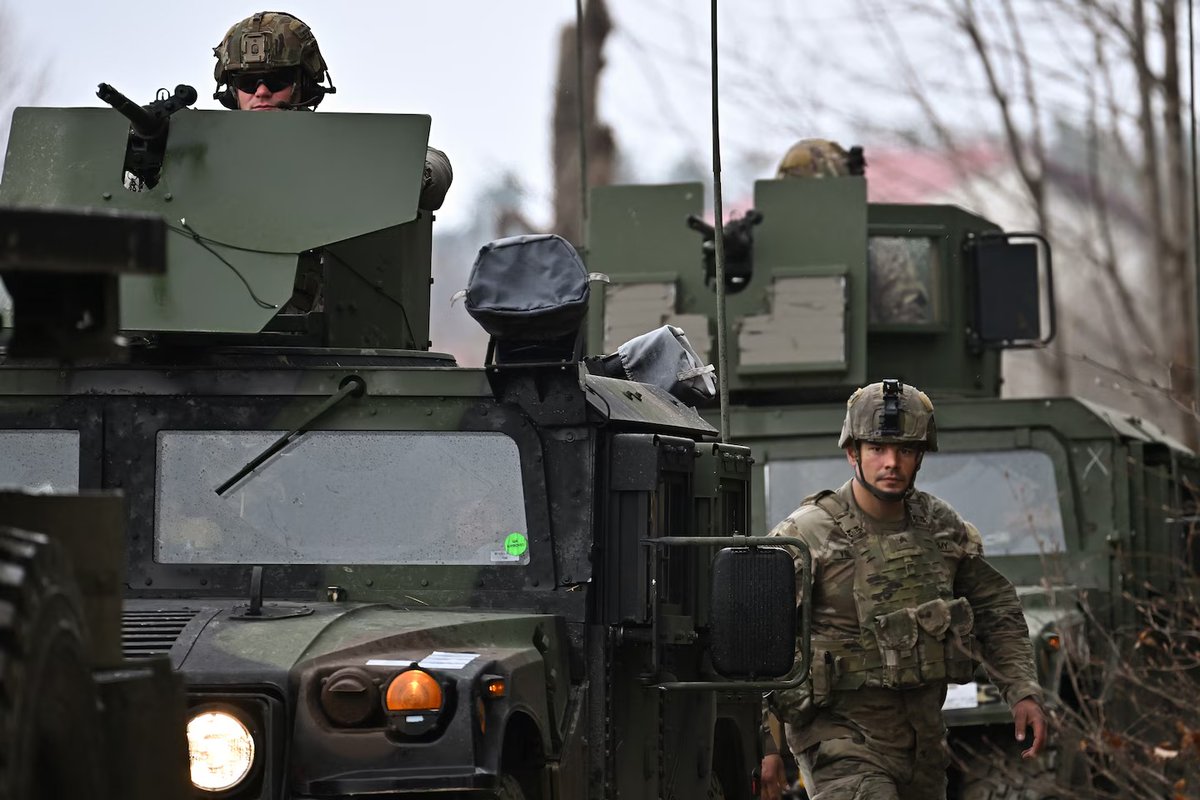
The US Army canceled a major training exercise for the elite 82nd Airborne Division, nicknamed “Devil’s Brigade,” sparking speculation they're prepping for rapid deployment to the Middle East.
The 82nd is famous for jumping into hot zones within 18 hours: seize airports, secure infrastructure, protect embassies, run evacuations.
One official: “We’re all preparing for something, just in case.”
Source: Washington Post
Geopolitics is never black and white.
Notice how avoids commenting on Russia here. That may not be accidental.
In wars there are often two winners — and sometimes they stand on opposite sides of the conflict.
The real question isn’t whether interests are being made.
The question is:
Is this about profit… or about destabilizing ?
Let’s stop pretending democracy can be delivered by foreign pressure.
Real legitimacy must come from inside the country — not from Washington.
The Iranian people will not accept another “democratic leader” installed from abroad. History already taught that lesson during the Shah era.
There are only two realistic paths.
First: let the country decide its own future. But that carries the risk of another regime rising from the chaos.
Second: internationally supervised elections — not controlled by Washington or Israel, but monitored by the UN.
That would give the Iranian people a real chance to choose their future.
Not another regime. Not another puppet destined to fall sooner or later.
German Chancellor Merz on Iran:
We are urging strongly that Iran’s statehood be preserved.
We do not want to see a Syrian scenario here, but rather we want this state to become functional from within itself.
And that is why I also appeal, both in Washington and in all talks with the Israeli government, to create the conditions as quickly as possible for this country to be stabilized, for it to get a democratically legitimized government, and for it to be able to continue to exist as a state.
It is a country with over 90 million inhabitants, and we naturally also have a high self-interest in this in order to avoid new refugee flows from the region.
Everyone talks about mediation like it's simple.
But real mediation means both sides at the table, not just pressure on one.
Iran is slowly losing key positions at home, while the U.S. and Israel are also facing growing shortages and public pressure.
The question now: which side will blink first?
@MarioNawfal Or maybe this isn’t incompetence.
Maybe it’s a calculated move.
No one knows what will happen in the next 2–3 days.
Sending HMS Dragon to Cyprus now would instantly drag the UK deeper into this conflict.
@FoxNews Hard to believe anyone will take that offer seriously.
A month ago protests in Iran were crushed and an estimated 30,000 people were killed, while promised support never came.
Why would anyone trust this now?
Is Europe’s security supposed to depend entirely on Washington?
The U.S. opposes European nuclear ambitions — yet reacted very differently when Israel’s nuclear capability was suspected.
So the question is: does Europe want nuclear capability… or is it starting to feel it might need it?