Chemical Engineer of Cuban Nationality and Student of the Doctorate in Sciences in Engineering at the Technological Institute of Aguascalientes, Mexico.
@dtc2lab@LatEnvChemPSE It is right! In my study I use two poly(D-glucosamine) units. Thank you very much for the reference, it can be very helpful!
Thank you very much!.
Hi, my poster is: Study of the molecular properties of different reactive dyes and their adsorption on chitosan hydrogels using computational chemistry models.
@LatEnvChemPSE#PSEFundComp
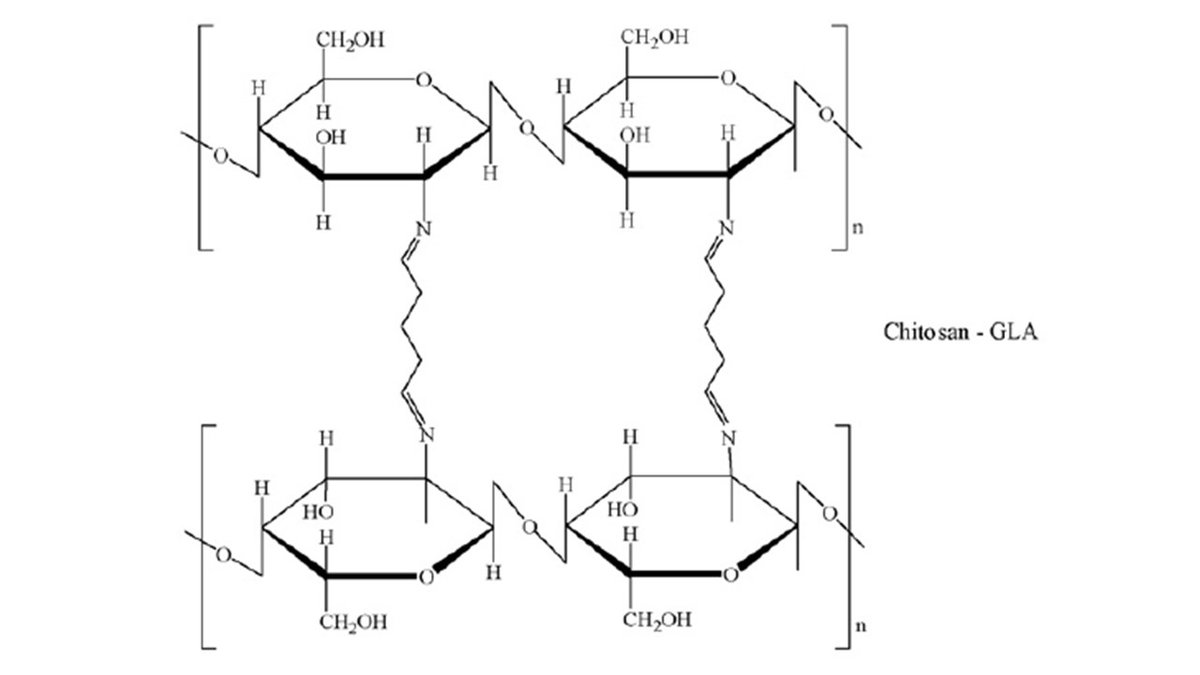
@BillyAlbertoAC@LLietty@LatEnvChemPSE El entrecruzamiento vía experimental se llevará a cabo mediante una metodología elaborada para dicho entrecruzante y el quitosano, por la vía de la química computacional se utilizará el software HyperChem Professional 8.0, te adjunto una imagen del entrecruzamiento.
@BillyAlbertoAC@LLietty@LatEnvChemPSE Hola Billy, pues si, el quitosano será entrecruzado con el glutaraldehído con el objetivo de obtener un material más estable y resistente a la interacción con soluciones acuosas, y para obtener una mejor superficie de contacto entre el adsorbato y el adsorbente.
@GustavMondragon@LatEnvChemPSE It is correct!!!, but you cannot apply Hartree–Fock and DFT due to computational limitations, which would be more accurate in the energy data, but it was not possible. To guarantee the minimum of the thermochemical data with greater accuracy, Hartree–Fock and DFT must be applied.
@EmanuelContC@LatEnvChemPSE Hi, the molecules under study were extracted from the scientific paper and subsequently drawn in GaussView 6.0. The semi-empirical methods are less accurate than the Hartree–Fock method and DFT.
@obag74@LatEnvChemPSE Se aplica esta estrategia con el objetivo de conocer la reactividad y estabilidad química de las moléculas en estudio; y las ventajas de aplicar métodos semi-empíricos es el tiempo de cómputo, son mucho más rápidos que el método Hartree–Fock y DFT.
@dtc2lab@LatEnvChemPSE It is right! In this study the analysis of the thermochemical properties of each compound was carried out, where this analysis was not presented in the poster, thus demonstrating that each compound is stable, thus proceeding to the analysis discussed in this poster.
@dtc2lab@LatEnvChemPSE Hi, the conformational analysis of the compounds under study was not performed. In the case of the semi-empirical methods, they were applied because they are less demanding in computational requirements, it would be ideal to apply Hartree-Fock and DFT to obtain greater accuracy.
Hi, my poster is: Study of the adsorption of metal ions Cu(II) and Cd(II) on individual systems and competition with a chitosan-based cryogel at pH=6 and pH=7 by applying the Multilayer Perceptron Artificial Neural Network.
@LatEnvChemPSE#PSEModSimulat
@LatEnvChemPSE
Twitter Latin American Conference on Environmental and Chemical Process Systems Engineering
1 de Julio de 2021, 12:00 (UTC)
July 1st, 2021, 12:00 (UTC)
1 de Julho de 2021, 12:00 (UTC)
https://t.co/X20389Zua3
@DavidDanaci Hi @DavidDanaci, the target values obtained from molecular simulation of the adsorption of individual and competing copper and cadmium ions on chitosan beads. Thank you very much for your question!
Hello #IASTwitterPoster, this is my work, “Application of the multilayer perceptron neural network in copper/cadmium adsorption on chitosan beads using hyperbolic tangent sigmoid activation function in hidden layer neurons”
@wilkins_ns @RajendranArvind @GermaineRamon In the case of the simulation of the multilayer perceptron artificial neural network in Matlab the only input is the temperature to make the prediction of Gibbs free energy, Heat of formation, Dipole moment, Surface Area and Volume. Thank you!
@RajendranArvind @GermaineRamon Hello @RajendranArvind, regarding your question, the data for the training were obtained through molecular simulation of the adsorption process of copper and cadmium ions individually and in competition on chitosan beads.
@wilkins_ns Hello @wilkins_ns, regarding your question, this work has not considered another machine learning framework, but it is an excellent idea to make use of the regression of the Gaussian process. Thank you very much for your question, it was very instructive.
Hello #IASTwitterPoster, this is my work, “Study of the competing adsorption of copper/cadmium on chitosan beads by the multilayer perceptron neural network applying the logarithmic sigmoid activation function in the neurons of the hidden layer”