They're right for Japan, Korea, and Singapore. Those guys source 75% of refined products from the Persian Gulf. Hormuz closes, they bleed.
But Indonesia is a different story entirely.
Yes, Indonesia imports refined products. Pertamina's refining capacity doesn't fully cover domestic demand, so Pertalite and Solar get bridged through imports. The Hormuz shock hits that. Real exposure.
What makes Indonesia different is this.
Indonesia's actual risk from this isn't supply. It's fiscal. If oil prices spike because Hormuz stays closed, the government's subsidy bill for Pertalite and Solar expands. Wider deficit, rupiah pressure. That's the bear case for Indonesia, and even that's manageable.
The bull case is what nobody is talking about.
Indonesia runs B40 right now. 40% of every liter of diesel consumed domestically is palm oil biodiesel, not petroleum. When oil spikes, the incentive to push toward B50 or B55 gets stronger overnight. Import volume drops. Indonesia self-hedges using its own CPO supply. No other country in Asia has this. Not Korea, not Japan, not Singapore.
Then there's coal.
When Hormuz disrupts LNG and oil flows into Asia, the fastest lever available to power generators in Japan, Korea, and India is gas to coal switching. Indonesia is the world's largest seaborne thermal coal exporter. ADARO, ITMG, PTBA, BUMI don't suffer from this scenario. Export volumes go up. Realized prices go up. Royalty revenue to the government goes up.
Same logic on LNG. Indonesia exports from Bontang and Tangguh. When Middle Eastern supply gets disrupted, the spot premium on non Gulf LNG widens. Indonesian cargoes price up.
Same logic on CPO. High oil equals strong biodiesel demand globally equals strong CPO prices. Indonesia and Malaysia control 85% of global supply.
You see, Indonesia pays more for refined product imports. Fiscal subsidy pressure rises. Rupiah is a watch item. Those are real negatives.
But Indonesia earns more on coal exports, earns more on LNG spot, earns more on CPO, and reduces net petroleum import volume through accelerated biodiesel blending. The terms of trade move in Indonesia's favor, not against it.
The conventional take is "Indonesia is a net oil importer so oil shock is bad." The correct take is Indonesia is a net energy exporter in the commodities that directly substitute for disrupted Persian Gulf supply. A sustained Hormuz closure improves Indonesia's aggregate energy trade position, not deteriorates it.
Happy Sunday and Happy Easter.
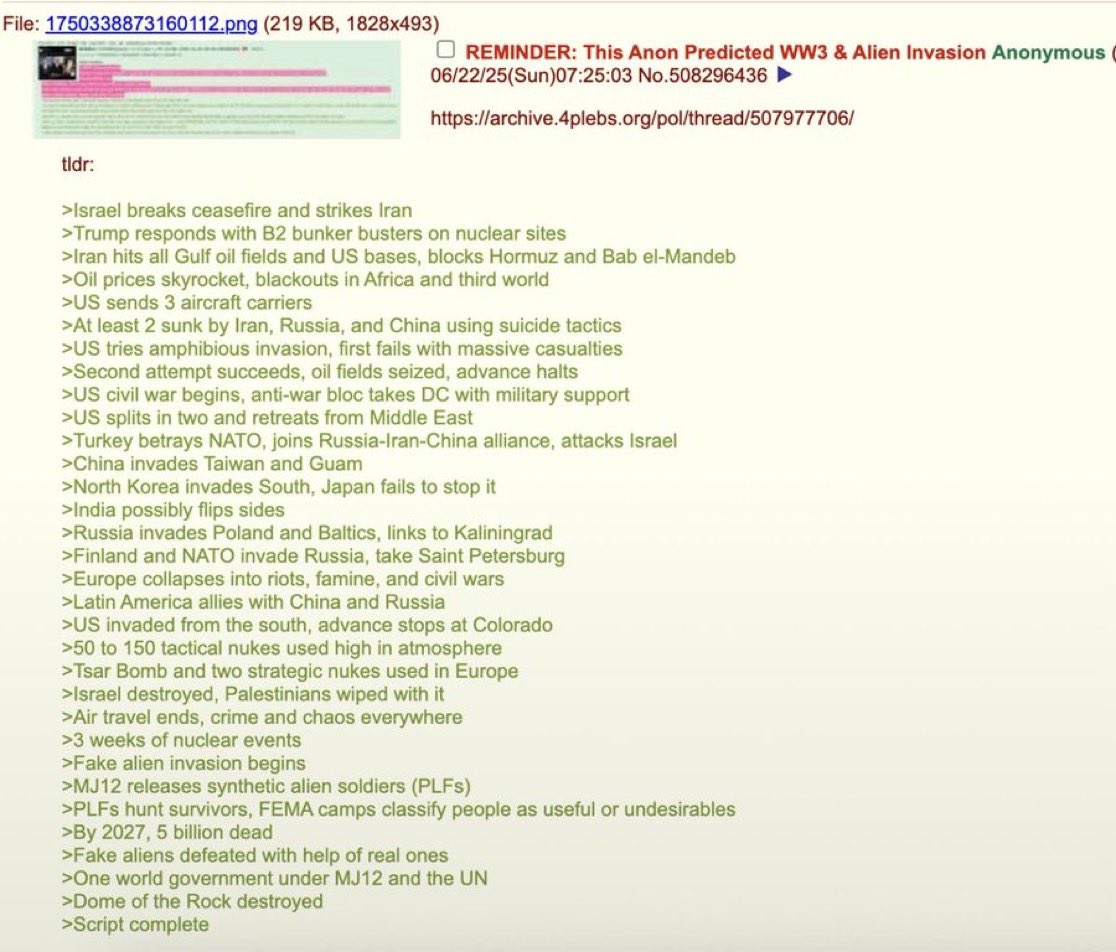
In June 2025 on 4chan, an anonymous poster dropped what he called 'the script' — a full timeline predicting the next phase of global events.
He warned of Israel breaking ceasefires and striking Iran, Trump responding aggressively with bunker busters, Iran hitting all Gulf oil fields and U.S. bases, oil prices skyrocketing, failed invasions, U.S. civil war, tactical nukes, then a staged fake alien invasion using synthetic soldiers released by MJ12.
By 2027 — 5 billion dead and a one world government.
The war's early phases are unfolding eerily close to the script: Israel struck Iran after fragile truces collapsed, Trump unleashed bunker-busters on hardened sites, Iran retaliated by hitting Gulf oil fields and U.S. bases, oil prices exploded, and the U.S. surged carriers into theater (two active now—Lincoln and Ford—with a third, Bush, on the verge of joining).
Coincidence or did an anon really leak the playbook?
Saylor has built a bond backed by bitcoin that pays 3x what treasuries pay..
and institutions are buying it without realizing what they’re actually holding
let me break this down simply..
STRC is a share that always trades at $100
not roughly $100. exactly $100.
saylor engineered this by using the dividend as a lever…
price drops below $100 → raise the dividend → buyers rush in → price goes back to $100
price rises above $100 → lower the dividend → less attractive → price comes back down
right now it’s at $100.01 and the machine is working
the yield is the story
you put $100 in. you get $11.50 back every year. paid monthly.
a 10-year US treasury? $4.00/year on the same $100
same “safe” stable price. same $100 in, $100 out
one is backed by government promises
and one is backed by 720,000 $BTC saylor is offering you 3x the yield and better collateral
why can’t institutions just buy bitcoin directly?
they can’t
pension funds, insurance companies, university endowments.. they have rules
“too volatile” “no income” “doesn’t meet distribution requirements”
they need stable price + monthly cash flow or their compliance department says no
so they’ve been stuck with 4% treasuries watching bitcoin go from $10k to $85k
$STRC solves this..
- stable price
- monthly income
- compliance approved
- they get their bond wrapper
- but underneath it is bitcoin
this is the trojan horse
they think they’re buying a high-yield preferred share
but they’re buying bitcoin exposure in a suit.. every dollar that flows into STRC flows through to strategy
strategy uses it to buy more bitcoin
more bitcoin = more collateral = better terms to raise more capital = buy more bitcoin
the flywheel only needs $BTC to not go to zero
miki pernah bilang di interview dulu, klo attitude beberapa player inter udah kaya paling jago, menang itu gampang.
nah taro nih udah tau juga cuma nyimpen dalam2,
klo urutannya gini semua ketauan
kenapa inzaghi di interview terakhir bilangnya udah cape, ya nyambung semua
#Inter
🚀 Less than 35 hours left until the $DROP Token Public Pre-sale begins! 💧
🗓️ Start Date: Feb 27 – 5 PM UTC
🗓️ End Date: Feb 28 – 5 PM UTC
🟢 No Vesting!
🟢 Everyone can participate!
🟢 Pay Method: $SOL (Solana)!
🟢 It's limited and when it reaches 3600 SOL the sale will be closed!
🟢 Fair distribution for those who want one last chance to add to their bag!
🔗 Official Pre-sale link: https://t.co/G5yMYAc3ws