Your AI can write a sonnet or teach you physics and still not know what you're working on.
So we built Brains. One place that holds your work life, so your AI already knows the plot. No recap, no first-date energy.
It's early and held together with tape, but we want you on it first.
Your work has a backstory. Your AI should understand it.
Every project carries a history of conversations, decisions, changing priorities, and unfinished business. A deadline only tells part of the story. So does a document, a meeting invite, or the latest message in a thread.
Context is understanding how those pieces connect.
It’s knowing that a project is on track, but an approval is holding up the next step. That a recent comment changes what needs to be discussed. That an upcoming meeting is the opportunity to finally resolve a decision.
When that context is missing, you become the go-between. You find the relevant documents, recap the conversations, explain the dependencies, and tell your AI what matters before it can help.
That setup takes time and attention you wanted to spend on the work itself.
Brains brings your work’s context into the conversation, helping surface what’s relevant, what’s unresolved, and what needs your attention.
So when you ask for help, you can start from where the work actually stands—with the background that makes an answer useful and the connections that make the next step clearer.
Less time piecing everything together. More time moving things forward.
Work is better when your AI isn’t making you guess.
A Friday handoff, for your Monday self
Things you finished.
Things you promised.
Things you dropped the ball on.
Things you carried through with.
Brains gives you personalized reports that carry your context, and map them against the team's goals.
The sales call ends with a rollout plan to send and a security review to book. Then everyone’s on to the next meeting.
Brains turns those commitments into follow-ups ready for review, with an owner, timing and the relevant documents attached.
You can pick up what you promised without replaying the call.
A customer was promised a replacement yesterday. Today, a different person picks up the ticket.
Brains can help prepare the handoff with the approved exception, the email behind it and what still needs doing.
The next person has something useful to work from.
Your inbox doesn’t become the company inbox just because you connected it to AI.
In Brains, personal context stays private unless you share it. Connected information keeps the permissions of its original source.
Sharing a project with your team shouldn’t mean sharing everything else you’re working on.
Learn how Brains makes collaboration easier for companies, by bringing in context from multiple tool, files, & conversations.
https://t.co/OIC3I6ZUek
The person who remembers why a decision was made shouldn’t have to attend every meeting where it comes up again.
Their explanation is part of the work. It deserves to be as easy to find as the decision itself.
Some of your best copy is sitting in customer emails and sales notes.
Use Brains to find how customers describe the problem, what nearly stopped them buying and what mattered enough to mention afterwards.
Bring that language into your next brief. It’s easier to write something that resonates when you know how your customers talk about it.
Brains is being used by sales, marketing, customer success & revenue teams in leading organizations.
Reach out to us to start a pilot.
https://t.co/Q1t0Rlkive
The team needs a morning update. Someone has to check the projects, chase what changed and pull it all together before the day gets going.
Give Brains that recurring job. Choose the projects it can read, set a weekday schedule and have the updates and blockers brought into Slack at 9am.
You can start with what needs attention.
Brains is being used by sales, marketing, customer success & revenue teams in leading organizations.
Reach out to us to start a pilot.
https://t.co/Q1t0Rlkive
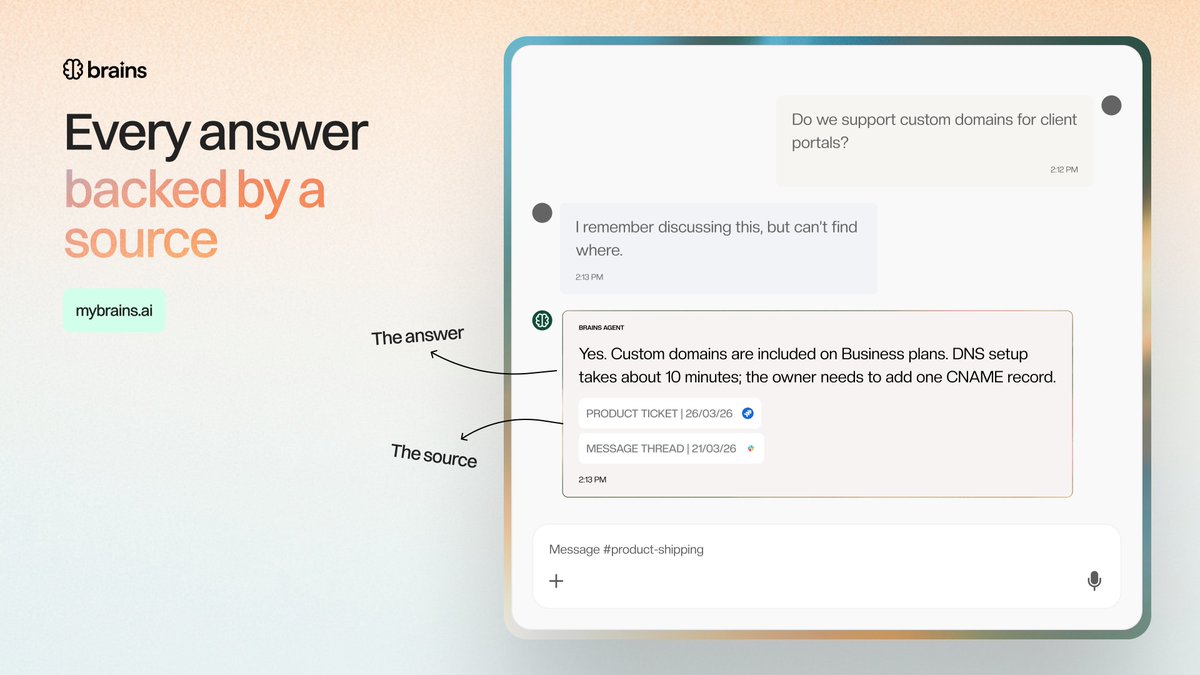
A useful answer is only half the job.
If it concerns a customer commitment, a policy or an internal decision, the person using it should be able to see where it came from.
In Brains, every answer includes the source material behind them. Open the citation. Read the original line. Decide whether the context is right for the work in front of you.
The source is part of the product, because judgment stays with the person doing the work.