During the late 19th and early 20th centuries, King Leopold II of Belgium ruled over the Congo Free State as his personal colony. Under his exploitative regime, the Congolese people suffered immensely.
King Leopold's primary motive was to extract as much wealth as possible from the Congo, particularly through the production of rubber.
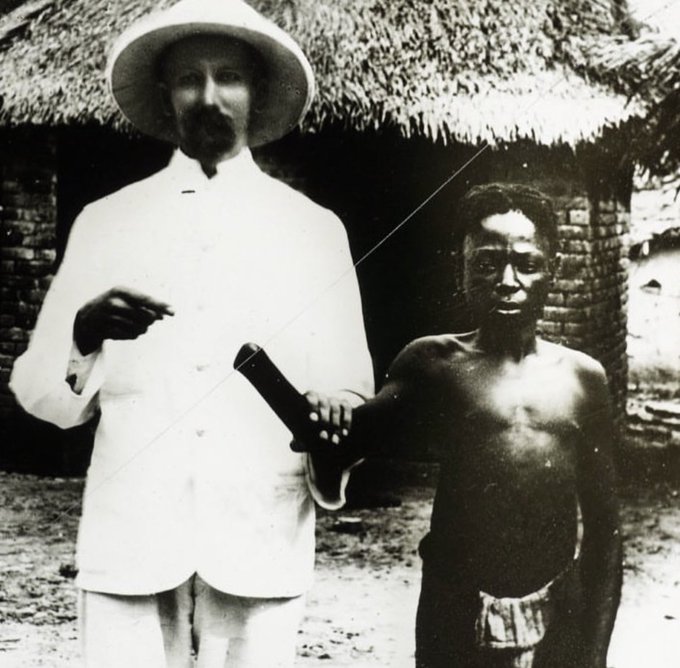
To enforce his control and maximize profits, King Leopold imposed a reign of terror on the Congolese population. This photo mentioned captures a grim aspect of the brutality. Congolese individuals who failed to meet the demanding rubber production quotas set by the Belgian administration were subjected to severe punishment.
Thousands of Congolese were subjected to executions, including public hangings, or had their hands amputated as a means of punishment.
These cruel acts were carried out as a deterrent and as a means of maintaining control over the local population.
The atrocities committed during this period have been well-documented and are considered one of the darkest chapters in colonial history. In the photo, a child victim of these Belgian atrocities in the Congo is depicted alongside a missionary.
Missionaries played a complex role during this time, as some were complicit in the exploitative system, while others may have provided some level of humanitarian assistance.
The image serves as a haunting reminder of the profound suffering endured by the Congolese people under King Leopold's oppressive regime.
If you like paintings of the ocean then you'll love Ivan Aivazovsky — he was the most famous seascape artist of the 19th century.
What made him so good? Aivazovsky realised that the key to painting the sea wasn't the waves...
During the Depression, onions were a common and easily grown and stored vegetable. So, they were readily available and, most importantly, free.
Meanwhile, peanut butter was also inexpensive. So, the Bureau of Home Economics devised the recipe for peanut butter-stuffed onions as an easy way for American homemakers to feed their families.
The recipe for this curious dish was published in many 1930s newspapers and magazines. It eventually found its way onto American dining tables as a healthy, tasty, simple, and low-cost meal that could be served any time of the day.
The mishmash consisted of baked onions with peanut butter filling mixed with stale bread crumbs. These ingredients came together and created a distasteful and disliked dish that people only ate to fill their hungry stomachs.
Why does The Lord of the Rings trilogy still look so good?
Many reasons, but here's one: Minas Tirith wasn't CGI. They built a miniature version of the whole city and filmed that. It looks realistic... because it was real.
And this wasn't even the biggest model they made...
“In one of the most notable moments in sports history, Kenyan runner Abel Mutai was just a few feet from the finish line, but became confused with the signage and stopped thinking he had completed the race.
A Spanish athlete, Ivan Fernandez, was right behind him, and after realizing what was happening, he started shouting at the Kenyan for him to continue running; but Mutai didn't understand his Spanish.
Fernandez eventually caught up to him and instead of passing him, he pushed him to victory.
A journalist asked Ivan, "Why did you do that?"
Ivan replied, “My dream is that someday we can have a kind of community life where we push and help each other to win.” The journalist insisted “But why did you let the Kenyan win?" Ivan replied, "I didn't let him win, he was going to win.” The journalist insisted again, “But you could have won!”Ivan looked at him & replied, “But what would be the merit of my victory? What would be the honor of that medal?
What would my Mom think of that?”
Values are transmitted from generation to generation.
What values are we teaching our children?
Let us not teach our kids the wrong ways to WIN.”
Calltoactivism
The technology we know as Bluetooth derives its name from Harald Bluetooth, a Viking king who passed away over a millennium ago. Just as he united factions of Denmark and Norway, Bluetooth technology unifies various electronic devices. The Bluetooth logo cleverly incorporates his initials, represented by the runic symbols for Hagall (*) and Bjarkan (B).
The origins of Harald Bluetooth's nickname remain a subject of debate. Some sources suggest that his fondness for blueberries resulted in permanently blue-stained teeth. Others speculate that he had a dark blue/grey-colored tooth, possibly due to decay.
300 years ago a famous Italian artist called Giovanni Battista Piranesi did something strange.
He drew an infinite, imaginary prison filled with impossible architecture, shadowy figures, and mysterious torture devices.
Why? Nobody knows...
This is the town of Shibam in Yemen, known as the "Manhattan of the Desert".
But it's much older than Manhattan — these skyscrapers are 500 years old...
Inside Vasco da Gama's flagship for his first voyage to India in 1497-99, São Gabriel!
Vasco da Gama's armada consisted of four ships, two of these, São Gabriel and São Rafael, were carracks, newly built for the voyage on which he successfully discovered the sea route to India.
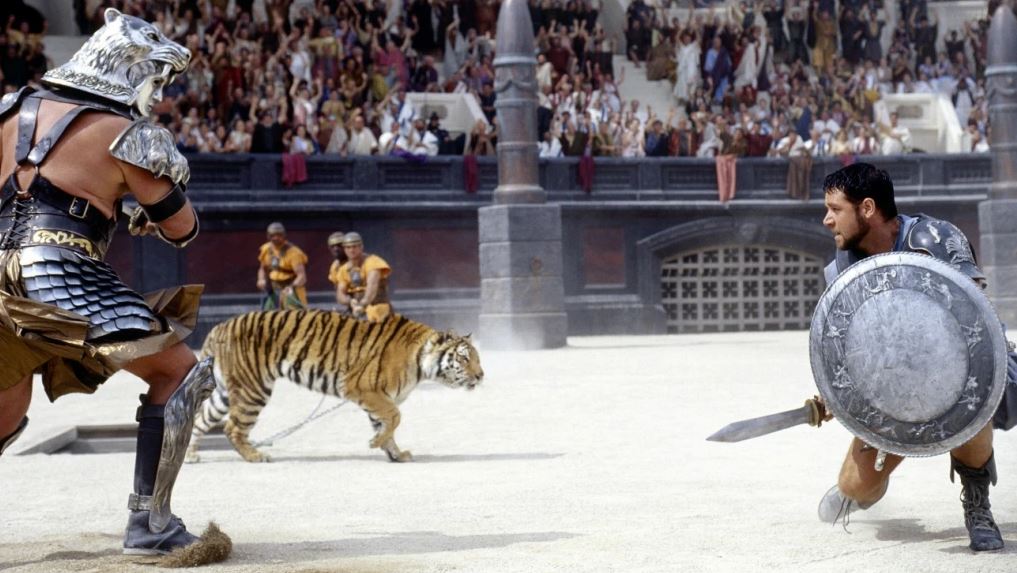
Ridley Scott’s swords-and-sandals classic GLADIATOR was released 23 years ago today. An enormous production full of star names, the making of story is as epic as the film itself.
A THREAD
1/35
This is the Baltic Way. On 23 August 1989, two million people joined their hands to form a human chain spanning 675.5 km across the three Baltic States of Lithuania, Estonia and Latvia. The protest was against Soviet oppression, and to support the independence movements of the three States and their desire to escape communism.
This elevator of the One World Trade Center Observatory climbs 102 stories in 47 seconds and reveals the transformation of New York City from unsettled lands to today’s remarkable forest of skyscrapers
[📹 bobbyluck88: https://t.co/4wHG18yH3S]
This is The Last Judgment, painted by Michelangelo nearly 500 years ago.
And it's one of the most controversial (and heavily censored) paintings of all time.
Some say it's a masterpiece, some say it's a mess, and some have even tried to destroy it...
On Twitter, I usually talk about Russia and Ukraine, but for a moment I'd like to talk about #China. I have a graduate degree in Asian Studies/Chinese, I speak Chinese, I've been to China multiple times, and the Army certified me as a Foreign Area Officer (FAO) for China. I spent a lot of my 30-year-long career in the intelligence community looking at China.
Bottom line: We have a problem with China. A big one.
We normalized relations with China in 1979. Since the early 1980s, American and multinational businesses couldn't resist the sizeable profits to be made by outsourcing their production operations to China. In so doing, they slowly but steadily enabled China to become the world's manufacturing hub. This, coupled with China's systematic and profligate theft of intellectual property has turned once-backward China into a global economic juggernaut whose GDP will surpass that of the US (if it hasn't already).
There are 195 countries in the world, but fully half of all FBI counterintelligence cases involve China. Every 10 days, the FBI opens a new counterintelligence investigation against a Chinese individual or entity. Chinese economic espionage is a massive problem in and of itself.
Before we can even contemplate fixing the problem, we first need to accept -- as a nation -- that we HAVE a problem, understand the nature and scope of the problem, and then deal with it in a sober, realistic, determined, and bipartisan manner.