Verdict is live.
An independent watchdog that scans prediction markets and scores rule clarity, resolution quality, and dispute risk before users trade.
No black boxes. No post-trade excuses.
https://t.co/S2N5mPSTsB
We’ve been quiet for a while, so here’s the simple version.
Why does Verdict exist?
Because prediction markets can get the event right and still resolve the market wrong.
Aren’t the rules enough?
Not always. Rules can be vague, edited, clarified too late, or interpreted differently after traders have already committed money.
What does Verdict do?
We break down the rules before resolution risk becomes everyone’s problem.
Is this about attacking prediction markets?
No. We believe in them. That’s exactly why they need better standards.
Prediction markets are becoming too important to run on “read the fine print and hope.”
That’s why Verdict exists.
Prediction markets are now too powerful to operate without an independent watchdog.
In 2026:
• France blocked Polymarket nationwide
• A Google employee was charged after allegedly making $1.2M using confidential data
• Traders reportedly made $1.2M hours before the attack that killed Iran’s Supreme Leader
• French police investigated suspected weather-sensor manipulation linked to Polymarket bets
• A journalist received death threats and bribe offers to change a report controlling millions in payouts
• Regulators opened multiple insider-betting investigations
Meanwhile, ordinary users continue losing money to unclear rules, questionable evidence and disputed resolutions—with nowhere independent to turn.
Today, Verdict is launching the Prediction Market Integrity Files.
We will investigate and publicly document:
• Ambiguous market rules
• Disputed resolutions
• Suspicious trading
• Evidence manipulation
• Undisclosed conflicts
• Cases platforms refuse to address
Every credible case will be preserved with evidence and independently scored. The most serious cases will receive full public reports.
If you have ever lost money because a prediction market changed its interpretation, ignored evidence or resolved against its own rules:
Reply with the market link and your evidence.
Follow this account. Repost this investigation.
Prediction markets watch the world.
Now someone is watching them.
https://t.co/6L4OXyPdMk
The United States has now declared the ceasefire effectively over, and the US and Iran are exchanging strikes again. Iranian civilians are once again paying the price. (Reuters)
Yet Polymarket resolved a market asking whether the two countries had reached a “permanent peace deal” to YES—based on an interim arrangement that was supposed to lead to further negotiations. (TNW | The heart of tech)
The fighting has resumed.
So where exactly is the “permanent” peace?
People’s suffering is not a word game, and market rules should not become one either.
NEWS: Polymarket is trying to sell the public a new story about “trust” as it pushes deeper into the U.S. market.
But trust is not built with PR campaigns.
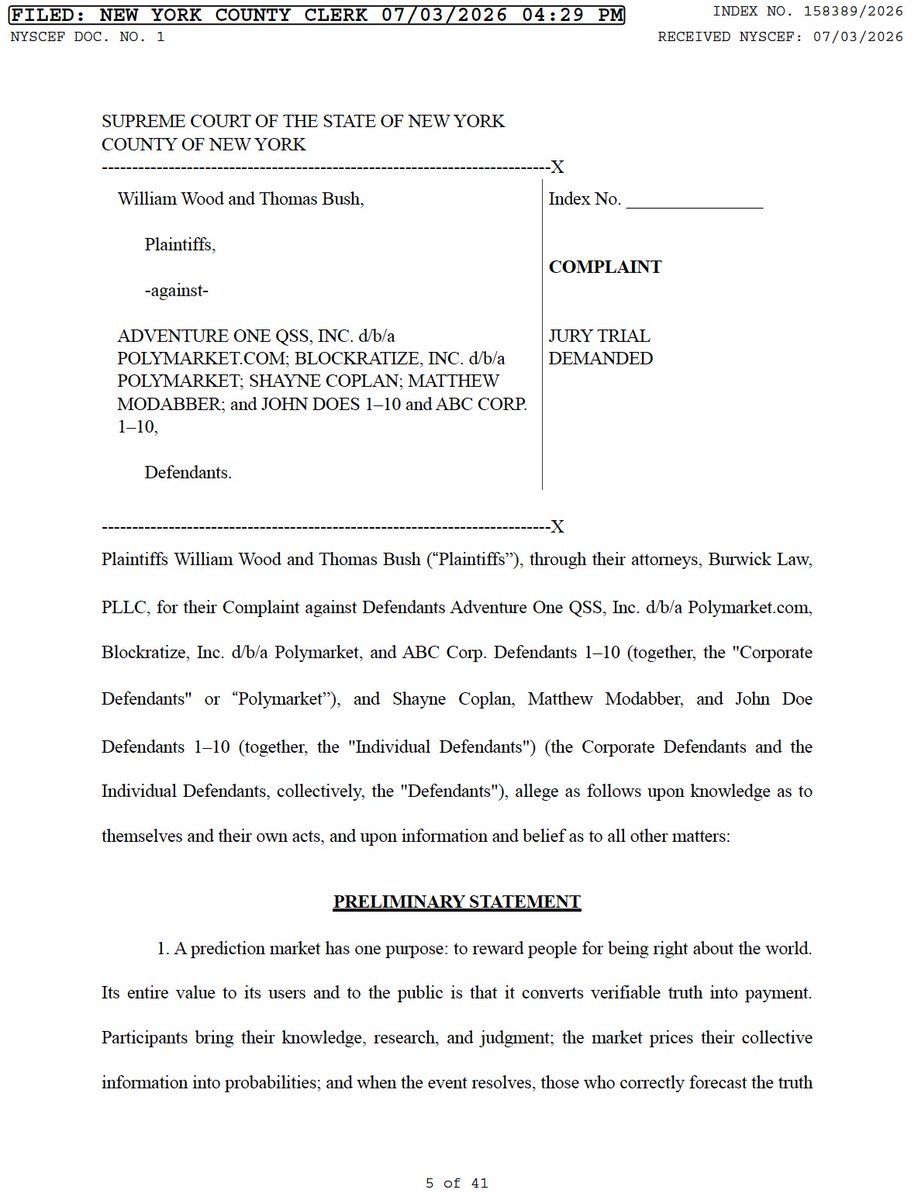
This week, Polymarket is facing a New York lawsuit over the controversial Strategy / MicroStrategy Bitcoin market, where YES holders allege the platform refused to pay despite Strategy’s own SEC filing showing it sold 32 BTC between May 26 and May 31.
At the same time, recent reporting has raised serious questions about Polymarket’s marketing practices, including paid creator campaigns and staged-looking betting content.
This is exactly why independent oversight matters.
Prediction markets cannot become mainstream if users have to worry about:
• retroactive rule interpretations
• conflicted resolution systems
• opaque dispute processes
• misleading marketing
• no real path to accountability
Verdict HQ will continue tracking resolution risk, contract design, and platform conduct across prediction markets.
Markets need rules.
Users need protection.
Platforms need accountability.
Polymarket’s resolution risk is not theoretical — I experienced it firsthand.
In the controversial MicroStrategy Bitcoin market, clear evidence was ignored, YES holders were wiped out, and users were left with no fair path to accountability. That kind of conduct damages trust not only in one platform, but in the entire prediction market industry.
That is exactly why I started @GetVerdictHQ: to build an independent watchdog for prediction market contracts, resolutions, and user protection.
Thank you @GerlacherC and Prediction Market Movers for giving me the opportunity to tell this story and discuss why transparency, accountability, and fair resolution standards matter.
I was a Top 10 YES holder in this exact market:
“Strategy Inc. / MicroStrategy sells any Bitcoin by May 31, 2026”
I lost $35,000 USDC because of Polymarket’s wrongful resolution.
SEC filings clearly show Strategy sold 32 BTC within the market period.
Yet Polymarket resolved the market to NO — wiping out YES holders.
This must be strictly investigated.
Platform accountability and fair resolution rules are non-negotiable.
I fully support this lawsuit and will always stand with @willo2_Poly’s recovery efforts for all affected users.
More victims and large holders: speak up.
Let’s demand justice.
#Polymarket #PolymarketLawsuit #CryptoJustice
On a new episode of Prediction Market Movers, @GerlacherC sits down with the founder of Verdict HQ @0xDinoCrypto to discuss Polymarket's resolution risk and how a controversial MicroStrategy Bitcoin market led him to build an independent watchdog for prediction market contracts.https://t.co/JKNrSpSgKd
BREAKING: @willo2_Poly and another affected trader have taken Polymarket to court over the Strategy / MicroStrategy Bitcoin sale market.
The dispute centers on a market that resolved NO despite SEC filings allegedly showing Strategy sold 32 BTC within the relevant period.
This is exactly why resolution quality matters.
Prediction markets cannot scale if traders are forced to gamble on vague rules, unclear evidence standards, and post-resolution interpretation.
Markets need clear criteria before money is at risk.
Verdict will continue tracking resolution risk, disputed markets, and platform accountability.
#Polymarket #PredictionMarkets #CryptoJustice
Most prediction market disputes do not begin at resolution.
They begin the moment a market is written poorly.
Vague criteria.
Undefined evidence standards.
Missing edge cases.
Unclear resolution sources.
Post-trade interpretation.
By the time traders notice, money is already at risk.
Verdict scores resolution quality before you trade.
5/5
And now more MSTR markets are live again, including:
Will MicroStrategy announce selling any Bitcoin by ___?
After the previous MSTR resolution controversy, this matters.
Wildfire betting.
Fake marketing.
Regulatory pressure.
MSTR markets again.
This is not one isolated problem.
It is a pattern.
1/5
Prediction markets are having an ethics crisis.
In the last few days:
WIRED reported on wildfire betting
The Times reported growing regulatory pressure
Polymarket’s fake-bet marketing scandal is still unresolved
and new MSTR markets are live again
This is no longer just “forecasting.”
4/5
Then there is the marketing problem.
Polymarket was built around the promise of transparency: on-chain, auditable, real money, real signals.
But the fake-bet marketing scandal showed the opposite image:
fake wins, dummy sites, staged content, and viral “easy money” clips.
That damages the entire premise.
3/5
The defense is always the same:
“Markets create better information.”
But US Forest Service and Cal Fire reportedly said they do not use prediction-market data for wildfire forecasting.
The agencies doing the actual work rely on scientific models, weather, terrain, fuel conditions, and operational data.
Not gambling odds.
2/5
The wildfire story is the clearest example.
People used Polymarket to bet on California fires — how they would grow, how long they would last, and how much destruction they would cause.
When real people are evacuating, losing homes, and dying, turning that into a market is not neutral innovation.
The more I read about old stock market manipulation cases, the more I realize crypto didn’t invent anything new.
Same playbook. New wrappers.
1/ Accumulate enough supply.
2/ Spread it across hundreds or thousands of accounts.
3/ Use some wallets to trade the token, others to move capital around.
Wash the volume. Paint the chart. Make the market look alive. Confuse everyone watching.
4/ Then the “educational” content starts.
Two useful threads. One hidden shill.
Suddenly the asset gets placed next to the hottest narratives in the market.
5/ Price starts moving.
6/ Influencers keep posting. Communities get louder. The chart becomes the marketing.
And just like that, a “generational opportunity” is born.
The ending is usually just as predictable.
Someone inside the circle breaks the informal lock-up, dumps before everyone else, and the whole structure collapses from within.
Different century. Different market. Same human nature.
Never use money to test people.
I used to think crypto was a new game.
Turns out we are still playing the old one, just with wallets, Discord groups, and better memes.
Old market manipulation playbooks did not disappear.
They moved on-chain.
The pattern is still recognizable:
Accumulate supply.
Split positions across wallets.
Create artificial volume.
Paint the chart.
Attach the asset to a trending narrative.
Use “education” as distribution.
By the time the market calls it momentum, the structure may already be engineered.
On-chain data makes some things more transparent, but it does not remove human incentives.
It only makes the cycle faster.
This is why markets need independent monitoring before the damage is done.