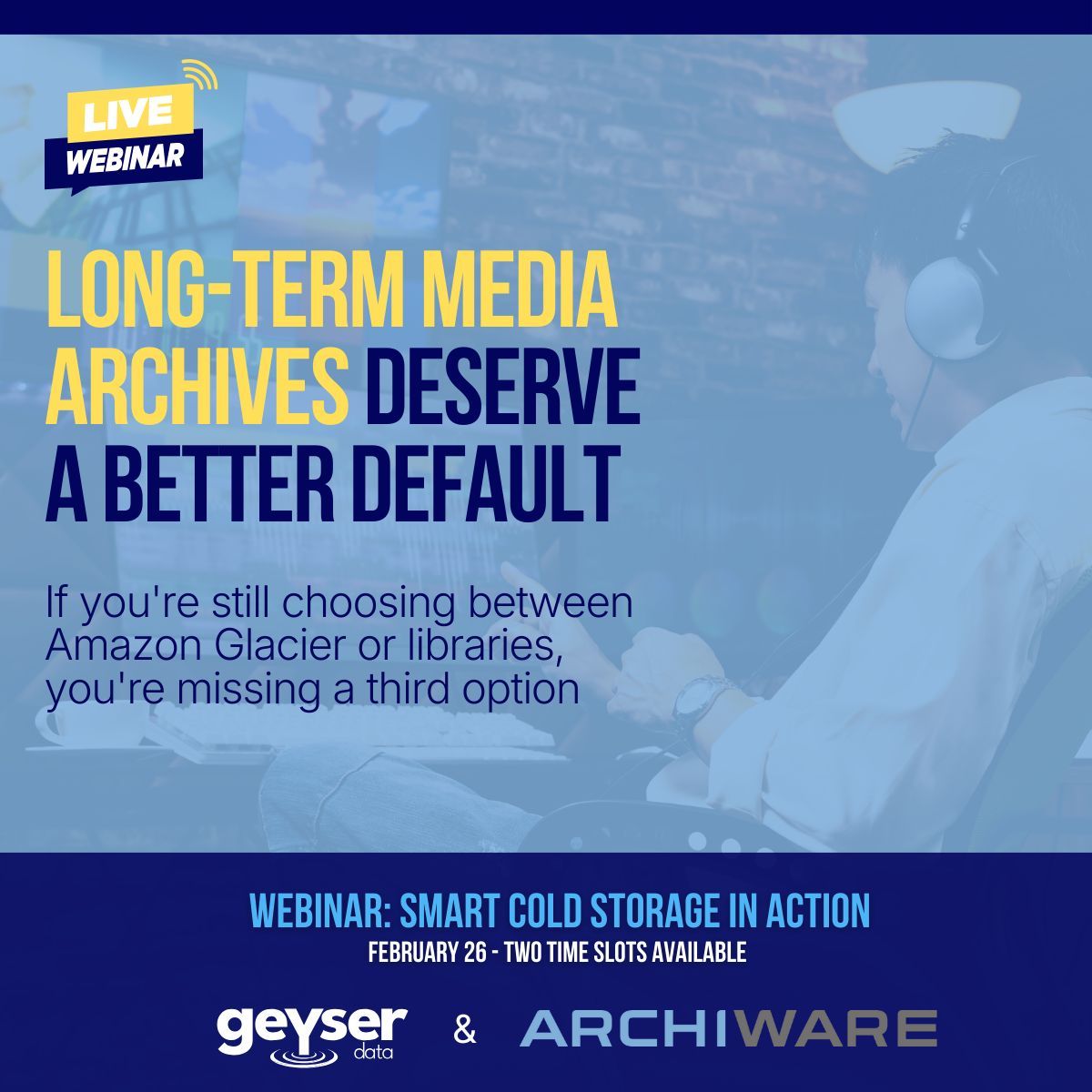
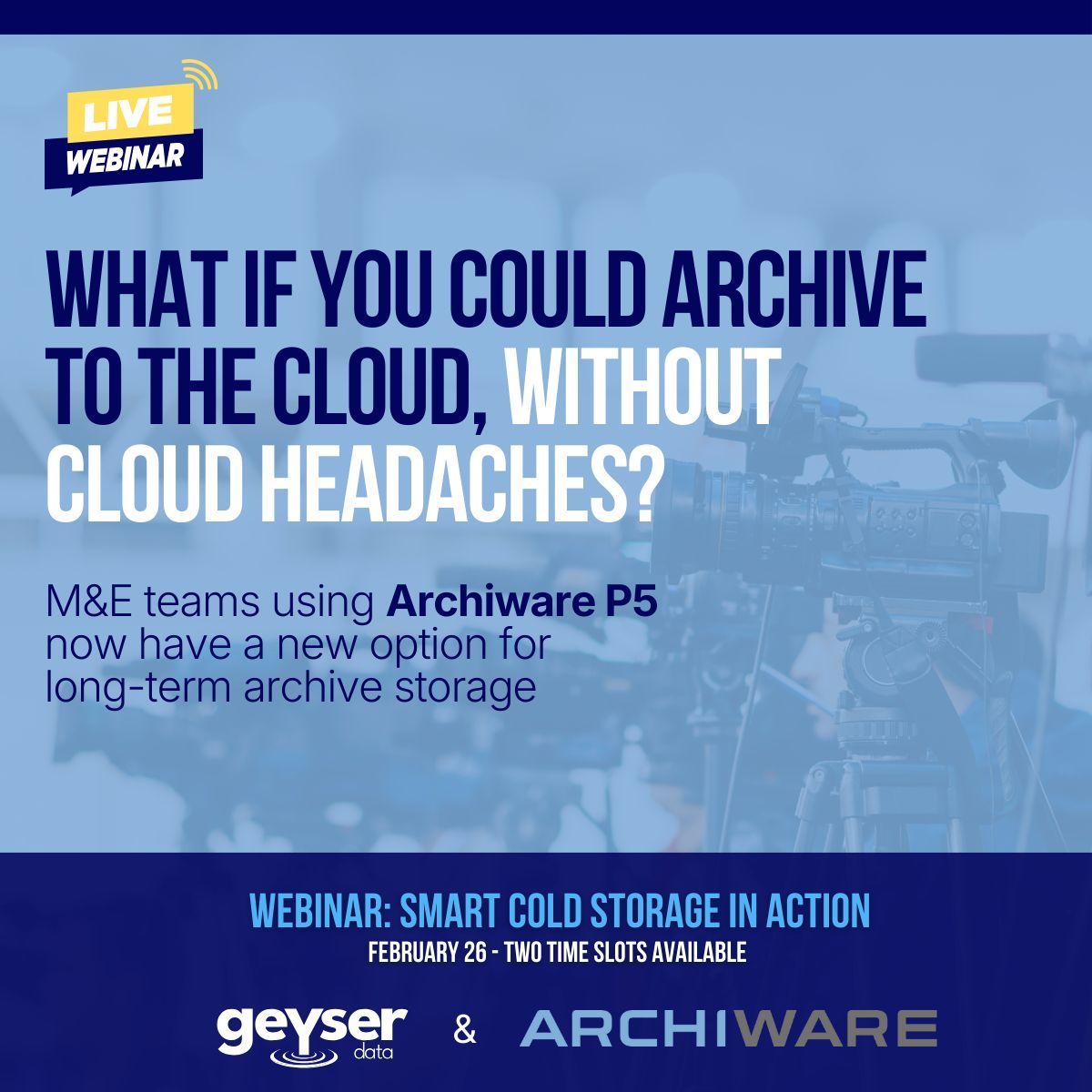
If you're in Media & Entertainment and deal with long-term storage, this session is one you don’t want to miss. Join Manjusha (COO, Geyser Data) and David (Solutions Manager, @Archiware) for a live webinar. It’s happening tomorrow
👉 https://t.co/bXY9dTudMK
In this live webinar, @Archiware and Geyser Data will show how you can:
🎬 Use P5 Archive to move media into S3-compatible cold storage
📂 Keep files indexed and accessible
🚫 Say goodbye to restore fees and infrastructure complexity
👉 https://t.co/bXY9dTudMK
Creative teams in M&E need archives they can trust — without complex restore workflows or budget surprises. That’s why @Archiware and Geyser Data are teaming up for a webinar on a better way: 🎥 See the demo and get your questions answered:
https://t.co/bXY9dTudMK
If you use @Archiware P5 Archive, you now have a new path for long-term media storage.
It’s all covered in this live webinar with Geyser Data and Archiware.
📅 February 26 — save your seat: https://t.co/bXY9dTudMK
Amazon Glacier looks affordable — until you need to retrieve content.
For M&E teams with high-volume footage and long-term storage, access costs add up fast.
🎬 Join us for the full workflow walkthrough:
https://t.co/bXY9dTudMK
Managing an on-prem library gives you control — but also infrastructure, support, and cost headaches. This webinar introduces a new option: Use @Archiware P5 Archive to write directly into Geyser’s cloud-based cold storage —
📆 Learn more on February 26: https://t.co/bXY9dTudMK
M&E teams don’t just store data — they return to it constantly.
So why is archive access still so expensive and unpredictable?
Join @Archiware and Geyser Data for a webinar exploring a new archive model:
🎬 See what’s possible: https://t.co/bXY9dTudMK
What if your archive could be affordable and accessible?
If you work in media or post-production, this is for you.
📅 February 26 — choose your time
👉 https://t.co/bXY9dTudMK
If your archive looks good on paper but feels stressful in practice, that’s worth paying attention to.
If you want to talk through how your archive actually behaves in the real world, let’s talk.
Read the full post:
https://t.co/tKYZ6GNldW
Most infrastructure teams aren’t chasing the lowest number on a pricing page.
They’re chasing confidence, predictability, and systems that behave the way they expect when it matters.
That mindset is at the core of this post.
https://t.co/tKYZ6GNldW
Media & Entertainment teams often face two archive choices:
📦 The public cloud — with unpredictable fees
📼 On-prem libraries — with infrastructure overhead
🎬 Register now: https://t.co/bXY9dTudMK
This isn’t about avoiding AWS, Azure, or GCP.
It’s about removing uncertainty from archive access so teams aren’t afraid to retrieve their own data.
That architectural shift changes how an archive is actually used.
https://t.co/tKYZ6GNldW
Archive systems aren’t just technical.
They shape how people behave when timelines are tight and stakes are high.
When access feels risky or expensive, workarounds appear, and costs creep back in.
More on that dynamic here:
https://t.co/tKYZ6GNldW
Audits, compliance reviews, and legal requests are often when teams truly discover how their archive behaves.
Unfortunately, that’s also when delays and access fees hurt the most.
I break this down in more detail here:
https://t.co/tKYZ6GNldW
If you use @Archiware P5 Archive, there's a new way to extend your workflow — without changing how you work.
Join us for a live demo + platform walkthrough.
📍 Save your spot: https://t.co/bXY9dTudMK
In infrastructure, surprise costs are rarely cheaper in the long run.
Predictable pricing almost always wins once systems move from theory into production.
This is especially true for long-term archives.
https://t.co/tKYZ6GNldW
Cloud access is easy. Tape is economical. What if you didn’t have to choose? Join us for a live webinar where @Archiware and Geyser Data will show how to bridge the gap — using P5 Archive
📅 February 26 — 2 live time slots
🎬 Register here: https://t.co/bXY9dTudMK
If engineers hesitate to retrieve archived data because of fees, delays, or approvals, that’s not a process issue.
It’s a signal from the architecture.
Here’s why that pattern shows up so often in cloud archive designs.
https://t.co/tKYZ6GNldW
Amazon Glacier works exactly as designed.
So do archive tiers from Azure and GCP.
The challenge is what happens when your archive is optimized solely for storage costs, without accounting for real-world access patterns.
https://t.co/tKYZ6GNldW
Most archive strategies focus on storage cost per GB.
Very few account for what happens the first time someone actually needs the data back.
Restore fees, delays, and operational friction are where archive decisions start to hurt.
Full perspective here:
https://t.co/tKYZ6GNldW