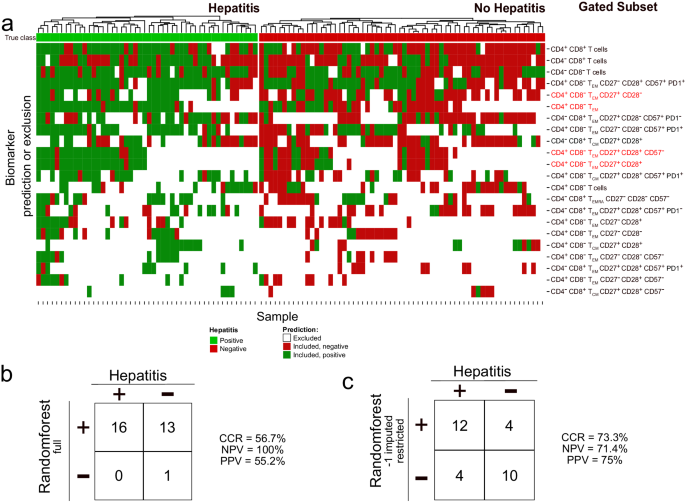
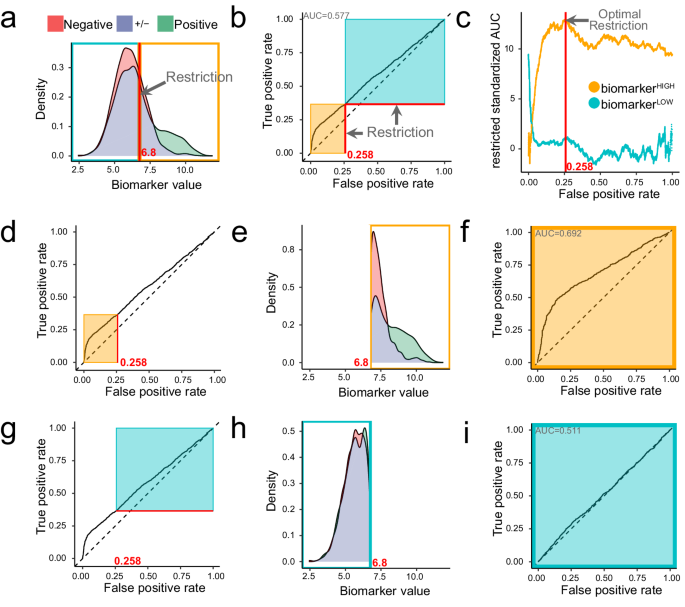
Restriction also helps with intraclass heterogeneity. An unanticipated consequence of restriction is that disease biomarkers with a bimodal distribution in the positive class, such as might arise from multiple aetiologies, are findable.
#biomarkers#predictive_models#ROC_curve
Restriction is a procedure that splits datasets into classifiable and unclassifiable samples to define a biomarker’s informative and uninformative ranges.
Our new paper in Nat Comms tackles the special challenge of unequal variability between classes for immune biomarker discovery and interpretation. We introduce Dataset Restriction as a solution that can be extended to any classification task.
https://t.co/RSfD5PlM3r
We successfully applied restriction to flow cytometric, mass cytometric, transcriptomic, microbiomic and proteomic data in advanced melanoma, so you might really want to try this out in your own data!
Restriction overcomes this problem by separating classifiable and unclassifiable samples, generally leading to better predictive models. Our research unveils new biomarkers and significantly improves predictions for immunotherapy-related risks.
I'm thrilled to announce that our work on dataset restriction has just been published today! 🎉 https://t.co/S1CSokm9xQ
This innovative method identifies patient heterogeneity as a major roadblock for biomarker identification and interpretation.
#bio#Bioinformatics#DataScience
New Research: External validation of biomarkers for immune-related adverse events after immune checkpoint inhibition: Immune checkpoint inhibitors have revolutionized treatment of advanced melanoma, but commonly cause serious immune-mediated… https://t.co/8CApNj9dGy #immunology
Independent reproducibility studies are the scientifically rigorous way to validate and compare the discriminatory value of biomarkers https://t.co/NrAL5UJ4gW