Short pairs of biographies from 500AD to now, modern lives in Plutarch's style. Human in the loop, Grok doing the work to gather source, assemble and compare.
An outcast boy left to die on the steppe became the khan who remade Eurasia. The first life of Modern Parallel Lives: Genghis Khan, every claim sourced. Spot an error? Reply with your own source and if we find it more truthful I'll correct it in public. https://t.co/ULQs4WENKr
Richard the Lionheart's ransom was set at 150,000 marks, two to three times the English crown's annual revenue.
Sailing home from the crusade in October 1192, he was driven into the Adriatic by storms and tried to cross Germany in disguise. Shortly before Christmas he was captured near Vienna by Duke Leopold of Austria, who had not forgotten Acre, and was handed over to the emperor Henry VI. Pictured: his capture, in a manuscript of about 1196.
At Speyer in March 1193 he defended himself before the imperial court so eloquently that, according to several chroniclers, his hearers wept.
England paid with a levy of a quarter of revenues and movables, the wool of the Cistercians and the plate of churches. He was released at Mainz on 4 February 1194.
The famous rescue is not in the record. The story that his minstrel Blondel found him by singing beneath castle windows first appears in a French collection of tales written about 1260. No contemporary source supports it.
From Richard the Lionheart, Modern Parallel Lives, Book 1, Pair 2.
In January 1079 William the Conqueror was knocked off his horse by his own eldest son.
Robert Curthose, 'short-boots', had long been acknowledged as heir to Normandy, but was given no real power there. In 1077 or 1078 a brawl at L'Aigle, in which his younger brothers William Rufus and Henry emptied water over him from a gallery, sparked open revolt.
Robert fled, and Philip I of France gave him the border castle of Gerberoy. There William besieged his son. In a sally Robert unhorsed and wounded his father, apparently without recognising him. Rufus was wounded too, and an Englishman, Toki son of Wigod, was killed bringing the king a fresh horse. William raised the siege.
Matilda, who had secretly sent Robert money, brokered a reconciliation in 1080. After her death in 1083 Robert left again, and he was absent when his father died.
William had subdued a kingdom and could not command his own household.
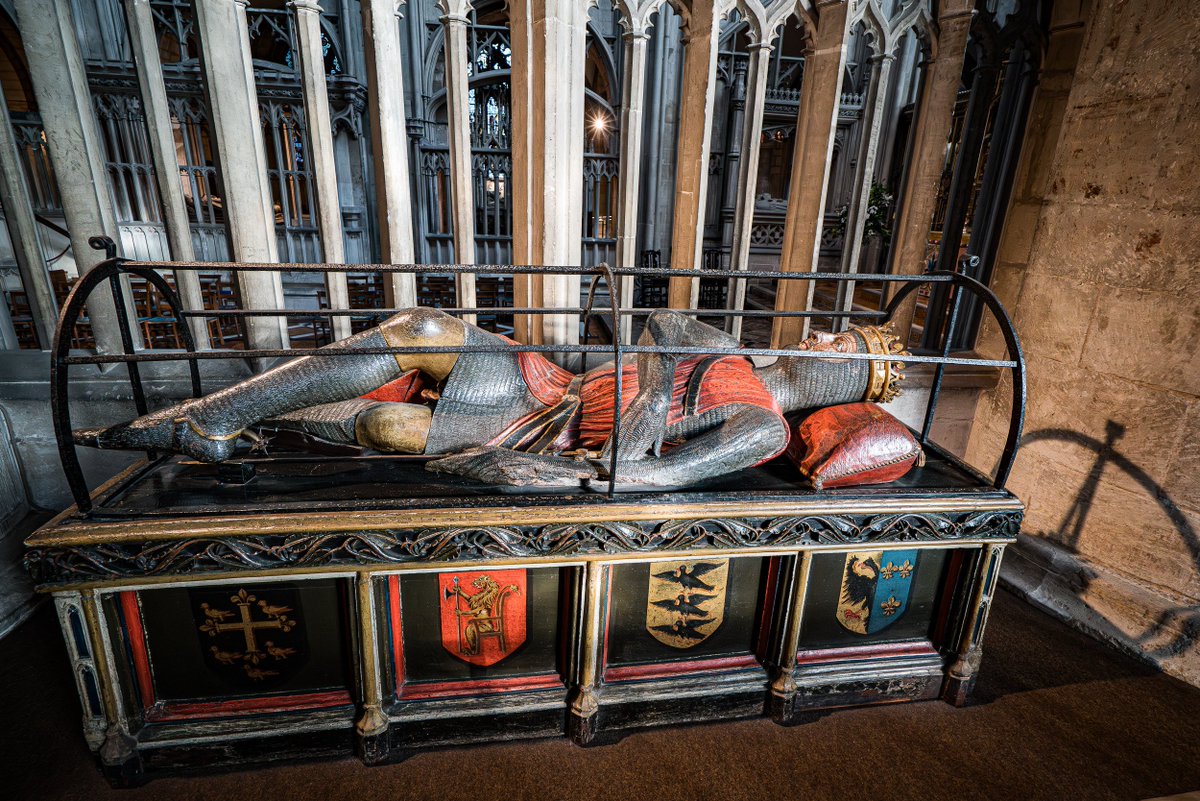
Pictured: Robert's effigy in Gloucester Cathedral, carved long after his death. Photo: Brian Deegan, CC BY-SA 2.0.
From William the Conqueror, Modern Parallel Lives, Book 1, Pair 1.
Check the source: what Pyrrhus actually said after Asculum.
King Pyrrhus of Epirus has beaten the Romans again, and someone congratulates him. In Bernadotte Perrin's Loeb translation, 'we are told that Pyrrhus said to one who was congratulating him on his victory, "If we are victorious in one more battle with the Romans, we shall be utterly ruined."'
Note 'we are told'. And look at what Plutarch sets just before it: two sources that disagree. Hieronymus says the Romans lost 6,000 men and, citing the king's own commentaries, that Pyrrhus lost 3,505. Dionysius knows of no two-day battle and no admitted Roman defeat, and puts the dead on both sides at over 15,000.
Plutarch then explains the remark. Pyrrhus had lost a great part of his army and nearly all his friends and generals, while the Roman army refilled 'as if from a fountain gushing forth indoors'.
Plutarch never uses the phrase 'Pyrrhic victory'. That came much later.
Pyrrhus 21.8–10.
Photo: Marie-Lan Nguyen, CC BY 2.5
Myth vs Record: Cortés never burned his ships.
Myth: in 1519, on the coast of Mexico, Hernán Cortés set fire to his fleet so that no one could turn back.
Record: the eyewitness accounts, his own included, describe the ships as stripped of their gear and run aground, or holed and sunk. There is no fire. The burning first appears in a flattering dedication of 1546 and in later sixteenth-century retellings, and became proverbial.
Cortés had sailed in defiance of the governor of Cuba, Diego Velázquez, and Velázquez's supporters in the expedition wanted to return. Disabled ships meant no going back.
He had already done the legal work. At Veracruz he founded a town whose newly appointed council released him from Velázquez's authority and made him answerable directly to the crown.
The truth is less romantic and more interesting: not a grand gesture but calculated sabotage, presented to his men as a necessity. The engraving pictured gets it right. Its caption reads, in French, 'ships of Cortés stripped and run aground by his orders'.
From Hernán Cortés, Modern Parallel Lives, Book 1, Pair 7.
What did Buckingham Palace know before the Dismissal?
On 11 November 1975 the Governor-General, Sir John Kerr, dismissed Gough Whitlam's Labor government during a deadlock over supply, and appointed Malcolm Fraser caretaker prime minister. Afterwards the Queen's private secretary told the Speaker that the Queen had no part in decisions which the Constitution placed in the Governor-General's hands.
The 'Palace letters' between Kerr and the Palace came out only in 2020, after Jenny Hocking won her case in the High Court.
They show that Kerr discussed the possibility of dismissal, and the reserve powers, with the private secretary, Martin Charteris, in the months before. They do not show that the Queen or the Palace instructed him. Kerr wrote that he acted 'without informing the Palace in advance'.
What they mean is still argued. Hocking sees involvement at odds with the Palace's claims; Anne Twomey, and Paul Kelly and Troy Bramston, see a Governor-General who acted alone.
Pictured: the Queen at Parliament House, Brisbane, March 1954.
From Queen Elizabeth II, Modern Parallel Lives, Book 1, Pair 8.
Two lives, one question: is a realm made safe by pushing its frontiers outward, or by drawing a line around it?
Mehmet II answered with conquest. He spent thirty years at war, doubled his empire, and opened his capital to Greeks, Jews, Armenians and Italians, provided they served the sultan.
Tokugawa Ieyasu is usually given the opposite answer: isolation. But he was no isolationist. He traded with the Dutch, the English and the Spanish, licensed Japanese merchant ships to Southeast Asia, and restored relations with Korea. The seclusion edicts came under his grandson Iemitsu, in the 1630s.
The detail I keep coming back to: 'sakoku', 'closed country', was never the shogunate's word. It was coined in 1801 by the translator Shizuki Tadao, rendering part of Engelbert Kaempfer's account of Japan. Even then Japan kept four controlled gates to the outside world.
What Ieyasu did establish was the principle beneath it all: every contact with the outside world was the shogun's to permit or forbid.
From the comparison in Modern Parallel Lives, Book 1, Pair 6.
And the half-brother who did get the throne, Cleomenes, died without a son, so Leonidas married his daughter Gorgo (Herodotus 7.205). Plutarch keeps her best line: told by a foreign woman that Spartan women were the only ones who ruled their men, she is said to have answered, 'Yes, we are the only ones that give birth to men' (Lycurgus 14).
Plutarch's version runs on tears rather than seating plans. After Alexander gave his guard posts to Persians, the Macedonians came to his tent unarmed, in their tunics only, and stood weeping at his door for two days and nights. On the third day he came out, wept at the sight of them, then sent the unfit home with magnificent gifts (Alexander 71). The table, Macedonians nearest and Persians next, is Arrian's (7.11).
The emperor who could not read, and left a library of some 24,000 books.
Akbar, Mughal emperor from 1556 to 1605, never learned to read or write, despite a succession of tutors. His court historian, Abul Fazl, presented this as a sign of divine gifts: Akbar's knowledge came from God rather than books. Others put it down to a disordered childhood (as an infant he was passed between warring uncles) and a love of the hunt.
He made up for it with a prodigious memory and with books read aloud to him every day. By the end of his life his library held some 24,000 volumes. The figure comes from an inventory reported after his death, so treat it as approximate.
His translation bureau rendered the Mahabharata and the Ramayana from Sanskrit into Persian.
His son Jahangir, who had rebelled against him, later wrote that Akbar conversed with the learned so well that no one could tell he could not read. Pictured: Jahangir holding a portrait of his father, c. 1614.
From Akbar the Great, Modern Parallel Lives, Book 1, Pair 4.
Two lives, one question: in a national crisis, is the greater virtue to give power up, or to take more of it?
George Washington's greatness lay in what he would not do. He resigned his commission to Congress in December 1783 and left the presidency after two terms, a precedent that held until 1940.
Abraham Lincoln's lay in what he would do. He suspended habeas corpus, at first without the authority of Congress; his administration held at least 13,000 civilians (estimates run much higher) by military authority; he freed the slaves of the rebel states by proclamation, as a war measure.
Yet on 23 August 1864, expecting defeat, Lincoln wrote: 'This morning, as for some days past, it seems exceedingly probable that this Administration will not be re-elected.' He pledged to cooperate with the winner to save the Union, then folded the note and had his cabinet sign the outside without reading it.
He held an election in the middle of a civil war, and was prepared to lose it. That may be the most Washingtonian act of his life.
From the comparison in Modern Parallel Lives, Book 1, Pair 9.
Alexander affected not to care. When news came that Antipater had crushed Agis at Megalopolis, Alexander joked to his men that while they were beating Darius, there had been 'a battle of mice' back in Arcadia (Plutarch, Agesilaus 15). Diodorus says Agis, too wounded to stand, fought on from his knees until he was cut down (17.63).
Pompey had set the record only a few years before: ten days for the war against Mithridates, on Cicero's motion. Caesar's fifteen for the Belgae in 57 BC broke it, and Plutarch notes it was longer than for any earlier victory (Caesar 21). Cicero got a thanksgiving too, for crushing Catiline's plot, and never let anyone forget he was the first civilian, a man in a toga, to be so honoured.
Plutarch shows Caesar doing both. In Gaul, with the army wavering before Ariovistus, he said he would march with the Tenth Legion alone, and the Tenth sent him thanks (Caesar 19). Years later, facing mutinous legions in Italy, he addressed them as 'citizens' rather than 'soldiers' (Caesar 51). Suetonius adds that they at once protested they were his soldiers and followed him to Africa (Julius 70).
Check the source: the voter who asked Aristides to write 'Aristides'
Plutarch's best-known story about Aristides 'the Just' is set at an ostracism vote in Athens in the 480s BC. In Bernadotte Perrin's Loeb translation:
'it is said that an unlettered and utterly boorish fellow handed his ostrakon to Aristides, and asked him to write Aristides on it.'
When Aristides asked what wrong he had done the man, 'None whatever,' was the answer, 'I don't even know the fellow, but I am tired of hearing him everywhere called "The Just."' Aristides wrote his own name and handed it back.
Note Plutarch's hedge, 'it is said'. He was writing nearly six centuries later.
The physical record is real, though. Potsherds bearing Aristides's name survive in the Agora Museum in Athens (pictured). And a well on the north slope of the Acropolis yielded 190 ostraka against Themistocles, written in about fourteen hands, apparently prepared in advance for voters to use.
Aristides 7.5–6. The whole chapter, including how the votes were counted, is short and worth reading.
Photo: Giovanni Dall'Orto, Wikimedia Commons
Myth vs Record: the most famous broadcast of Charles de Gaulle's life was one that few people heard and the BBC never recorded.
Myth: on 18 June 1940 he told France, 'France has lost a battle! But France has not lost the war!'
Record: that line is not in the broadcast of 18 June. It comes from a poster composed later and put up in London at the beginning of August 1940.
No recording of 18 June survives. The voice usually played on anniversaries is from his broadcast of 22 June. The text was also changed before it went to air, at the insistence of the British cabinet, which did not yet want to break with Pétain's government, so the version later printed, including in his Memoirs, is not quite what was heard.
What he did say that evening was that 'whatever happens, the flame of French resistance must not and shall not be extinguished'.
Few in France heard it. Its meaning was conferred by what followed. Had Britain made peace in 1940, it would be a footnote.
From Charles de Gaulle, Modern Parallel Lives, Book 1, Pair 5.
On 20 March 1942, at Terowie railway station in South Australia, Douglas MacArthur told reporters: 'I came through and I shall return.'
He had left Corregidor by PT boat on 11 March, on Roosevelt's orders, with his family and staff, and flown to Australia. On 1 April, before Bataan and Corregidor fell, he was awarded the Medal of Honor, partly to counter Japanese propaganda about his departure. Bataan surrendered on 9 April and Corregidor on 6 May.
For a Brisbane reader there is a nearer trace. From July 1942 to November 1944 his General Headquarters for the South West Pacific Area was in the AMP building in Queen Street, and his name is still on it.
His communiqués from those years need careful reading. They were notorious for claiming credit and minimising the part played by others, including the Australians who did much of the fighting in New Guinea.
From Douglas MacArthur, Modern Parallel Lives, Book 1, Pair 14.
Two lives, one question: can a soldier's virtues be judged apart from the cause he serves?
John Monash and Erwin Rommel both rose from outside the officer class: one a citizen soldier and the son of Jewish immigrants, the other a schoolmaster's son from Württemberg in an army run by Prussian aristocrats. Monash planned his battles like orchestral scores, to use his own image; Rommel led from the front and improvised.
Rommel's rise owed much to Hitler's favour and Goebbels's publicity, and he served the regime willingly until late in the war. Monash survived a campaign, coloured by antisemitism, to block him, and served a democracy without seeking political power.
Monash died in his bed in 1931 and was buried before a crowd of perhaps a quarter of a million in Melbourne. Rommel was forced to take poison in 1944 by emissaries of the regime he had served, which then gave him a state funeral.
In the craft of war, I would call it close. On virtue and cause, it isn't.
From the comparison in Modern Parallel Lives, Book 1, Pair 15.
Photo (Rommel): Bundesarchiv, Bild 146-1977-018-13A / Otto, CC BY-SA 3.0 DE
Check the source: what Plutarch said he was doing
The opening of his Alexander is the nearest thing Plutarch gives us to a mission statement. In Bernadotte Perrin's Loeb translation (1919):
'For it is not Histories that I am writing, but Lives; and in the most illustrious deeds there is not always a manifestation of virtue or vice, nay, a slight thing like a phrase or a jest often makes a greater revelation of character than battles where thousands fall, or the greatest armaments, or sieges of cities.'
He goes on to compare himself with a portrait painter, who takes the likeness from the face and the eyes and pays little attention to the rest of the body.
It is a useful warning. Plutarch is not giving us the full military record of Issus or Gaugamela; he is looking for the telling moment. Where his stories are our only source, they deserve the care we would give any anecdote.
Alexander 1.1–3. The passage is short and worth reading in full.
Hastings at least had better crowd control: Bishop Odo, club in hand, 'confortat pueros', cheering on the lads. Did you catch the men pointing up at Halley's Comet? 'Isti mirant stella(m)', these men marvel at the star. It sits just after Harold's crowning, about as clear an omen as anyone could stitch.
On 26 and 27 July 1822 the two great liberators of South America, José de San Martín and Simón Bolívar, met privately at Guayaquil. There were no witnesses or secretaries, and no record of what they said survives. San Martín left that night, after a ball.
The earliest account is a memorandum sent two days later by Bolívar's secretary. San Martín's own statements were brief and late: Bolívar had not believed in his sincerity, would not accept his offer to serve under him, and there was not room in Peru for both of them.
A letter in which he supposedly told Bolívar he would leave Peru so that Bolívar could finish the war was published only in 1843–44, and the original has never been found. Argentine historians have generally accepted it; some Venezuelan and Colombian historians have called it a forgery.
What is certain is what followed. On 20 September 1822 San Martín resigned his powers to the Congress of Peru and left the country that night.
From José de San Martín, Modern Parallel Lives, Book 1, Pair 10.