Anthropic just dropped the advisor strategy as a native API tool → smaller models (Sonnet/Haiku) now escalate to Opus only when stuck, not end-to-end.
Key unlocks:
- Sonnet + Opus advisor: 2.7pp improvement on SWE-bench while cutting cost 11.9%
- Haiku + Opus advisor: 41.2% on BrowseComp (vs 19.7% solo), costs 85% less than Sonnet solo
- Single /v1/messages request, no context management, tokens billed separately
- Set max_uses to control advisor calls per task
Limitation: Advisor generates only short guidance (400-700 tokens), so it's not suitable for tasks requiring deep iterative refinement at frontier intelligence—works best for clear decision points the executor can't resolve alone.
How are you thinking about the trade-off between Sonnet solo vs Sonnet+advisor for your agentic workflows?
Read more here: https://t.co/T2zZ4cr1E6
Claude Managed Agents just launched (public beta) → agents go from prototype to production in days, not months
Key unlocks:
- Production infrastructure handled: sandboxing, checkpointing, credentials, permissions baked in
- Long-running autonomous sessions that persist across disconnections
- Multi-agent coordination (research preview) so agents can delegate to other agents
- Built-in session tracing + analytics in the console to inspect every tool call and failure
Limitation: Currently requires managed-agents-2026-04-01 beta header; some features (outcomes, multiagent, memory) still in research preview, need access request
How are you planning to use this—code generation, document processing, or something else?
Read more here: https://t.co/iNCmuIA8Bt
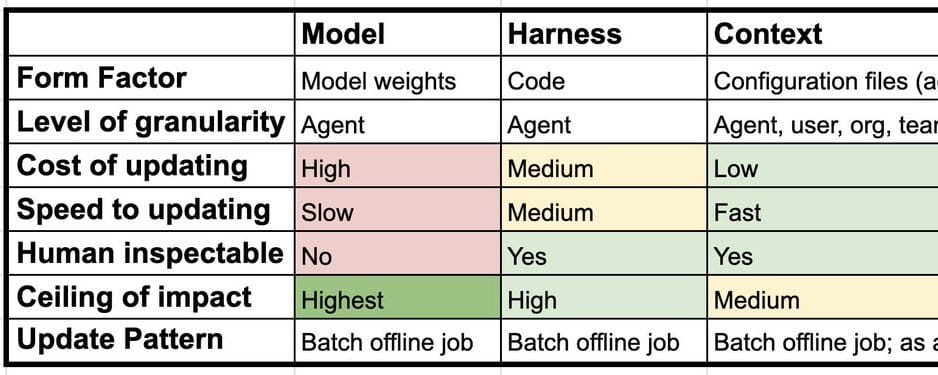
Most people think continual learning for AI agents means updating model weights. Wrong layer.
Agentic systems learn at three distinct layers:
- Model: the weights themselves
- Harness: the code/instructions that power the agent
- Context: configuration (memory, skills, instructions) outside the harness
This changes everything about how you build systems that improve over time.
Key unlocks:
- Harness optimization (like Meta-Harness) extracts insights from execution traces and improves the agent code itself — often faster ROI than retraining
- Context learning at multiple levels: agent learns its own memory, users get personalized context, orgs accumulate shared knowledge
- Traces are the foundation — LangSmith captures full execution paths, then a coding agent can analyze them to suggest improvements
- You can mix all three: agent-level + user-level + org-level context updates simultaneously
Limitation: Most implementations optimize at the agent level. Per-user harnesses or LoRAs remain theoretically sound but practically rare — the overhead currently outweighs benefits for most systems.
Where's the bottleneck in your current setup — is it the model, the harness logic, or the context configuration?
Read more here: https://t.co/eYfvZVz6v1
Browser Use CLI just went open source → direct browser control from your terminal without leaving the dev environment.
Key unlocks:
- ~50ms latency persistent daemon keeps browser alive between commands
- Three modes: managed headless Chromium, real Chrome with profiles, cloud-hosted via API
- Full state inspection (clickable elements numbered), screenshot, JavaScript execution
- REST passthrough to Browser Use API v2/v3 — anything in the dashboard is accessible from CLI
- Cloudflare tunnel integration to expose local dev servers to cloud browsers
Limitation: extract command (LLM-based data extraction) not yet implemented. JavaScript eval and manual element indexing are the current patterns.
What's your primary use case — automation testing, web scraping, or agent task orchestration?
Read more here: https://t.co/u7uCK9gq7F
What this means for agent architecture:
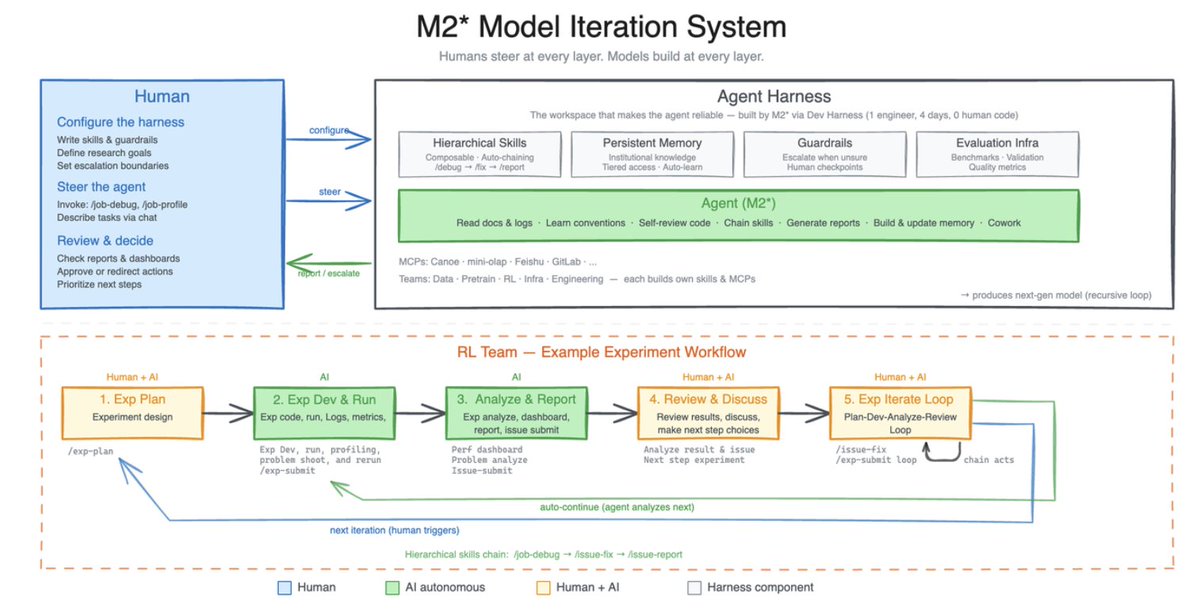
The boundary between model and harness is blurring. M2.7 doesn't just execute tasks within a harness — it rebuilds the harness itself based on feedback and results.
Future agentic systems won't separate "dumb model + smart harness." Evolution becomes bidirectional.
Read more here: https://t.co/LCeMQqXcUD
MiniMax M2.7 just dropped and the architecture shift is significant: it's the first model deeply participating in its own evolution through autonomous agent harnesses.
Not just iterating on benchmarks. The model is building its own skills, optimizing its own scaffolds, and running 100+ autonomous loops to improve itself.
Thread 👇
Limitation: the autonomous loop is still guided.
While M2.7 runs 100+ optimization iterations autonomously, it's working within constrained environments (internal scaffolds, defined evaluation sets). Full end-to-end autonomy across data construction, training, inference, and evaluation — still early exploration phase.
Also: no public benchmarks yet on these self-evolution metrics. Internal testing only.
Mistral just launched Forge → enterprises can now train frontier-grade models on proprietary data instead of relying on generic, publicly-trained LLMs.
Key unlocks:
- Pre-training + post-training + reinforcement learning pipelines on internal datasets
- Support for dense and MoE architectures (optimize for latency, cost, performance)
- Agent-first design: autonomous systems can fine-tune models, find hyperparameters, generate synthetic data
- Continuous evaluation against internal benchmarks before production deployment
- Models learn internal terminology, workflows, compliance rules, operational constraints
Limitation: requires substantial internal data volume and governance infrastructure to be worthwhile. Not a plug-and-play solution for smaller orgs.
For enterprises building agentic systems: this shifts the game from "which model should we use" to "what institutional knowledge do we encode." What's your primary bottleneck: data prep, infrastructure, or governance?
Read more here: https://t.co/YsoLeAJkG4
Claude #Dispatch just launched (research preview) → you can now assign tasks to Claude from your phone and it executes on your Mac Key unlocks:
- Single persistent thread syncs across phone + desktop
- Claude accesses your local files, Slack, email, Google Drive from mobile
- Works with all connectors and plugins already in Cowork
- Outputs delivered back to your phone (spreadsheets, reports, etc)
Limitation: Mac must stay awake with Claude Desktop app running. No proactive notifications when tasks complete. Currently ~50% success rate on complex actions—still in research preview territory. What's the first task you'd dispatch from your phone to your desktop?
AI amplifies expertise gaps instead of closing them.
Senior consultants using GenAI are pulling further ahead of junior staff. Why? Because judgment—knowing which outputs to trust, which to discard, which to refine—is built on experience.
Key unlocks:
- Experience teaches pattern recognition. GenAI outputs become useful only when you can evaluate them
- Juniors lack the baseline knowledge to spot hallucinations or surface-level suggestions
- The gap widens: experts iterate AI 10x faster because they know what good looks like
- Training on domain becomes critical—GenAI won't bridge inexperience, it exposes it
Limitation: This creates a structural problem for orgs scaling junior talent. GenAI adoption without intentional mentorship accelerates attrition and slows knowledge transfer.
How are you seeing judgment gaps play out in your team—is AI closing or widening them?
Read more here: https://t.co/O3WdNoqhoE
For leaders building high-performance teams:
Stop asking "How do we improve talent?"
Start asking "What is our system teaching people every day?"
Which of your routines actually shape behavior vs. just fill calendars?
Most CEOs invest heavily in talent and culture but miss how elite performance actually works
It's not about hiring A-players or launching culture programs
It's about designing systems where excellence becomes unavoidable
Thread 👇
Limitation: This approach requires sustained CEO ownership and patience
Most organizations treat talent, culture, and execution as separate structural problems
Rewiring them as one interconnected system demands uncommon coordination across business units