FYI: Teenage girls here in San Diego are wearing short shorts with their butts hanging out and short cropped shirts with half of their breasts showing. We live in Babylon. Don’t allow your daughter to dress like Babylonians (harlots).
🚨#BREAKING: Outrage is erupting after a 22-year-old who runs into BURNING BUILDINGS as a volunteer firefighter was told he isn't qualified to be a paid firefighter...
...because he was HOMESCHOOLED.
Then the city changed the job posting to cover it up.
His name is Andrew Coates. He's 22 years old, in Nebraska.
Right now, today, he runs into burning buildings as a volunteer firefighter for Cedar Bluffs Fire. He is a state-licensed EMT.
He is doing the job. For free.
All he wanted was to get PAID to do it. In his words: "Make a career out of it would be the goal. To get paid to do what you love."
So he applied to the Fremont Fire Department.
And in April, the city rejected him. Why?
Because his high school diploma says he was homeschooled.
That's it. That's the whole disqualification.
Not his EMT license.
Not his fitness.
Not his record.
Not his experience pulling people out of fires ALREADY!!
...how he was educated.
The job posting he applied to said "graduation from high school."
That's all it said.
He graduated high school.
He has a diploma.
And AFTER they rejected him, the city went back and added the word "accredited" to the job description.
His own fire chief, the man who has watched Andrew work, showed up to defend him:
"I feel the city of Fremont is really missing out here, and in my mind, because of his homeschooling, you guys are discriminating against him."
Over THIRTY homeschool families showed up to stand behind this kid.
And the Civil Service Commission? They said it isn't their job to touch city policy.
Homeschoolers are literally a generation of kids who read ABOVE grade level, who work with their HANDS, who volunteer in their communities, who show up for their neighbors.
And this young man is the proof.
At 22, he's a certified EMT and a volunteer firefighter, while plenty of his peers are on a couch.
When your house is on fire at 3 a.m., I promise you will not ask the man dragging your children out where he went to high school.
You will not ask if his diploma was accredited.
You will thank GOD he came.
Andrew isn't even fighting for himself anymore. His words:
"I think now it's turned into we want to make sure that every homeschooler has an equal opportunity."
That's a better man than the policy that rejected him.
Fremont, you have a licensed EMT and an active firefighter begging to serve your city. And you turned him down over paperwork, then rewrote the paperwork to cover it.
Fix this.
Hire him!!!!!!!
Deep sleep repairs your body. REM sleep processes your emotions and consolidates memory.
You need both, and most sleep trackers lump them together like they're interchangeable.
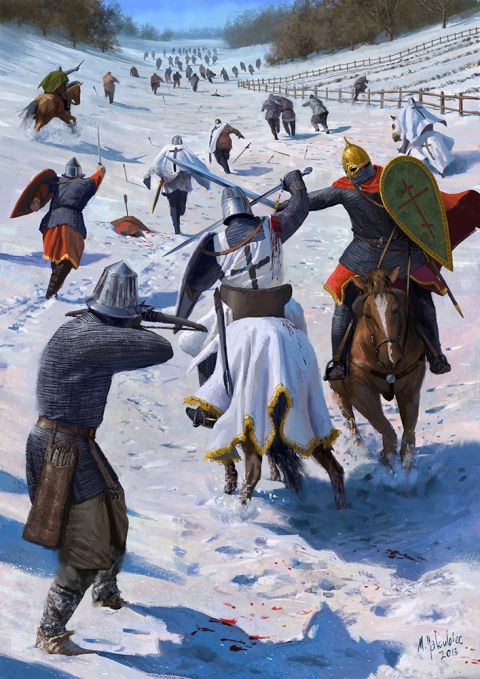
September 20, 1260. The Old Prussians rose against the Teutonic Order in a war they nearly won, and losing it erased them so completely that the word Prussia now means Germans.
That last sentence is the whole point of this post, so hold on to it.
The Old Prussians were a Baltic people, related to Lithuanians and Latvians, with their own language and their own religion, living along the southeastern Baltic coast. They were not Slavs and they were not Germans.
From about 1230 the Teutonic Order came to conquer and convert them, and by 1242 had broken five of the seven main Prussian clans. They did it by building stone castles and holding river lines rather than chasing Prussians through forest, because armoured knights beat Prussian warriors in the open and lost to them in the trees.
Then in July 1260 the Order was smashed at Durbe by the Lithuanians and Samogitians, the worst defeat the Teutonic Knights took in the entire thirteenth century.
The Prussians saw the opening. On September 20 they rose.
And it very nearly worked. Each clan raised its own leader. The Natangians followed Herkus Monte, a man who had been taken as a boy, raised and educated in Germany as a Christian, and who came home and led the revolt against the people who had brought him up. The Bartians followed Diwanus. The Sambians followed Glande.
They besieged castle after castle. At the low point the Teutonic Order held five strongholds in the whole of Prussia. Balga, Elbing, Culm, Thorn and Königsberg.
Five castles.
Two things beat them.
There was no single commander. Each clan fought its own war in its own territory, and the Pomesanians never joined at all. So the Order could be pressed everywhere and destroyed nowhere.
And from about 1265 German reinforcements began arriving in numbers, because the Order could draw on crusade recruitment across the whole of Christian Europe and the Prussians could draw on nobody. That asymmetry decided it. The Order could lose ten times and be resupplied. The Prussians could not afford to lose once.
Sambia dropped out. The clans were beaten one at a time. Herkus Monte was eventually caught and hanged. The uprising ended in 1274 when the Order took the rebel base at Heilsberg.
Fourteen years.
What followed was not a peace settlement. Prussians were enslaved in large numbers. The surviving nobility converted and was absorbed. Others fled to Lithuania or Sudovia. German settlers were brought into the emptied land in enormous numbers, deliberately and as policy.
The Old Prussian language survived in the countryside for a few more centuries and then died. The last speakers are thought to have gone sometime in the early 1700s. What survives of it is essentially a vocabulary list and a couple of catechisms.
The people were erased. Their name was not.
The territory went on being called Prussia. The German state that grew there kept the name. In 1701 its ruler became King in Prussia. That kingdom beat Austria, beat France, unified Germany under itself in 1871, and for the next seventy years Prussia was a byword for German military power across the world.
Frederick the Great was not a Prussian. Bismarck was not a Prussian. Von Moltke was not a Prussian.
The actual Prussians lost this war and then had their name worn by the people who took their country, for six and a half centuries, until the Allies formally abolished the state of Prussia in 1947.
One last thing worth knowing. Historians of the Baltic generally credit this uprising with buying Lithuania the time it needed. Fourteen years of the Teutonic Order fighting for its life in Prussia is fourteen years it was not pushing north, and Lithuania used them to consolidate into a state strong enough to hold the Order off for two centuries and eventually break it at Grunwald.
The Old Prussians lost everything, including their name, and in losing it they saved their neighbours.
People frame the Rubicon like Caesar woke up one morning and decided to overthrow the Republic. The actual choice in front of him in January 49 BC was narrower and uglier than that.
His command in Gaul was ending. His enemies in the Senate, Cato above all, wanted him to give it up and come back to Rome as a private citizen. That sounds reasonable until you understand what it meant. A private citizen had no immunity. There were men waiting with charges going back to his consulship in 59 BC, when he had shoved legislation through over his colleague Bibulus and the auspices. Cato had already stood up in the Senate in 55 and proposed handing Caesar over to the Germans in chains for his conduct against the Usipetes and Tencteri. Conviction meant exile and the loss of everything he had spent thirty years building. Caesar said it himself, quoted by Asinius Pollio, who was standing next to him: if he had not appealed to his army they would have condemned him.
He tried to avoid it. A law carried by ten tribunes in 52 BC gave him the right to stand for consul in absentia, which would have let him move from command to office without a gap of vulnerability. He offered to give up Gaul and keep one province and one legion. Curio put a motion to the Senate that Caesar and Pompey disarm at the same time, and it passed 370 to 22. The consul Lentulus refused to let it go anywhere. On January 7 the Senate passed the final decree, and the tribunes Mark Antony and Quintus Cassius fled north to Caesar's camp in fear for their lives.
That is the moment. He had one legion with him, the Thirteenth. Crossing a boundary stream in arms was treason with no legal road back. Suetonius says he hesitated at the bank and told the men around him that they could still turn back, but once they crossed, everything would have to be settled by the sword. Then the line about the die.
So should he have done it?
If you are asking whether it was right for Caesar, the answer is obvious. He was fifty, he had the best army in the world, and the alternative was trial by men who had been trying to break him for a decade. He wrote in his own account of the war that he had always held his dignitas dearer than life. Take that seriously rather than as vanity. In Roman terms it was his entire public existence. He crossed, he won in four years, and he became the most famous man who ever lived in the ancient world.
If you are asking whether it was right for Rome, the bill is harder to look at. Pharsalus, Thapsus, Munda, Roman armies killing Roman armies from Spain to Egypt. His own murder five years later. Then another thirteen years of civil war that only ended at Actium in 31 BC. The Republic he claimed to be defending against a Senate faction never came back.
But the honest answer is that the Republic was already dying and everyone in the room knew it. The Senate house had burned down in 52 BC as a funeral pyre for a murdered politician. Street gangs decided elections. Sulla had marched on Rome twice, Pompey had helped him do it, and the men demanding Caesar disarm were perfectly happy to have Pompey keep his own legions in Spain. The precedent for solving Roman politics with an army was thirty years old and it was not Caesar who set it.
He did not kill the Republic at the Rubicon. He finished something other men had already opened up, and he did it better than they had.
Elon just gave a HUGE The Boring Company update
The Boring Company is now working on a simple precursor Hyperloop tunnel between Austin and San Antonio
Target speed: 200+ MPH
A trip that can currently take up to 2.5 HOURS because of traffic could be cut to a consistent UNDER 30 MINUTES
Austin → San Antonio
2.5 hours → <30 minutes
On the evening of the 20th of September 1066, Harald Hardrada must have felt unstoppable.
After a few celebratory meads he perhaps reflected on just how far he had come.
From being a young exile, he had risen to become commander of the Varangian Guard, and eventually King of Norway.
He had led armies in the Holy Land, Bulgaria, Sicily, Constantinople and Scandinavia.
And now he stood in the heartland of Northumbria as it's conqueror.
The legendary Varangian must have known his greatest fight lay ahead, but with the raven banner at his back, who could stop him.