INEC Releases Final List of 18 Presidential Candidates for the 2027 Elections
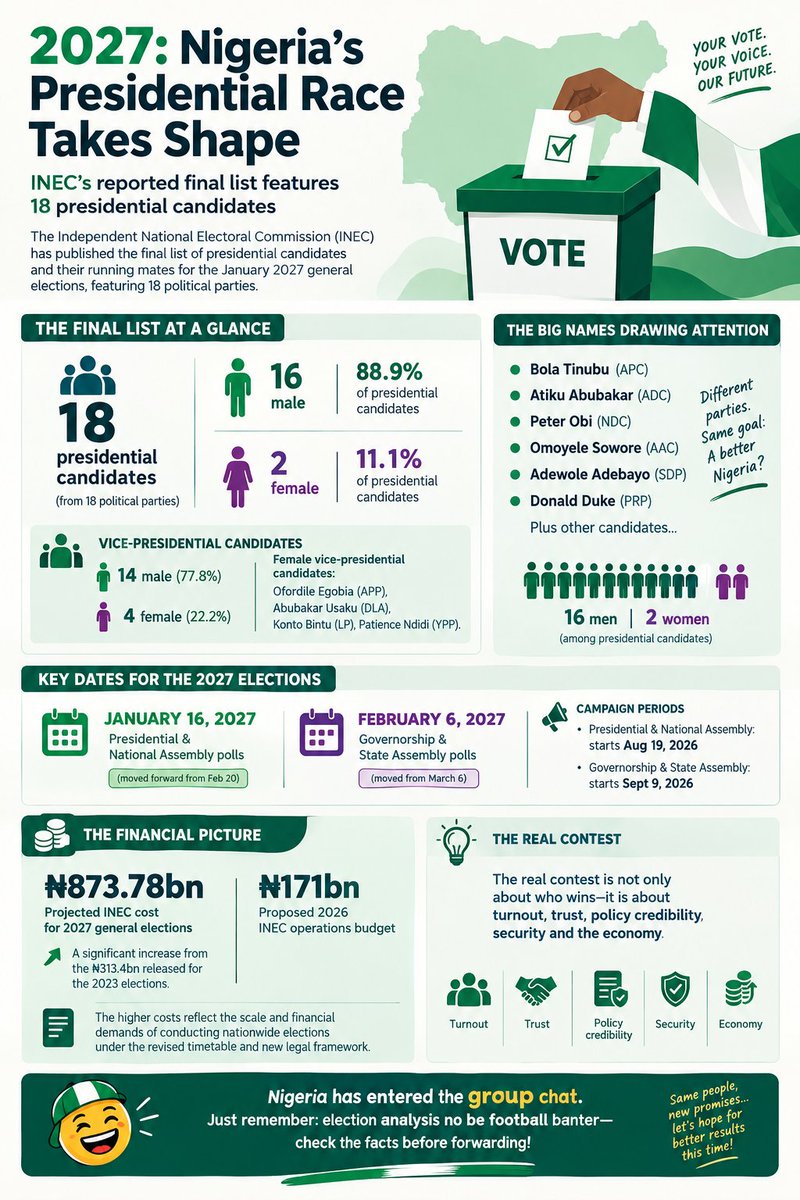
Nigeria's road to the 2027 General Elections is becoming clearer. The Independent National Electoral Commission (INEC) has published the final list of 18 presidential candidates and their running mates, setting the stage for another major democratic moment in our nation's history.
The presidential and National Assembly elections are scheduled for Saturday, January 16, 2027, while the governorship and State Houses of Assembly elections are expected to hold on February 6, 2027. The final list features candidates from 18 political parties, including some of Nigeria's most prominent political figures, alongside lesser-known candidates who will also be seeking the opportunity to lead the country.
An interesting feature of the list is the gender representation. Of the 18 presidential candidates, 16 are male and two are female, while four women are listed as vice-presidential candidates. This once again raises an important conversation about gender inclusion and representation in Nigeria's political leadership.
But beyond the headlines, party logos, campaign rallies and social-media arguments, the bigger issue is this: Nigerians now have choices,and choices come with responsibility.
As we approach 2027, voters should look beyond catchy slogans, viral campaign videos and the usual “my candidate can fix Nigeria before breakfast” promises. 😄 We must interrogate candidates based on their competence, character, track record, policies and their practical understanding of Nigeria's economic and social challenges.
For those of us in Nigeria, we know how passionate election conversations can become. From Twitter Space, WhatsApp groups to beer parlours, offices and family gatherings, suddenly everybody becomes a political analyst, with some people sounding like they personally audited the national budget! 😂
However, democracy is too important to leave only to online debates. Your vote matters. Your voice matters. Your participation matters.
Do not sell your vote. Do not stay away because you believe your vote will not count. Do not wait until election day to start asking questions. Study the candidates, understand their policies, participate peacefully and exercise your constitutional right.
Nigeria's future will not be shaped only by those who win elections, but also by the citizens who take the responsibility of choosing their leaders seriously.
🇳🇬 In 2027, vote wisely. Vote peacefully. Vote responsibly. Exercise your right. Your vote is your voice, and every voice matters.
Because after all the campaign music stops and the posters start peeling off the walls, na the decisions we make today we go still live with tomorrow. 😉
#2027Elections #NigeriaDecides #YourVoteMatters #NigerianPolitics #Democracy #GoodGovernance @inecnigeria #INEC #VoteWisely #CivicResponsibility #PoliticalAwareness #Nigeria #Election2027 #VoteNotFight #LeadershipMatters #FutureOfNigeria #ActiveCitizenship #YouthInPolitics #Accountability #BetterNigeria #ExerciseYourRight
FED SEPTEMBER 2026: 25BPS HIKE - AND WHY NIGERIA SHOULD CARE
The U.S. Federal Reserve has delivered its first rate hike since July 2023, raising the federal funds target range by 25 basis points to 3.75%-4.00% at its September 15-16 meeting. The decision was broadly expected, with markets pricing roughly a 90% probability ahead of the announcement.
But the real story is not just the hike. It is what comes next.
The September projections point to one additional 25bps hike in 2026, implying 50bps of total tightening this year. That is less aggressive than the roughly 3.5 hikes markets had reportedly priced over the longer horizon. In other words, the Fed hiked-but markets had already imagined a bigger “sharpen your pencil” scenario.
Why the tightening? Inflation remains sticky, the labour market is resilient, and higher energy prices are adding another layer of inflation risk. The supplied market note highlights August core CPI at 0.3% m/m, payroll growth of 162,000, unemployment at 4.1%, and wage growth of 3.1% y/y.
WHAT DOES THIS MEAN FOR NIGERIA?
FX: A higher U.S. policy rate can widen the rate differential and increase pressure on emerging-market currencies, including the naira. The market note puts NFEM around ₦1,329/$ before the decision and CBN reserves at $54.08bn, providing some buffer against volatility.
Fixed Income: Nigerian bonds and money-market instruments may need to maintain attractive yields to compete for foreign portfolio flows. Strong OMO demand-₦3.03trn subscriptions against ₦1trn offered-shows domestic appetite remains firm.
Equities: The NGX enters this period after a very strong run, with the ASI +56.35% YTD and Banking Index +67.96% YTD in the supplied note. Higher global rates could increase volatility and encourage some investors to reassess emerging-market exposure.
Treasury/FX dealer watchlist: DXY, U.S. 2Y/10Y yields, Brent crude, FPI flows and USD/NGN.
For Nigerian markets, the Fed decision is therefore less about one 25bps move and more about global liquidity, dollar strength, oil prices and investor risk appetite.
As we say in Nigeria: “When America sneezes, the FX market checks its BP!” 😂
#Fed @cenbank@ngxgrp #InterestRates #MonetaryPolicy #Nigeria #Naira #USDNGN #FX #Treasury #NGX
Bullish Vibe on Broad Street: NGX Gains ₦650 Billion as Market Cap Hits ₦158 Trillion
If your stock portfolio didn't smile on Tuesday, September 15, 2026, check your broker app again-you might need to tap "refresh." The Nigerian Exchange (NGX) delivered a sweet ₦650 billion gift in market capitalization, taking the total market value to ₦158.4 trillion. The All-Share Index (ASI) surged by 1,005.27 points (0.41%) to close at 244,304.51 points, making it four consecutive sessions in the green. Trading activity was electric as investors swapped over 520.65 million shares across nearly 72,000 deals, proving that money isn't sleeping, even if "sapa" is lurking outside.
This rally reflects strong liquidity movement and robust investor appetite despite macro shifts like the buzz surrounding Dangote’s refinery IPO. NGXGROUP led the top gainers, soaring 9.95% to ₦179.00, closely trailed by Aradel Holdings, which jumped 9.62% to close at ₦1,550.00. High-flying energy and consumer goods sectors provided the fuel, with the NGX Oil/Gas Index posting the day's biggest surge. Meanwhile, over in the banking sector, GTCO, Zenith, and Access Holdings kept cash flows humming through heavy trading volume.
Of course, the market isn't all sweet jollof; a few stocks got seasoned with paper pepper. Ecobank Transnational Incorporated (ETI) hit the maximum 10% limit down to close at ₦66.60, while PZ Cussons dropped 9.52% to ₦75.10. Look, stock trading in Nigeria is like buying 'suya' on Broad Street-sometimes you get the soft, juicy beef, and other times you accidentally bite into pure 'kanda' (kpomo). But for now, the bulls are clearly holding the steering wheel.
#NGX #NigerianStockMarket @cenbank@ngx #BroadStreet #NigerianEconomy #StockMarketNews #Equities #WealthBuilding #FinanceNigeria #MarketCapitalization
NGX Bulls Flex Again: Market Adds N392bn as Banks, Breweries & Insurance Lead the Charge
NGX Bulls Flex Again: Market Adds N392bn as Banks, Breweries & Insurance Lead the Charge
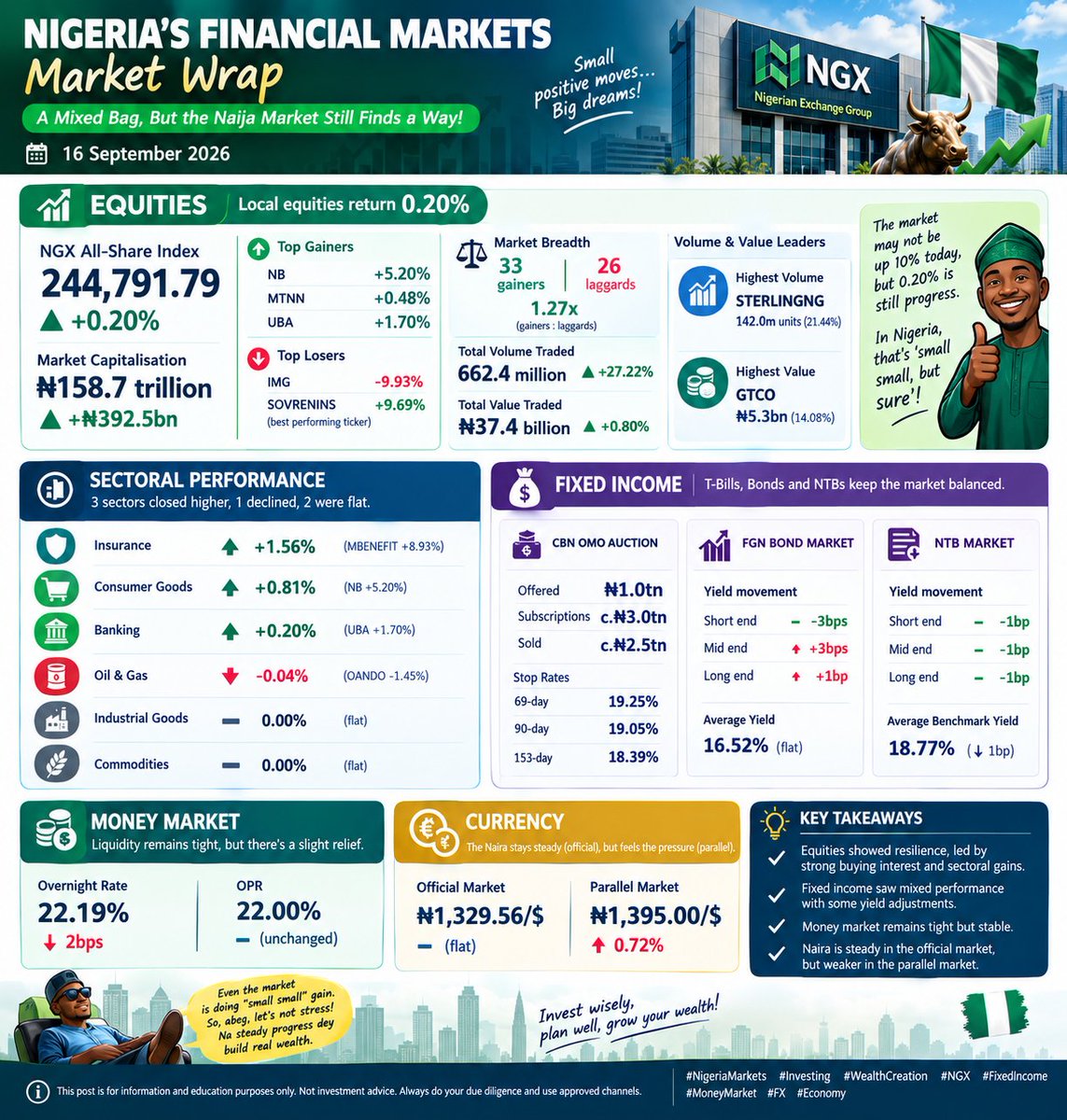
Nigerian equities notched another gain on Wednesday, September 16, 2026, with the All-Share Index (ASI) climbing 0.20% to close at 244,791.79 points. Market capitalisation swelled by N392.5 billion to N158.7 trillion, extending the year-to-date rally that's got investors smiling like we just collected arrears after 10 months of "salary is coming." 😂💰
The rally was broad-based and convincing. Market breadth stayed firmly positive at 1.27x, with 33 gainers comfortably outnumbering 26 laggards. SOVRENINS emerged as the session's top performer, surging 9.69%, while IMG led the decliners with a 9.93% drop-proof that even in a bull market, somebody's portfolio is still crying like NEPA just took light at 2pm. ⚡😭
Trading activity picked up meaningfully. Total volume jumped 27.22% to 662.4 million units, while value traded rose 0.80% to N37.4 billion. STERLINGNG dominated the volume chart with 142.0 million units (21.44% of total), and GTCO ruled the value log with N5.3 billion worth of trades (14.08% of total). If volume was a Lagos danfo, STERLINGNG would be the one conductor dey shout "Ojuelegba! Ojuelegba!" while everybody rush enter. 🚌🏃
Sectoral performance was bullish across the board. The Insurance index led gains with a 1.56% advance, driven by MBENEFIT's 8.93% surge. Consumer Goods followed with a 0.81% rise, anchored by Nigerian Breweries' impressive 5.20% gain. The Banking index rounded off the gainers with a 0.20% increase, buoyed by UBA's 1.70% advance. Meanwhile, Oil & Gas slipped 0.04% on OANDO's 1.45% decline, while Industrial Goods and Commodities indices closed flat-basically the market's way of saying "we dey kampe, no be everybody fit fly." 🦅
On the fixed-income front, the CBN held an OMO auction offering N1.0 trillion across 69-day, 90-day, and 153-day papers. Total subscriptions hit roughly N3.0 trillion, and the CBN sold approximately N2.5 trillion at stop rates of 19.25%, 19.05%, and 18.39% respectively. That's oversubscription levels that make you wonder if Nigerians are hoarding cash like it's Indomie before price increase. 🍜📈
The FGN bond market closed mixed, with yield expansions in the mid (+3bps) and long (+1bp) segments offsetting contraction at the short end (-3bps). Average yields held flat at 16.52%. The NTB market was marginally bullish, with yields contracting 1bp across all segments, pushing the average benchmark yield down to 18.77%. Money market rates stayed elevated but stable: OPR unchanged, while the overnight rate dipped 2bps to 22.19%.
In the FX market, the naira held steady in the official window at N1,329.56/USD but depreciated 0.72% in the parallel market to N1,395.00/USD. So while the official rate is behaving like that your friend who says "I no get money" but just bought new Benz, the parallel market is still doing "I dey manage" like the rest of us. 🤷♂️💸
@ngxgrp@cenbank #bank #fixedincome #Investissement #investment #cbn #CentralGovt
NGX Bulls Are Back: Market Adds N316bn as Banks, Breweries Lead the Charge
Nigeria’s equities market maintained its bullish momentum on Wednesday, September 16, as the NGX All-Share Index (ASI) gained 0.20% to close at 244,791.79 points.
Market capitalisation increased by approximately ₦315.94 billion, pushing the market’s year-to-date return to 57.31%. That means the NGX is still carrying considerable momentum, even as investors remain selective about where they put their money.
What makes Wednesday’s session particularly interesting is the improvement in participation. 34 stocks advanced against 27 decliners, while trading volume jumped 27.23% to 662.43 million shares, valued at ₦37.45 billion across 63,271 deals.
Some notable gainers included Nigerian Breweries (+5.20%), NGX Group (+4.47%), Transcorp (+4.09%), UBA (+1.70%) and AccessCorp (+1.39%). GTCO also dominated traded value, while Sterling led volume activity.
From a treasury and FX perspective, the naira remained relatively stable at the BDC window, with the average BDC rate unchanged at ₦1,385/US$, while the NFEM rate was at ₦1,329.86/US$. Meanwhile, the overnight money-market rate eased slightly to 22.19%, with OPR unchanged at 22.00%.
The broader takeaway? Investor participation is improving, equity momentum remains positive, but liquidity and macro conditions still matter. Oil prices, money-market liquidity and upcoming corporate earnings could influence whether this momentum broadens or becomes more selective.
And as Nigerians like to say: “Na small small dem dey climb mountain.” 😂 In the market too, not every green day needs to be +10%. Sometimes, a 0.20% gain is simply the market saying, “I’m still here; make I no overdo.” 📊🇳🇬
Market sentiment: constructive, but watch the fundamentals.
#NGX #NigerianStockMarket @cenbank@ngxgrp
#NigeriaEconomy #FXMarket #Naira #Treasury #CapitalMarket #Investing #FinancialMarkets #Economics
After a whole decade in the index "sanctuary," Nigeria is officially back on J.P. Morgan’s radar!
J.P. Morgan has added Nigeria to its newly launched Government Bond Index–Emerging Markets Edge (GBI-EM Edge), assigning FGN bonds a 7.4% weighting-just a hair shy of the maximum 8% cap.
Before we start throwing a carnival at Eagles Square, let’s clarify the small print: this isn’t a direct readmission into the flagship GBI-EM Global Diversified index that we were kicked out of back in 2015. Think of the GBI-EM Edge as the premium lounge for high-performing frontier markets. We might not be at the main table yet, but we’re definitely back in the VIP building!
What does the data say?
Big Allocation: Nigeria sits comfortably with a 7.4% weight across 16 government bond instruments worth $17.47 billion.
Sweet Yields: The average yield on included Nigerian debt stands at 17.1% (with a duration of 3.38 years), wiping the floor with the benchmark average of 10.39%.
Frontier Heavyweights: Africa dominates this new index with a 44.5% total share, alongside peers like Egypt, Morocco, Kenya, and Vietnam.
Currency Comeback: After the heavy FX hits in 2023 and 2024, the Naira stabilized with positive FX returns of 6.7% in 2025 and 8.1% so far in 2026-a crucial shift for offshores tracking total dollar returns.
Why this matters for global investors
Foreign portfolio investors (FPIs) love two things: juicy yields and index validation. With 17.1% yield on offer and the FX market showing renewed stability following structural reforms, Nigeria’s inclusion puts FGN bonds back on the buy-list for global asset managers tracking frontier debt.
For a market that went from being removed in 2015 to "Overweight" downgrade in 2022, seeing FX liquidity and transparency reforms bear actual index fruit is a massive win for the DMO, CBN, and domestic treasury desks.
As every Nigerian parent would say after a long wilderness journey: "So after 11 years, you finally remembered the way to my house?" We take the win!
#JPMorgan #NairaBonds #NigeriaEconomy #GlobalMarkets #FixedIncome #FGNbonds @ngxgrp@cenbank #Treasury #FrontierMarkets #CBN
Dangote Refinery’s IPO has started with a bang, and Nigerians clearly did not come to “observe” the market from the sidelines.
Imagine logging into your banking app at 9:00 AM on a Monday, and by 10:00 AM, Nigerians have already dropped N1.5 trillion on a single stock! That’s exactly what happened when the Dangote Petroleum Refinery and Petrochemicals (DPRP) IPO opened on the Nigerian Exchange (NGX). In just 60 minutes, over 402,000 transactions rolled in. Forget black market rates for a second-Nigerians actually found money under their mattresses to buy this stock.
The offer aims to raise roughly N2.15 trillion ($1.6 billion) by selling 4.1 billion ordinary shares at N525 each. With the deadline set for October 13, 2026, the rush was made possible by an aggressive digital rollout-over 55 electronic channels spanning 20 banks, fintechs, and the NGX Invest platform. To make it "the IPO of the people," the minimum entry barrier was set at just 10 shares (N5,250). At this point, even your local suya guy might be a shareholders' committee member!
At the NGX Gong Striking ceremony in Lagos, Aliko Dangote made it clear that this isn't just about raising funds; it's about democratising wealth so everyday Nigerians can own a piece of Africa's largest refinery. Plus, because these are new shares, all proceeds go straight into funding the refinery's operations.
Dangote also dropped some massive long-term targets: expanding refining capacity to 2.1 million barrels per day by 2030, targeting a $350 billion market cap within four years, and opening a new facility in Kenya. Perhaps the real sweetener for Nigerians tired of fx volatility: investor dividends will be denominated in US Dollars, alongside a proposed bonus share incentive for retail investors who hold long-term.
It turns out when Alhaji Aliko Dangote said he wanted 10 million subscribers, Nigerians took it as a personal challenge.
#DangoteIPO #NGXInvest #NigerianStockExchange #DangoteRefinery @AlikoDangote@cenbank@ngxgrp #InvestingInNigeria #NSE #WealthCreation #AfricanMarkets #StockMarketNigeria #FintechNigeria
Nigeria's capital market just entered a new chapter. The Dangote Petroleum Refinery IPO opened on Monday, 14 September 2026, with a N2.15 trillion public offer targeting up to 10 million retail investors-a scale never before attempted in Africa. Shares are priced at N525 each, with a minimum subscription of 10 shares (N5,250), and the offer will run until 13 October 2026.
What makes this IPO different is how you can buy in. Instead of paper forms and a handful of receiving banks, Dangote's team deployed about 55 approved digital channels: 20 commercial banks, two mobile money operators, the NGX Invest platform, and 32 fintech and investment firms such as Bamboo, PiggyVest, Cowrywise, and Moniepoint. Within hours, platforms reported over N10 billion in subscriptions, with some estimates putting first‑day inflows as high as N1.5 trillion, even as a few apps struggled under the load.
This is not just about raising capital for the refinery. According to sources close to the deal, Aliko Dangote insisted the offer be "for the people"-slogan "Na Your Own"-and built around digital distribution so Nigerians who have never owned shares can participate easily via mobile apps, web platforms, POS, and mobile money. Many traditional brokers did not have the infrastructure to onboard millions of new retail users, so they either built new platforms or partnered with fintechs that already had the technology, payment rails, and large active user bases.
This transaction is a live stress test of Nigeria's electronic public‑offer infrastructure: BVN‑based onboarding, payment processing, CSCS account creation/validation, and share allotment under real‑time retail demand. If it works smoothly, it sets the template for future mega‑listings, including the much‑anticipated NNPC IPO, and could permanently expand the country's retail investor base.
The commercial stakes explain the scramble among banks, brokers, and fintechs. Beyond IPO fees, participating platforms are racing to acquire millions of first‑time equity investors who can generate long‑term flows in trading, wealth products, and payments. For regulators and the exchange, the deal is both a capital‑formation catalyst and proof that Nigeria can onboard investors at digital scale.
And because Nigerian market no dey carry last: "If your app don crash today, na sign say Dangote IPO serious-like when NEPA take light during your transfer." "N5,250 minimum? That one na small small like buying pure water, but now you're buying refinery." "10 million shareholders? If that one happen, CSCS go need bigger server room than CBN vault.
#DangoteIPO #NGX #NigeriaCapitalMarket #Fintech #RetailInvestors #Treasury #FXNigeria #Equities #FinancialInclusion #AfricanMarkets
The Nigerian bourse opened the week with a narrow but steady advance: the NGX All‑Share Index (ASI) rose 0.10% to 243,299.24 points, adding roughly ₦160bn to investors’ wealth and pushing year‑to‑date (YTD) returns to 56.35%. Despite the headline gain, market breadth stayed negative-28 decliners vs 20 gainers-and turnover fell 22.41% to 428.97m units worth ₦20.52bn, signaling selective accumulation rather than broad euphoria.
Leadership was concentrated in financials and the exchange’s own listing. NGXGROUP (+10.00%), CUSTODIAN (+7.14%), FIDELITYBK (+5.26%), and FIRSTHOLDCO (+3.68%) drove the index, while ARADEL led value traded (₦2.48bn) and STERLINGNG led volume (18.20% of total). Meanwhile, REGALINS and TRIPPLEG printed 52‑week lows, a reminder that this rally is very much a “stock‑picker’s market.” Unlisted equities also participated, with the NASD Securities Index (NSI) up 1.86% to 4,555.42 on eight deals.
FX and liquidity conditions stayed calm. The average BDC rate closed flat at ₦1,385/US$, while the NFEM window firmed slightly to ₦1,326.30/US$. The overnight rate edged up to 22.31%, with open repo flat at 22.00%, keeping money‑market yields attractive for treasury desks parking liquidity. Externally, crude stole the show: Brent +4.08% to US$108.88 and WTI +3.82% to US$103.87 after attacks disrupted Saudi energy infrastructure-bullish for Nigeria’s fiscal and reserve outlook, but still a live risk for imported inflation. Gold and silver eased about 1%, while cocoa gained 4.52%, supporting the AFEX complex.
For investors, the message is simple: the YTD gain of 56.35% is impressive, but today’s thin breadth and lower turnover argue for discipline over FOMO. For treasury and FX teams, stable BDC/NFEM prints and elevated short‑term rates create a comfortable carry environment while you wait for clearer entry points in bonds and selective equities.
And because Nigerian market no dey carry last: “NGX up 0.10% but my portfolio still dey beg for alert-na who get the real ASI?” “BDC hold at ₦1,385 like aunty at church door: ‘No change today, come back tomorrow.’” “Crude don jump to $108, but fuel price still dey act like NEPA bill: every month e dey surprise us.”
#NGX #NigeriaStockMarket #FXNigeria #Treasury #FixedIncome #Macroeconomics #InvestingNigeria #BDC #OilAndGas #AfricanMarkets
Nigeria’s FAAC Allocation Hits Record ₦3.01 Trillion
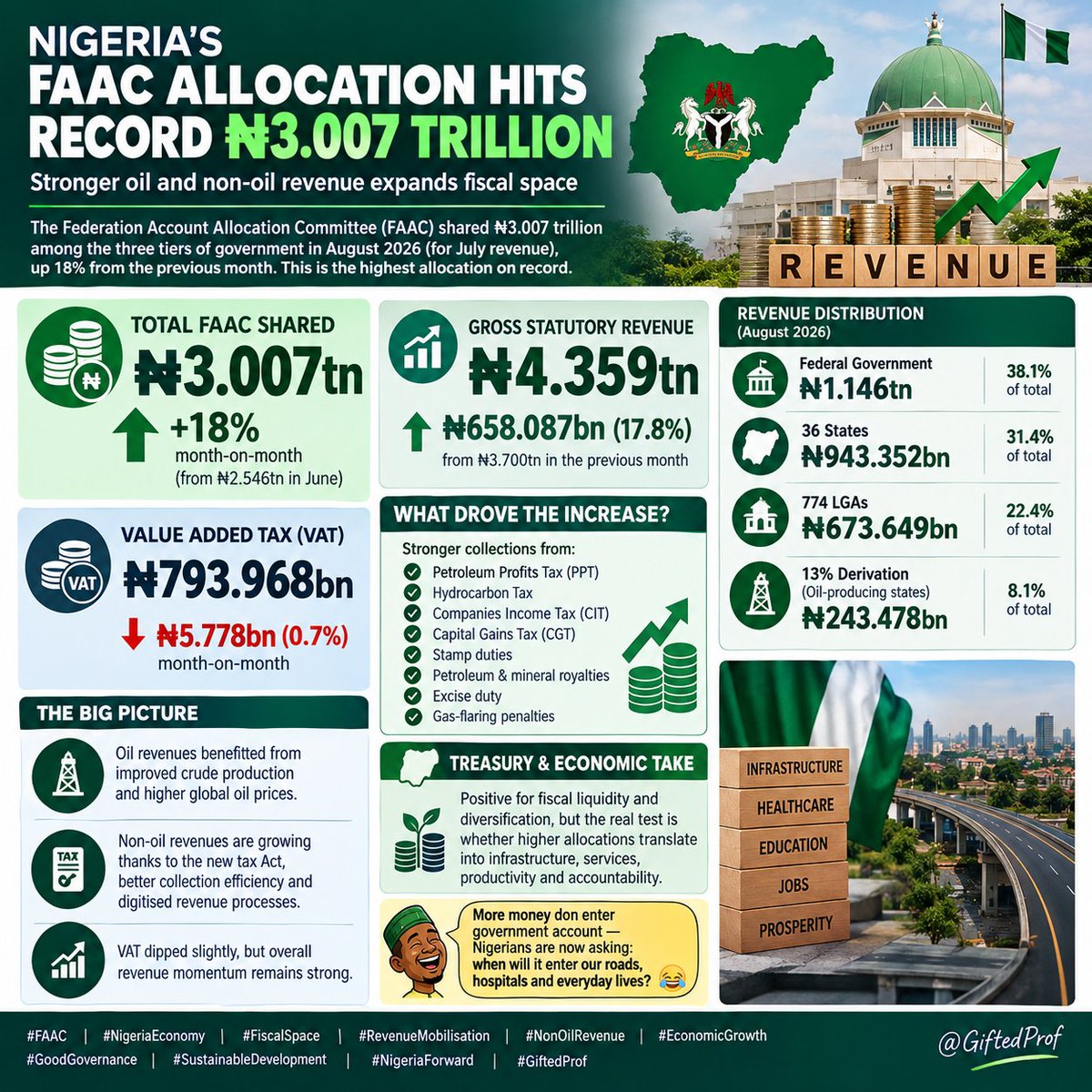
Nigeria’s Federal Government, 36 states and 774 local government councils shared a record ₦3.007 trillion in July revenue, representing an 18% increase from the previous month and the first time monthly FAAC allocation has crossed the ₦3 trillion mark.
The rise was supported by stronger statutory revenue, which increased from ₦3.70 trillion in June to ₦4.36 trillion in July-a gain of ₦658.1 billion or 17.8%. Improved collections from Petroleum Profit Tax, Hydrocarbon Tax, Companies Income Tax, Capital Gains Tax, stamp duties, petroleum royalties, mineral royalties, excise duties and gas-flaring penalties contributed to the improvement.
How the Money Was Shared
***Federal Government: ₦1.146 trillion
***State governments: ₦943.35 billion
***Local governments: ₦673.65 billion
***13% derivation to oil-producing states: ₦243.48 billion
VAT collections, however, slipped marginally by 0.7% to ₦793.97 billion, showing that consumption-related revenue remained broadly resilient but was not the main driver of the month’s increase.
From a fiscal and treasury perspective, the numbers are encouraging. They suggest that Nigeria’s revenue base may be gradually broadening beyond crude oil, supported by tax reforms, improved revenue administration, exchange-rate reforms and digital collection systems.
But higher FAAC receipts are not automatically the same as stronger public finances. The real test is whether the additional revenue is converted into better infrastructure, healthcare, education, security and productive investment.
In Nigeria, once FAAC increases, everybody becomes a fiscal expert overnight. The family group chat starts calculating how much each local government should receive-and somehow, someone will still ask: “So, when are they sharing our own?” 😂
The opportunity is clear: governments must use this stronger revenue cycle to reduce waste, improve transparency, strengthen internally generated revenue and invest in sectors that can expand the economy.
More money is welcome. But more value from every naira is the real target.
Key drivers
***Stronger oil-related revenue.
***Improved non-oil tax collections.
***Better revenue administration and digitisation.
***Higher collections from CIT, PPT, royalties, stamp ***duties and excise duties.
Continuing impact of fiscal and tax reforms.
Watch point: VAT declined slightly to ₦793.97bn, while import duties and some oil-related revenue lines weakened.
Bottom line: Nigeria’s fiscal space is expanding, and non-oil revenues are playing a bigger role in reducing crude dependence. However, high allocations are like cooking a massive pot of jollof rice at the state level, if it doesn’t reach the grassroots, citizens are only smelling the aroma. 🍲
Sustaining this progress requires strict fiscal discipline across all three tiers of government to ensure these windfalls build capital infrastructure, ease inflation, and improve productivity.
What’s the FAAC situation looking like in your state? Are you seeing the impact yet? Let’s discuss in the comments! 👇
Source: FAAC communiqué as reported by THISDAY and PRNigeria. This commentary is for information and market education only; it is not investment, tax, legal or financial advice.
#FAAC #NigeriaEconomy #FiscalPolicy #Treasury #FXMarket #RevenueMobilisation #PublicFinance #EconomicGrowth #NonOilRevenue #oil #Nigeria #NigeriaBusiness
Dangote Refinery IPO: What Nigerians Need to Know (and How to Buy)
The long-awaited Dangote Refinery IPO is officially here, and as expected, every Nigerian WhatsApp group and Twitter space is buzzing. The Dangote Petroleum Refinery & Petrochemicals FZE is launching one of Nigeria’s biggest public equity offers, opening on September 14, 2026 and closing on October 13, 2026, ahead of listing on the Nigerian Exchange (NGX). The offer price is fixed at N525 per share, with a minimum subscription of 10 shares (N5,250), making it accessible to everyday retail investors. For just ₦5,250, you can officially become a co-owner in a 700,000-barrel-per-day mega refinery.
What You’re Actually Buying
Before you rush to squeeze this into your monthly budget, let us break down what you are actually buying. This is an Offer for Subscription, meaning Dangote is issuing 4.1 billion new shares to raise about N2.15 trillion, with proceeds going directly to the refinery for expansion and growth. Successful applicants become shareholders with rights to dividends and price movements after listing-though, as with all equities, neither is guaranteed.
Think of it like buying a small piece of the refinery that’s already turning crude into petrol, diesel, and jet fuel. If the refinery does well, your slice could grow in value. If not, well… let’s just say “invest responsibly” isn’t just a slogan.
How to Invest (Without Stress)
Retail investors can apply through approved electronic channels, including:
****NGX Invest
****Bank platforms: Wema Bank, Access Bank, Ecobank, Fidelity Bank, FirstBank and others
****Investment/fintech apps: Meritrade, Bamboo, PiggyVest, Cowrywise, and others
You’ll need a valid BVN for electronic applications. While having a stockbroking account, Clearing House Number (CHN), and CSCS account is encouraged, first-time investors without these can still apply. If allotted, shares will be held temporarily under a Registrar Identification Number (RIN) and transferred to your CSCS account once details are provided.
So no, you don’t need to be a “big man” with a stockbroker on speed dial to participate.
What Happens If Everyone Applies? (Oversubscription)
If demand exceeds supply, not everyone will get all the shares they applied for. Dangote may increase the offer by up to 30% (to about 5.33 billion shares) with SEC approval.
***Applications at or below a Full-Allotment Threshold get full allocation.
***Larger applications may be scaled back.
***Surplus funds (plus accrued interest) are refunded within five business days after allotment.
In Nigerian terms: it’s like jollof rice at a wedding-everyone wants extra, but the pot is finite.
Who Controls the Company After IPO?
Now, for the reality check. Does ₦5,250 make you a major boss? Not quite. Uncle Aliko is not giving up the driver's seat anytime soon. The base IPO represents only about 3.3% of the enlarged company, and Aliko Dangote will still hold over 84% control. efore the offer, he beneficially owned about 87.27% of shares; post-IPO, that’s expected to fall to roughly 84.4%. The IPO broadens ownership but doesn’t dilute control meaningfully. So while you can proudly tell your friends that "we just bought new equipment at our refinery," remember you are a passenger on this ship, not the captain!
Why Is Dangote Raising N2.15 Trillion?
Proceeds will fund part of a $14.27 billion expansion to double refining capacity from 700,000 to 1.4 million barrels per day. The balance will come from internal cash flow, debt, and project finance.
Is N525 Per Share Cheap?
Valuation analyses suggest N525 is fair to full, not a bargain. Peer comparisons imply lower equity values, while future cash-flow models support higher valuations. Private-placement investors entered at about $0.35/share, versus roughly $0.385 for the IPO, indicating a ~10% premium for public investors.
Can H1 2026 Profits Be Sustained?
Dangote reported N2.50 trillion profit after tax in H1 2026, already exceeding any NGX-listed company’s H1 results so far. However, refining margins were unusually strong in Q1 2026 and are expected to moderate. Annualizing H1 profits would imply a P/E of ~13x, above some peers but in line with others.
Private placement investors also got in about 10% cheaper earlier. However, major analysts still project a 12-month target price around ₦688 to ₦826 based on long-term expansion goals, meaning the upside depends heavily on execution.
Final Thought
This IPO offers Nigerians a rare chance to own a piece of Africa’s largest refinery. But as with any investment, do your homework, understand the risks, and don’t invest money you can’t afford to tie up. And remember: in the stock market, just like in Lagos traffic, patience and planning beat panic every time.
#DangoteIPO #DangoteRefinery #NGX #NigerianStockMarket #InvestingInNigeria #FinancialLiteracyNG @AlikoDangote@cenbank@ngxgrp #NaijaStocks #WealthBuilding @alat_ng@wemabank #NaijaFinance #NaijaFinance #MoneyMindsetNG #NaijaInvestors #CapitalMarket
NIGERIA IS BACK ON THE MAP! FTSE RUSSELL RECLASSIFIES NGX TO FRONTIER MARKET
In September 2023, foreign portfolio investors looked at our FX queues and trapped funds and did a massive “Japa” from our capital market. We were bumped down to 'Unclassified'. But like a true Nigerian who goes back to the drawing board after a US Visa denial, we did the workings, cleared the backlog, and now FTSE Russell is officially saying, "Welcome back, Odogwu!" 😂
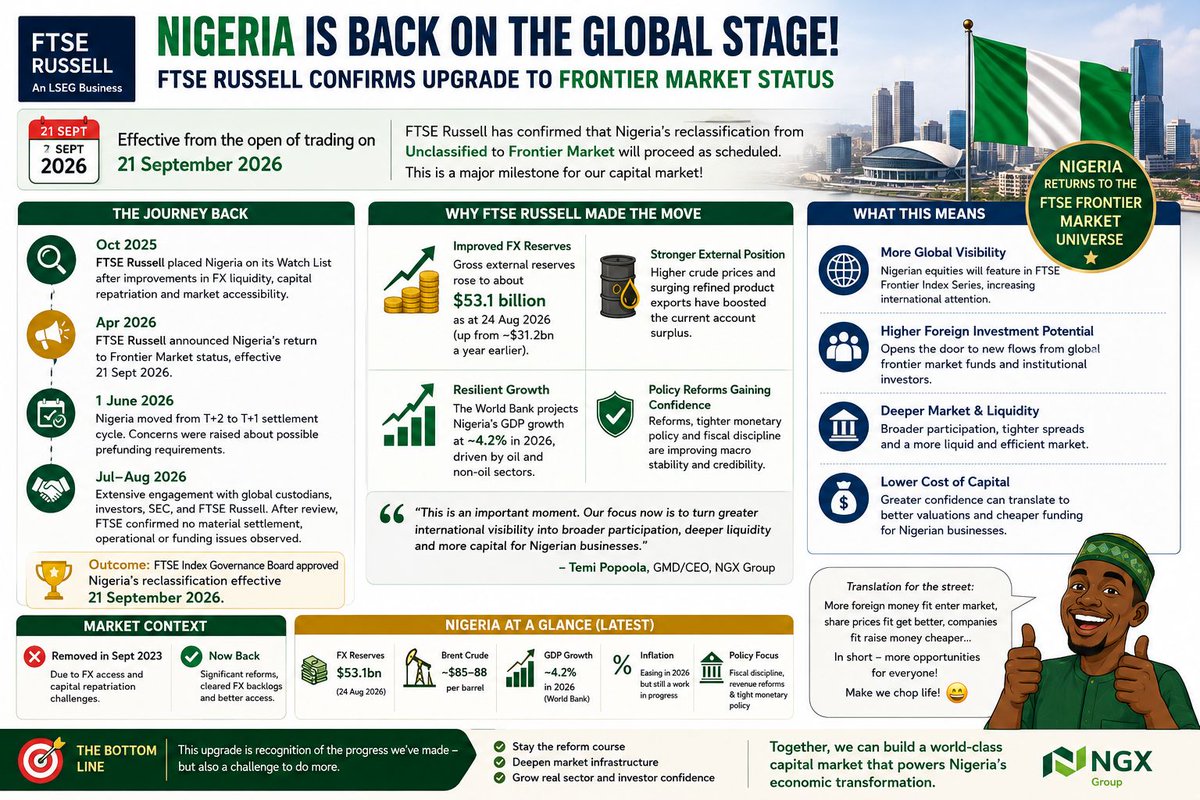
This is a massive win for Nigeria's macroeconomic landscape. Effective 21 September 2026, Nigeria officially returns to the global Frontier Market universe.
The Backstory & The T+1 Stress Test: FTSE Russell initially announced our upgrade earlier this year, acknowledging the massive improvements in FX liquidity and capital repatriation. However, they pressed pause when Nigeria boldly transitioned from a T+2 to a T+1 settlement cycle in June.
International institutional investors panicked, fearing this would force a de facto pre-funding requirement. But after intense engagements by the NGX Group and SEC with global custodians in July, the verdict is in: our T+1 infrastructure works flawlessly without operational or funding hiccups.
Why This Matters to the Market:
1. Capital Inflows: Benchmark-driven funds that track Frontier indices can now confidently allocate capital back into Nigerian equities.
2. Global Validation: S&P Dow Jones has already placed Nigeria on its Watch List for a potential 2027 Frontier Market upgrade. The herd is returning.
3. Deeper Liquidity: As NGX Group GMD Temi Popoola noted, the goal now is converting this global visibility into deeper market liquidity and cheaper capital for Nigerian corporates.
With the Central Bank’s sustained monetary tightening and the fiscal side working on reforms, this reclassification is a solid vote of confidence in our recovering FX machinery.
Are we about to see a massive Q4 rally driven by FPI inflows? Let me know your thoughts below! 👇🏾
#Nigeria #Macroeconomics #ForeignExchange #Treasury #NGX @cenbank #CapitalMarkets #FrontierMarkets #Finance #Investment
Moody’s Positive Outlook on Nigeria: Better Days Ahead or Just "Japa" for Our Debts?
Moody’s Ratings just upgraded Nigeria’s credit outlook from Stable to Positive while keeping our actual sovereign rating at B3.
In layman's terms: Moody's is saying, "We see your hustle, Nigeria, but you never reach investment grade!" Think of it as passing JAMB with 290, but the university is still asking for your 'O' Level results before granting admission.
Why are the charts smiling?
1. FX Reserves on Steroids: Our external buffers are finally eating well! CBN data shows our gross FX reserves hit a massive $53.1 billion by late August 2026. That's a +$20 billion jump from $31.2 billion just a year ago. The FX "sapa" (scarcity) is gradually fading.
2.Export Boom: We are exporting roughly 7x more seaborne petroleum products now compared to the 2023 average. Our current account surplus is holding its ground beautifully even if crude prices decide to do a slight dance.
3.Growth Vibes: With the World Bank projecting a 4.2% GDP expansion for 2026, both the non-oil and oil sectors are putting in the work.
🛑 Why aren't we popping the premium champagne just yet?
Because a B3 rating is still six notches below investment grade. To global portfolio investors, we’re still that uncle who promises to pay back but has a shaky track record.
1.Revenue Squeeze: The government's revenue-generation capacity remains limited. We have the assets, but the sovereign wallet is tight.
2.Debt Affordability: Debt servicing remains the heavyweight champion sitting on our fiscal buffers.
💡 My Takeaway:
With S&P upgrading us to 'B' in May and Fitch holding us steady, Moody’s positive outlook is a formal signal that a full upgrade is possible in 12-18 months. But only if our fiscal discipline matches our external wins.
Are you feeling this positive shift in your sector, or are we still relying on the classic Nigerian "we move" resilience? Let’s chat below! 👇🏾
#NigeriaEconomy #Finance #FXMarket #Treasury #MoodyRating @cenbank #currency #moody #rating
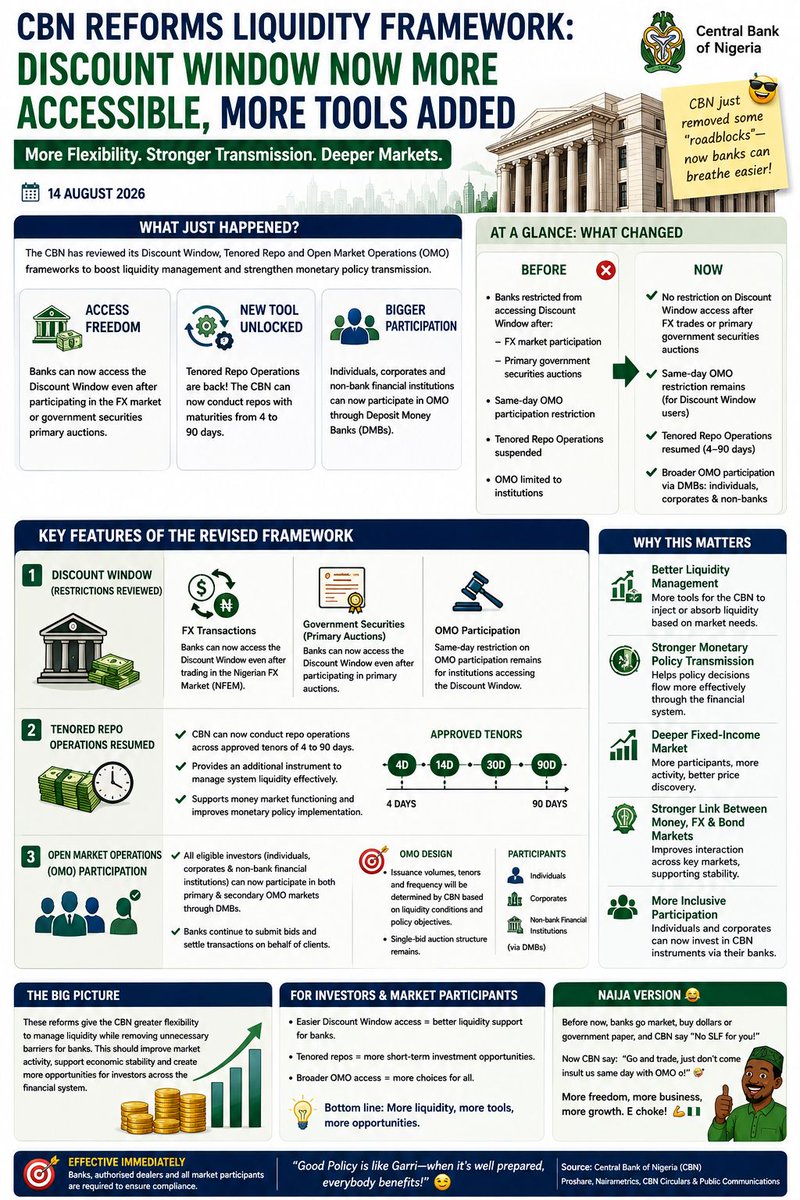
𝗖𝗕𝗡 𝗨𝗻𝗹𝗼𝗰𝗸𝘀 𝘁𝗵𝗲 𝗗𝗶𝘀𝗰𝗼𝘂𝗻𝘁 𝗪𝗶𝗻𝗱𝗼𝘄: 𝗢𝗠𝗢 𝗥𝗲𝗼𝗽𝗲𝗻𝗲𝗱 𝘁𝗼 𝗔𝗹𝗹 𝗜𝗻𝘃𝗲𝘀𝘁𝗼𝗿𝘀
If you have ever managed a bank treasury in Nigeria, you know the daily struggle of liquidity management.
Under the old rules, if your bank participated in the foreign exchange market (NFEM) or placed bids at primary government securities auctions, the CBN locked you out of borrowing overnight cash at the Discount Window (SLF) on that same day. It felt like your Nigerian parents telling you: "Since you went to buy fine clothes at Balogun market today, don't even look towards my kitchen when you return home!" 😂
Well, the Central Bank of Nigeria (CBN); has officially revised its liquidity management framework with immediate effect.
📌 𝗪𝗵𝗮𝘁 𝗖𝗵𝗮𝗻𝗴𝗲𝗱 𝗶𝗻 𝘁𝗵𝗲 𝗙𝗿𝗮𝗺𝗲𝘄𝗼𝗿𝗸?
1. 𝗗𝗶𝘀𝗰𝗼𝘂𝗻𝘁 𝗪𝗶𝗻𝗱𝗼𝘄 𝗨𝗻𝗹𝗼𝗰𝗸𝗲𝗱 (𝗦𝗟𝗙 𝗔𝗰𝗰𝗲𝘀𝘀 𝗥𝗲𝘀𝘁𝗼𝗿𝗲𝗱):
• FX Market (NFEM): Banks trading foreign exchange are no longer barred from accessing the Discount Window.
• Primary Auctions: Purchasing Treasury Bills or Bonds at primary auctions no longer restricts access to overnight liquidity.
• The Exception: The restriction on same-day OMO participation while accessing the Discount Window remains strictly in force.
2. 𝗧𝗲𝗻𝗼𝗿𝗲𝗱 𝗥𝗲𝗽𝗼𝘀 𝗥𝗲𝘀𝘁𝗼𝗿𝗲𝗱 (𝟰 𝘁𝗼 𝟵𝟬 𝗗𝗮𝘆𝘀):
• The CBN has lifted the suspension on Tenored Repo Operations.
• This gives the apex bank a flexible 4-to-90-day liquidity tap to manage systemic liquidity swings without constantly twitching the MPR benchmark rate (held steady at 26.5%).
3. 𝗢𝗠𝗢 𝗠𝗮𝗿𝗸𝗲𝘁 𝗥𝗲𝗼𝗽𝗲𝗻𝗲𝗱 𝘁𝗼 𝗥𝗲𝘁𝗮𝗶𝗹 𝗜𝗻𝘃𝗲𝘀𝘁𝗼𝗿𝘀:
• OMO instruments (which recently offered yields between 19.9% and 21.9%) are no longer an exclusive club for banks and PFAs.
• Individuals, corporates, and non-bank financial institutions can now bid directly in primary and secondary OMO markets through Deposit Money Banks (DMBs).
💡 𝗠𝘆 𝗧𝗮𝗸𝗲:
• 𝗙𝗼𝗿 𝗕𝗮𝗻𝗸𝘀: Removes operational bottlenecks and penalty fear, making cash flow management across FX and money markets smoother.
• 𝗙𝗼𝗿 𝗜𝗻𝗱𝗶𝘃𝗶𝗱𝘂𝗮𝗹 & 𝗖𝗼𝗿𝗽𝗼𝗿𝗮𝘁𝗲 𝗜𝗻𝘃𝗲𝘀𝘁𝗼𝗿𝘀: Opens access to high-yielding, government-backed short-term paper directly through your banker.
• 𝗙𝗼𝗿 𝗦𝘆𝘀𝘁𝗲𝗺𝗶𝗰 𝗟𝗶𝗾𝘂𝗶𝗱𝗶𝘁𝘆: Allows surgical, non-rate-based liquidity mop-ups ahead of seasonal spending pressures.
Systemic liquidity management just got a major operational upgrade!
Are you planning to take advantage of OMO investments through your bank? Let’s hear your thoughts below!
#CBN #Treasury #FixedIncome #NigeriaFinance #FXTrading #Macroeconomics #BankingNigeria #fx #forex #forextrading #OMO #BANKING #INVESTMENT #rate
𝗖𝗕𝗡 𝗨𝗻𝗹𝗼𝗰𝗸𝘀 𝘁𝗵𝗲 𝗗𝗶𝘀𝗰𝗼𝘂𝗻𝘁 𝗪𝗶𝗻𝗱𝗼𝘄: 𝗔 𝗕𝗶𝗴 𝗪𝗶𝗻 𝗳𝗼𝗿 𝗟𝗶𝗾𝘂𝗶𝗱𝗶𝘁𝘆 & 𝗧𝗿𝗲𝗮𝘀𝘂𝗿𝘆 𝗢𝗽𝗲𝗿𝗮𝘁𝗶𝗼𝗻𝘀
The Central Bank of Nigeria (CBN) has officially revised its operational frameworks for the Standing Lending Facility (SLF / Discount Window), Tenored Repo Operations, and Open Market Operations (OMO).
Before now, if a bank participated in foreign exchange (FX) market operations or primary government securities auctions, it was barred from borrowing at the CBN Discount Window on the same day. It felt like a parent saying: "Since you went to buy meat at the market, don't ask me for food when you come home!" 😂
Well, the apex bank just dropped those restrictions with immediate effect!
📌 𝗞𝗲𝘆 𝗣𝗼𝗹𝗶𝗰𝘆 𝗛𝗶𝗴𝗵𝗹𝗶𝗴𝗵𝘁𝘀:
𝟭. 𝗗𝗶𝘀𝗰𝗼𝘂𝗻𝘁 𝗪𝗶𝗻𝗱𝗼𝘄 𝗨𝗻𝗹𝗼𝗰𝗸𝗲𝗱:
• F𝗫 𝗧𝗿𝗮𝗻𝘀𝗮𝗰𝘁𝗶𝗼𝗻𝘀: Participation in the Nigerian Foreign Exchange Market (NFEM) will no longer restrict banks from accessing the Standing Lending Facility.
• 𝗣𝗿𝗶𝗺𝗮𝗿𝘆 𝗔𝘂𝗰𝘁𝗶𝗼𝗻𝘀: Participation in Treasury Bill or Bond primary auctions will no longer block access to the Discount Window.
• 𝗧𝗵𝗲 𝗖𝗮𝘁𝗰𝗵: The restriction on same-day OMO auction participation while accessing the Discount Window remains strictly in force.
𝟮. 𝗧𝗲𝗻𝗼𝗿𝗲𝗱 𝗥𝗲𝗽𝗼𝘀 𝗔𝗿𝗲 𝗕𝗮𝗰𝗸 (𝟰 𝘁𝗼 𝟵𝟬 𝗗𝗮𝘆𝘀):
• The CBN has lifted the suspension on Tenored Repurchase Agreements (Repos).
• The apex bank can now execute repos across 4 to 90-day maturities to better manage system liquidity and support money market stability.
𝟯. 𝗗𝗲𝗺𝗼𝗰𝗿𝗮𝘁𝗶𝘇𝗲𝗱 𝗢𝗠𝗢 𝗣𝗮𝗿𝘁𝗶𝗰𝗶𝗽𝗮𝘁𝗶𝗼𝗻:
• OMO auctions are no longer an exclusive playground for banks and PFA heavyweights.
• Retail investors, corporates, and non-bank financial institutions can now bid in both primary and secondary OMO markets through Deposit Money Banks (DMBs).
💡 𝗪𝗵𝗮𝘁 𝗧𝗵𝗶𝘀 𝗠𝗲𝗮𝗻𝘀 𝗳𝗼𝗿 𝗠𝗮𝗿𝗸𝗲𝘁 𝗣𝗮𝗿𝘁𝗶𝗰𝗶𝗽𝗮𝗻𝘁𝘀:
• 𝗙𝗼𝗿 𝗕𝗮𝗻𝗸𝘀 & 𝗙𝗫 𝗗𝗲𝗮𝗹𝗲𝗿𝘀: Enhanced liquidity buffers. You no longer have to starve your Treasury desk of overnight liquidity simply because you funded FX client demands or backed a primary T-bill issuance.
• 𝗙𝗼𝗿 𝗖𝗼𝗿𝗽𝗼𝗿𝗮𝘁𝗲 & 𝗥𝗲𝘁𝗮𝗶𝗹 𝗜𝗻𝘃𝗲𝘀𝘁𝗼𝗿𝘀: Broader access to high-yielding, government-backed OMO instruments directly through your bank.
• 𝗙𝗼𝗿 𝘁𝗵𝗲 𝗘𝗰𝗼𝗻𝗼𝗺𝘆: Smoother monetary policy transmission, reduced interbank rate spikes, and deeper liquidity across money, FX, and fixed-income markets.
𝘔𝘰𝘯𝘦𝘺 𝘮𝘢𝘳𝘬𝘦𝘵 𝘭𝘪𝘲𝘶𝘪𝘥𝘪𝘵𝘺 𝘵𝘳𝘢𝘯𝘴𝘮𝘪𝘴𝘴𝘪𝘰𝘯 𝘫𝘶𝘴𝘵 𝘨𝘰𝘵 𝘢 𝘴𝘦𝘳𝘪𝘰𝘶𝘴 𝘶𝘱𝘨𝘳𝘢𝘥𝘦! 🚀
#CBN #Treasury #BankingNigeria #LiquidityManagement #FixedIncome #FXTrading #Macroeconomics #NigeriaFinance #fx #treasury #market #economy #finance #financialmarket #centralbank
NIGERIA IS BACK ON THE GLOBAL INVESTMENT RADAR - AND THIS IS BIGGER THAN A STOCK MARKET HEADLINE.
Nigeria is officially back in the global capital market's VIP section. After a three-year exile in the "Unclassified" wilderness, FTSE Russell is returning the Nigerian Exchange (NGX) to the Frontier Market Index, effective September 21, 2026.
If the NGX were a person, it just did the classic Nigerian comeback- leaving the village empty-handed and returning three years later in a convoy of G-Wagons. 😂
Even more interesting: 31 Nigerian stocks have been identified in the FTSE Frontier Index Series.
The 10 newly eligible Large Caps include:
🔹 Aradel Holdings
🔹 Dangote Cement
🔹 First HoldCo
🔹 GTCO
🔹 MTN Nigeria
🔹 Nestlé Nigeria
🔹 Nigerian Breweries
🔹 Presco
🔹 Stanbic IBTC
🔹 Zenith Bank
Another 21 companies fall within the Mid- and Small-Cap categories, giving international investors broader exposure to Nigerian businesses.
This good news puts Nigerian equities back on the radar of global institutions, benchmarks and index-tracking investment products.
That can potentially improve:
✅ International visibility
✅ Market accessibility
✅ Institutional participation
✅ Liquidity
✅ The potential channel for foreign portfolio investment
We fixed the FX queues, and now the capital queues are forming. To keep our seat at the table, we must sustain this monetary discipline because global capital has zero tolerance for the classic Nigerian "come back tomorrow, oga is not on seat" administrative delays.
Are you positioning your portfolio for the anticipated Q4 FPI equities rally, or are you waiting on the sidelines? Let’s discuss in the comments!
#Nigeria #Macroeconomics #Treasury #ForeignExchange #NGX #CapitalMarkets #FTSERussell #Finance
Nigeria’s GDP Growth Accelerates to 4.43% in Q2 2026
Nigeria’s Q2 2026 economic scoreboard just dropped, and the numbers are walking into the room like an Owambe guest wearing a brand-new, starched Agbada!
According to the National Bureau of Statistics (NBS), real GDP growth accelerated to 4.43% year-on-year, stepping up nicely from the 3.89% recorded in Q1. Nominal GDP touched an impressive ₦119.29trn, with services and agriculture doing heavy lifting while the non-oil sector anchored a massive 95.84% of total output. Crude oil production also offered a welcome cushion, averaging 1..72 mbpd and driving a 7.31% real growth in the oil sector.
The composition of growth matters.
🌾 Agriculture: +4.39%
📡 Services: +4.60%
🏭 Industry: +3.96% — down sharply from 7.46% a year earlier
🛢️ Oil production: 1.72mbpd
💰 Nominal GDP: ₦119.29trn
🔄 Non-oil sector: 95.84% of real GDP
📊 Services: 56.62% of real GDP
The encouraging part is that the non-oil economy remains the real heavyweight, with agriculture, telecommunications, financial services, trade, real estate, manufacturing and construction supporting activity.
This is genuinely encouraging signal for FX liquidity and external reserves accretion. But let’s keep it 100-macro data can sometimes feel like a heavy-duty Snapchat filter. While the headline GDP is flexing at 4.43%, industrial growth slowed down to 3.96% (slipping from 7.46% last year).
Why? Because high energy costs, expensive diesel, financing hurdles, and infrastructure gaps are still doing push-ups on manufacturers' profit margins. It’s giving that classic Nigerian reality where your car dashboard says you are moving at 120km/h, but you can feel the engine knocking because you bought "black market" fuel! Growth without smooth credit transmission and steady power feels like ordering a luxury buffet online when your mobile banking app is experiencing temporary network failure-plenty of vision, zero liquid cash.
In classic Nigerian fashion, GDP is dressed in agbada for the Owambe, while manufacturers are outside calculating how many litres of diesel will survive Monday. 😂
As we navigate Q3 2026, the question isn't just whether we are growing, but whether the real economy can feel the pulse. Watch your liquidity, hedge your exposures, and don't quote tight rates on a jittery Friday afternoon!
#NigeriaEconomy #TreasuryOperation #Macroeconomics #GDP2026 #NigerianBanking #FinancialMarkets #InvestInNigeria #CentralBank #MarketLiquidity #EconomicGrowth #Nigeria #GDP #EconomicGrowth #Macroeconomics #Treasury #FX #FinancialMarkets #Investment #Naira #Inflation #InterestRates #OilAndGas #Manufacturing #Agriculture #EconomicDevelopment #BusinessGrowth #AfricanEconomy #CBN #Banking #bank #NigeriaWillBeOk #Nigeriafirst #nigeria
Africa’s Economy: Recovery, But Not Yet a Smooth Ride
Africa’s economic story this week was a mixed bag: trade and capital-market activity improved, but performance remained uneven across countries.
Nigeria stood out with a merchandise trade surplus of ₦12.60 trillion in Q2 2026, representing a 101.32% year-on-year increase. Exports rose by 18.77% to ₦27.02 trillion, while imports declined by 12.55%.
However, there is still a gap between investment announcements and actual money entering the economy. Of the approximately US$50 billion in investment pledges linked to the President’s foreign engagements, only about US$13 billion-25%-has been disbursed.
Ghana recorded 6.2% growth in the first half of the year, supported by an 8.0% expansion in services. Its latest four-year cedi bond also attracted GH¢4.46 billion in bids, compared with GH¢3.15 billion accepted-an indication of strong investor interest.
Senegal secured a US$2.2 billion IMF programme, while US$3.5 billion in domestic arrears was reprofiled rather than restructured. Tanzania’s exports climbed 16.5% to nearly US$20 billion, supported by a 37.4% rise in gold exports.
Angola is preparing to open its US$18.6 billion local bond market to global investors, while Standard Bank reported a 12% increase in continental deposits to US$156.3 billion.
South Africa, however, moved in the opposite direction. Its economy contracted by 0.2% in Q2, while the current-account deficit stood at 2.6% of GDP, alongside an 82.1% increase in fuel-import values. Recent reporting also confirms that the contraction was linked to weakness in mining, manufacturing and domestic demand.
What to Watch Next
The outlook will depend on:
==How quickly Nigeria’s remaining investment pledges become actual disbursements.
==Whether Ghana’s strong bond demand continues.
==The terms for opening Angola’s bond market to global investors.
==Senegal’s early IMF programme milestones.
==South Africa’s upcoming output and external-account data.
The big takeaway is clear: Africa’s recovery is gaining visibility, but the journey is still bumpy. Some economies are accelerating, others are applying the brakes-and, as usual, everyone is hoping inflation does not suddenly join the convoy.
#AfricanEconomy #Nigeria #Ghana #Senegal #SouthAfrica #Tanzania #Angola #EconomicGrowth #CapitalMarkets #Macroeconomics #Investment #MarketUpdate