@myherothedude@joecarlsonshow Robin Hood was stealing illegal tax collections from a usurper. He wasn't anti-government, in fact he was serving the true government, and when they came back, the usurper was executed
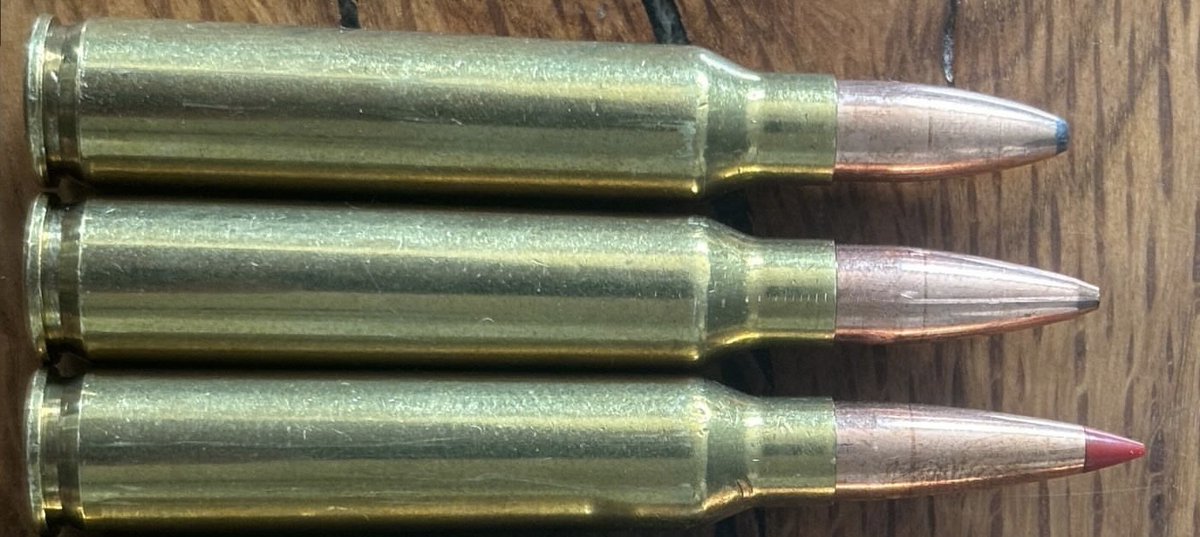
2.25" COL - the real limit to 5.56 performance
With a longer COL (2.35-2.5") the 5.56 could use modern VLD projectiles, like the below ELD-VT, which have a serious increase in effective range.
2950fps from a 14.5" comparison:
62gr M855A1 0.152 G7 = 1700fps at 450yd
62gr ELD-VT 0.199 G7 = 1700fps at 590yd
To give a sense of what a change that really is, you would need to launch the M855A1 at 3400fps - likely at 90kpsi pressure - to achieve 1700fps at 590yd.
In essence, the longer pointier bullet is equivalent to +450fps velocity.
Combined with new High Pressure Cases, this would provide a goldilocks round that has serious increases in range while maintaining the high capacity and light weight of 5.56.
At 3400fps, the 0.199 G7 ELD-VT = 1700fps at 770yd, and a supersonic range of 1,110yd.
Hopefully we will see a future 'AR-12' based on '5.56 Long' that can fire both legacy 2.25" bulk ammo as well as high performance '5.56 long'.
@LarryVickers I shot one an a 6.5 CM. With both the muzzle device and suppressor extension thing, it weighs 2.5lbs. Insanely quiet. We weren't at the range long before a small crowd formed (about 12 people, maybe half of the shooters at the range that day). It's a crowd pleaser for sure!
@ReviewsPossum 3 Mile was a nothingburger. President Carter (a nuclear engineer) said privately that it was a nothingburger. Then he told the public that it was a disaster. His single lie has done untold damage to the human race
@dontwryabtit24@Rothmus "Mind your own business! Jews aren't people, I can do whatever I want with them."
"Mind your own business! These Africans are my property, I can do whatever I want with them."
You buy a German anvil. It contains 83 moving parts and requires winding twice a day. It's forged from excellent steel, holds tolerances across all three striking faces to within three microns, includes a beautifully indexed horn-adjustment mechanism nobody asked for, and requires a proprietary 11-point spanner should you need to replace the rebound calibration bushing. It runs flawlessly for years, but one day it starts up in limp mode because the onboard anvil-management system detects that it's overdue for its 50,000-strike inspection.
You search AliExpress for a Chinese anvil, and are presented with a multitude of offerings from such household-name brands as DUKXJYIBF, HDBTGMXI, AND UEJQIP. They're all priced to within a few pennies of each other, appear completely identical except for the nameplate, and obviously all came out of the same factory. You text your blacksmith friend to ask if they're legit. He tells you he got one like that from KIXJBU a few years ago, and that it's been great and a terrific deal. You thank him, but KIXJBU seems to have folded so you buy the one from UEJQIP. When it arrives, it feels suspiciously light. You scratch it and realize it's iron-plated aluminum.
You buy an American anvil. It's five times the price of the competition, but it comes from a brand that your great-grandfather used to love. It comes boxed with a warranty registration postcard, twenty pages of safety instructions, assay certificate, and a regulatory slip which lists its FCC certification and ITAR registration. It looks just like your friend's KIXJBU. There's a "Made In China" sticker on the bottom.
You buy a Russian anvil. It arrives coated in cosmoline, wrapped in newspaper from 1974, and weighing 40% more than advertised. The finish looks like it was machined with a shovel. The face is not flat, but somehow this does not matter. You drop it off a truck, accidentally leave it outside for six winters, and use it to straighten a bulldozer blade. It's fine.
You buy a Swedish anvil. It comes flat-packed in a long cardboard box with cheerful Neo-Grotesk lettering and a line drawing of a smiling man assembling it with an Allen key. The instructions contain no words, only pictograms showing the anvil face, horn, waist, feet, and 112 identical-looking fasteners. Halfway through assembly, you discover that the pritchel hole was installed upside down, but only because you used peg B17 where you should have used peg B71. Once assembled, it is clean, stable, and works better than it has any right to. You immediately wonder whether you should have bought two.
You buy a Japanese anvil. It arrives wrapped in rice paper inside a paulownia box, accompanied by a certificate bearing three generations of signatures and a photograph of the first production example being presented to the Emperor. The face has been hand-polished by a seventy-eight-year-old master whose family has made striking surfaces since the Muromachi period. You are given detailed instructions for oiling it with a cloth folded in a specific way. It is the most beautiful object you own. You never quite work up the nerve to strike it.
Ça fait la dixième fois que je débunke ce mythe et les gens continuent à répéter que la Chine est communiste économiquement. On va le faire proprement avec des chiffres.
La Chine n'a pas une économie planifiée. La Chine a une économie de marché avec un Parti unique au-dessus. Ce n'est pas la même chose. Pas du tout.
Quelques chiffres officiels, sources Banque mondiale, FMI, NBS chinois :
Secteur privé en Chine aujourd'hui :
- 60% du PIB
- 70% de l'innovation technologique
- 80% de l'emploi urbain
- 90% des nouveaux emplois créés
- 50% des recettes fiscales
C'est la formule "60/70/80/90" enseignée à Harvard. Une économie où le privé fait 60% du PIB et 90% des nouveaux emplois n'est pas planifiée. Point.
Maintenant la trajectoire historique, parce que c'est là que le mythe s'effondre vraiment.
1949-1976, période réellement communiste sous Mao. Résultat : Grand Bond en Avant qui fait 30 à 45 millions de morts par famine entre 1958 et 1962, Révolution culturelle qui détruit le tissu économique et intellectuel du pays, PIB par habitant en 1976 inférieur à celui de l'Inde. La Chine est l'un des pays les plus pauvres du monde après 27 ans de planification communiste pure.
1978, Deng Xiaoping arrive au pouvoir et fait une chose simple : il introduit le marché. Décollectivisation agricole dès 1979, autorisation des entreprises privées à partir de 1980 (première licence à Wenzhou), zones économiques spéciales, ouverture aux investissements étrangers, privatisation massive des entreprises d'État dans les années 90.
En 1978, les entreprises d'État dominent l'économie. En 2013, leur part dans les exportations est tombée à 11%. Le PIB chinois est multiplié par 80 entre 1978 et 2024. C'est le plus grand miracle économique de l'histoire de l'humanité.
Ce miracle n'est pas le résultat de la planification. C'est le résultat de l'abandon de la planification. C'est exactement le contraire de ce que tu prétends.
Maintenant le comparatif que personne n'ose faire : France vs Chine sur la part de l'État dans le PIB.
France : 57% de dépense publique sur PIB. Le record absolu de l'OCDE.
Chine : 33% de dépense publique sur PIB.
Relis bien.
L'État français pèse PRESQUE DEUX FOIS PLUS dans son économie que l'État chinois. La France est plus interventionniste économiquement que la Chine communiste. Ce n'est pas une boutade, c'est la réalité statistique.
Quand tu dis "la Chine a une économie planifiée qui fonctionne mieux que l'Occident", tu décris en réalité une économie deux fois moins planifiée que la France. Tu confonds le drapeau rouge sur le bâtiment du Parti avec la réalité économique du pays.
Sur les véhicules électriques spécifiquement. BYD, NIO, Xpeng, Li Auto, Geely, ce sont tous des entreprises privées ou à capitaux mixtes en concurrence féroce les unes contre les autres sur un marché ultra-compétitif. BYD est cotée à Hong Kong et Shenzhen, fondée par un entrepreneur privé, Wang Chuanfu. Ce n'est pas une fabrique d'État soviétique.
La différence avec l'Europe n'est pas que la Chine planifie mieux. C'est qu'elle laisse la concurrence privée s'exprimer plus brutalement, avec moins de protections, moins de normes paralysantes, moins de subventions à la rente installée. Le marché chinois du VE compte plus de 100 constructeurs en concurrence darwinienne. La moitié va disparaître dans les cinq ans. C'est de la destruction créatrice schumpétérienne pure, pas du Gosplan.
La Chine n'est pas un modèle de planification économique réussie. C'est un modèle de capitalisme autoritaire, ce qui est très différent. L'autoritarisme politique cohabite avec une économie largement privée et concurrentielle. Tu peux discuter le modèle politique. Mais l'attribuer à la planification économique, c'est se tromper de 180 degrés sur ce qui marche réellement là-bas.
Le communisme économique a fait 30 millions de morts en Chine. Le marché a sorti 800 millions de personnes de la pauvreté en 40 ans. Ce sont les chiffres. Le reste, c'est de l'enfumage idéologique.
@elonhasherpes@HLC_actual Hi Dan! (Not trying to rag on you at all) What's the non-propoganda version of WWII Pacific theatre? Genuinely curious to learn from outside my bubble. Thanks!