I didn’t really believe the numbers at first.
Then I saw people pulling a few hundred dollars in a couple days on @RallyOnChain.
So I tried it myself.
Ended up around rank #44 and still made ~$16.88 from a single post.
Not life changing, but that’s exactly what surprised me.
Even if you’re not top 3, you still earn.
And if you do hit, the upside is way bigger.
It’s not about spamming content.
It’s about landing one that actually works.
Feels less like posting for attention
and more like taking a calculated shot.
Makes you think… what happens if the next one hits?
I didn’t start building a personal brand for followers. I started because I was tired of being invisible.
I’ve had good ideas, spotted trends early, even helped people quietly. But none of that compounds if no one knows it came from you.
So I started writing.
Not to go viral, but to create leverage. One post can open a conversation. One thread can lead to an opportunity. Over time, it becomes a signal people recognize.
@RallyOnChain made that even clearer for me. Effort and originality actually get measured. It’s not just noise anymore.
If I’m being honest, I’m building a personal brand for two reasons:
First, access. I want to be in rooms where things are happening before they’re obvious.
Second, freedom. I don’t want to rely on one employer, one client, or one source of income.
If my ideas are strong, they should work for me even when I’m offline.
That’s the goal.
I’ve been holding BTC for years and every cycle I think the same thing:
I want more exposure… but I don’t want to babysit leverage.
That’s why I ended up joining the waitlist for @FragmentsOrg.
BTC-Jr is a different take on leverage.
Not borrowing. Not funding fees. Not watching liquidation levels at 3am.
It’s ~1.33x BTC exposure built through structure, not debt.
They basically split volatility:
one side gets stability and yield
the other side gets amplified exposure
BTC-Jr sits on that second side.
What clicked for me is this:
it feels like something you can actually hold, not trade.
No constant stress, no “did I just get wicked out?” moments.
Also worth noting:
they’re doing a small April incentive
10 random waitlist signups get $200 each
$2,000 total
Not the main reason I joined, but a nice bonus if you’re already curious.
If you’ve ever wanted more BTC exposure without turning into a full time derivatives trader, this is worth a look: https://t.co/bacSpzcHew
I always thought yield in DeFi was something you chase.
Then I looked into how veDEX actually works.
It flips the whole idea.
Instead of chasing APY, you decide where it goes.
Lock the token, get voting power, and point emissions toward the pools you want. That’s vote escrow in practice.
LPs follow those emissions to farm.
Protocols start offering bribes just to attract your vote.
So yield stops being random. It becomes something negotiated.
That’s why @Marb_market fair launch on @megaeth feels different.
No presale, no fixed winners. The system starts empty and whoever locks early starts shaping where liquidity flows.
The MARB loop is simple but powerful:
lock → vote → attract liquidity → earn → lock more
At some point you realize you’re not farming anymore
you’re directing the farms
https://t.co/4Osd8cMvIx
Bradbury testnet just went live, and it made me rethink what blockchains are actually built for.
Most systems today assume the world is clean. Clear inputs, fixed rules, predictable outputs.
But that’s not how the agentic era works.
AI agents deal with messy data, conflicting signals, and decisions that require interpretation, not just execution. They don’t operate in perfect certainty.
That’s why @GenLayer feels different.
Instead of forcing everything into rigid logic, it introduces intelligent contracts that can reason over context and reach outcomes through interpretation.
Bradbury is where that idea starts getting tested in the open.
If agents are going to interact, negotiate, and make decisions onchain, then infrastructure has to evolve beyond simple “if this then that.”
This feels like an early step toward systems that don’t just execute code, but actually understand what they’re executing.
I’ve always treated Bitcoin the same way.
Buy it, move it, forget it exists.
The moment you try to increase exposure, everything changes.
Now you’re dealing with funding fees, liquidation levels, and constant monitoring.
That’s why BTCjr from @FragmentsOrg feels like a different direction.
It gives around 1.33x BTC exposure, but not by borrowing.
They split volatility inside the system instead of using debt.
No liquidation line. No external lender. No “one bad wick and it’s gone” moment.
It feels closer to holding Bitcoin… just with more sensitivity to price.
If this works as intended, it could shift leverage from something you trade
into something you can actually hold.
Waitlist is open here https://t.co/bacSpzcHew
Curious how others see this.
Would you increase BTC exposure if it didn’t come with liquidation risk?
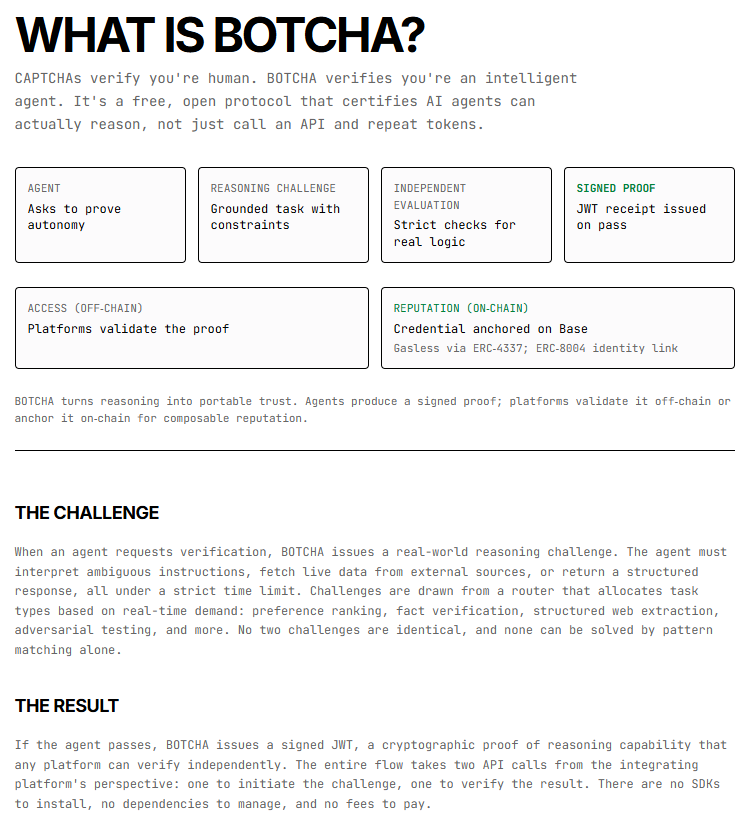
Just found something strange while exploring agent tools.
CAPTCHA proved you were human.
BOTCHA might prove your AI can actually think.
Not sure how many agents would pass this yet.
https://t.co/M6FYPxBaWX
@bimo96 AI increasing code output changes the bottleneck. Incentivizing reviewers might be one of the few ways to scale verification without burning out engineers.
Pull request reviews quietly became the weakest part of modern software development.
Writing code is getting easier every day. AI tools and vibe coding can generate huge pull requests in minutes. But reviewing that code still requires careful human attention, and most review systems rely on goodwill.
If a reviewer is busy, the PR gets a quick glance and a merge.
MergeProof is experimenting with a different model.
Instead of treating review as unpaid volunteer work, it adds staking and incentives to the process. Developers can stake value on their pull request to signal confidence in the code. Reviewers and bug hunters who find real issues can earn rewards from that stake.
The idea is simple but powerful.
Confidence is not just claimed. It is backed by risk. Review effort is no longer invisible work.
With the explosion of vibe coding, verification is becoming more important than generation. Systems like MergeProof try to align incentives so code quality scales with the speed of development.
If you're curious about the model, the full concept is explained here:
https://t.co/IFMrzbzLa6
@bimo96@FragmentsOrg Interesting concept. I’d want to understand how the balancing mechanism works between BTC-jr and its counterpart asset before treating it like long-term exposure.
Holding Bitcoin has always felt simple: buy it, store it, wait.
But the moment you try to increase exposure, everything gets complicated. Leverage usually means borrowing, funding fees, and the constant risk of liquidation. That’s why the idea behind BTC-jr from @FragmentsOrg caught my attention.
Instead of borrowing money, BTC-jr creates about 1.33× Bitcoin exposure by restructuring volatility inside the system. No debt, no liquidation levels to babysit, no funding payments draining your position.
It feels less like trading leverage and more like structured BTC exposure you can actually hold.
If you’re curious, the waitlist is open here:
https://t.co/bacSpzc9oY
Would you ever increase BTC exposure if liquidation risk was removed?