Mentite sapendo di mentire. Ecco le 63 raccomandazioni a tagliare il sistema sanitario pubblico e a privatizzarlo che la UE ha inviato tra il 2011 e il 2018 agli Stati membri.
[https://t.co/fokqSgo6O2]
@italy_exit La Commissione europea non ha mai chiesto all��Italia tagli alla spesa sanitaria che rimane un'area di competenza nazionale. Anzi ha più volte sottolineato come la spesa italiana fosse più bassa della media UE: https://t.co/fmulxbutJH
John Kenneth Galbraith wrote The Affluent Society in 1958 about a country drowning in private wealth while its schools, streets and public services went to shit.
Nearly 70 years later, Austrian economists are still arguing we haven't privatized enough.
Fucking brilliant.
scusate se ve lo segnalo a scoppio ritardato, ma se non avete visto questa inchiesta di @CarloLucarelli6#BluNotte sulla scomparsa del prof. #FedericoCaffè,dovete assolutamente vederla su @RaiPlay : è un pezzo di grande televisione nel pubblico interesse
https://t.co/9tpb1fg5J1
Quasi 5 miliardi in più alle armi, non alla Difesa. Perché i Carabinieri (usati strumentalmente nel titolo) portano a casa spiccioli, così come tutte le altre voci.
Ecco, è possibile chiedere e magari ricevere una risposta sul perché sia ritenuto più rispondente all’interesse pubblico spendere il denaro così, anziché , per esempio, non tagliare la rivalutazione sulle pensioni, tagliare l’Irpef, aumentare il fondo sanitario nazionale, ecc…
Dovrebbe essere il tema centrale del dibattito sulla legge di bilancio.
Delighted to debut in @Weltwoche with this piece about Donald Tusk’s EU-backed constitutional coup. In it, I explain that even though, at face value, this might seem like little more than a showdown between the government and opposition over control of the country’s highest court, it is actually part of a much larger power struggle within the EU establishment.
At its core, this is a battle over sovereignty in its most fundamental form: which legal order should prevail, the Polish constitution or EU law, when the two collide? In the past, the Tribunal has argued that the final word lies with the Polish constitution, not EU law — something Brussels has never forgiven it for. The supremacy of EU law over national law does not exist in any treaties; rather, it was created by the EU judiciary through a ruling made by the European Court of Justice (ECJ) known as Costa v ENEL in 1964. Since then, it has become the engine of EU “integration by law”: by constantly creating “laws” through its rulings, almost always in favor of “more Europe”, the ECJ has effectively become the bloc’s most important legislative and, indeed, constitution-writing body, thus hollowing out from above of national constitutional and legal systems. Alec Stone Sweet, an international-law expert, has termed this a “juridical coup d’état”.
A national constitutional court that rejects this principle represents an existential threat to Brussels. This is the real reason the EU was so adamantly opposed to Poland under the previous national-conservative government (and to Orbán’s Hungary for the same reason). This is ultimately what Brussels and Tusk refer to when they accuse the previous government, and the Tribunal itself, of having violated the rule of law. What they mean is that they dared to challenge the rule of Brussels’s law. This is the law Tusk wants to restore.
La solita favola monetarista: aumenta il bilancio della BCE, quindi aumentano i prezzi. Peccato che dopo il 2008 le banche centrali abbiano immesso liquidità senza precedenti, mentre l'inflazione è rimasta bassissima per oltre un decennio. Il bilancio della BCE non è il reddito delle famiglie. Se la liquidità resta prevalentemente nel circuito bancario-finanziario, senza tradursi in maggiore domanda, occupazione e salari, non genera automaticamente inflazione al consumo. Può invece gonfiare i prezzi degli asset. Nel 2022, secondo la stessa Banca d'Italia, circa due terzi dell'inflazione dell'Eurozona erano riconducibili ai rincari energetici. Alzare i tassi non produce gas né petrolio. Comprime la domanda e scarica il costo dello shock esogeno su famiglie e imprese. Prima di prescrivere la cura, sarebbe meglio azzeccare la diagnosi.
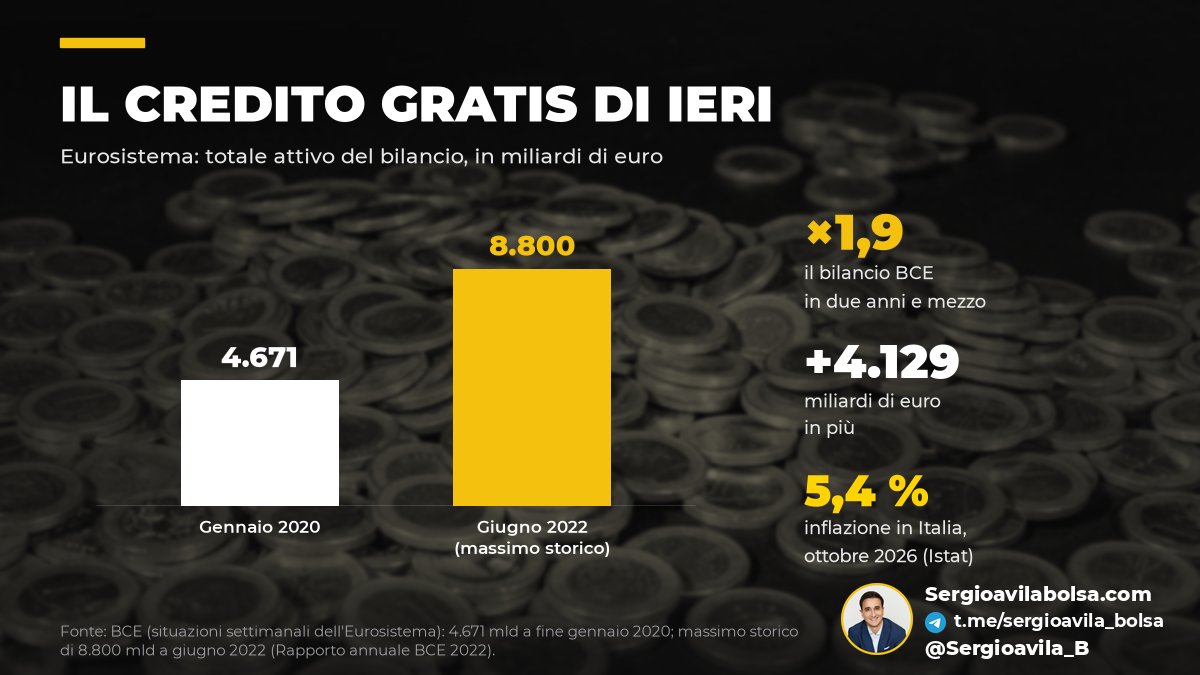
@Gitro77 Diagnosi a metà. Lo shock d'offerta rincara l'energia; perché salga tutto serve moneta. E la BCE ha portato il suo bilancio da 4.671 a 8.800 miliardi di euro tra gennaio 2020 e giugno 2022. Il paziente non lo ammazzano i tassi di oggi, ma il credito gratis di ieri.
Ennesimo capolavoro targato BCE che come di consueto tratta un'inflazione da offerta come fosse da domanda aumentando i tassi e aggravando così la crisi economica. Classico caso in cui per curare la malattia si ammazza il paziente.
Il problema non è l'inflazione percepita, ma quella cosiddetta reale che ha evidentemente fortissimi limiti. Sia nella rilevazione dei prezzi, sia nella composizione del paniere, sia nella distribuzione dei pesi assegnati alle singole componenti. L'aumento dei generi alimentari, per esempio, è nettamente superiore ai dati riportati da Istat (a parità di carrello della spesa, città e catena gli aumenti sono stati almeno il doppio di quelli riportati da Istat). Inoltre la quasi integrità di capacità di spesa di circa 3 famiglie su 4 riguarda generi alimentari, prodotti energetici (bollette e benzina) e spese per la casa. Categorie a cui dovrebbe evidentemente essere assegnato un peso maggiore all'interno del paniere. A conti fatti insomma l'inflazione percepita fotografa meglio la situazione di quella reale.
Actually, Germany ranked third in global GDP in 1990, behind the US and Japan. IMF data. Nice start.
And GDP size isn't productivity. Italian manufacturing productivity grew faster for decades, while Italy was catching up with West Germany in GDP per capita. By 1990, Maddison's figures even put Italy ahead of reunified Germany.
Then came reunification, wage suppression, Hartz reforms and an undervalued euro favoring German exports at its neighbours' expense.
Germany's economic model didn't emerge from some innate superiority. It increasingly relied on foreign demand, wage restraint and competitive asymmetries.
Try understanding the numbers before calling others clowns.
You're not mixing up timelines. You're rewriting economic history to fit your prejudices.
Italian manufacturing productivity grew 6.2% annually in the 1960s vs West Germany's 4.1%, and 3.1% vs 2.3% in the 1980s. UK Treasury figures, not Italian propaganda. Over 1974–95: Italy 3.8%, Germany 3.1% (EU-KLEMS).
The real divergence came later, especially from the mid-1990s.
So much for your claim that Italian productivity “never grew equally” with Germany. Perhaps try data before lectures.
@Gitro77 It absolutely has smth to do with Italian industrial decline, but you keep mixing up lira times with euro times.
Pre euro, Italian productivity per se was sub par and never grew equally with west Germany.
Post euro, it might be a different story but the euro has been bad
So exchange rates are basically productivity plus fiscal discipline? Fascinating. You just erased monetary policy, inflation differentials, interest rates, capital flows and balance-of-payments dynamics from international economics. Even the Bundesbank knows better.
And you accuse others of word salad? Try opening a macroeconomics textbook.
So you admit the DM appreciated against all major currencies, yet somehow Italy was uniquely guilty of “competitive devaluation”.
And since you insist on 1949–1989, Italian manufacturing productivity grew faster than West Germany's over much of that period. Exchange rates aren't a productivity scoreboard.
But your last point is revealing: you acknowledge how imposing the West German mark devastated East German industry.
Now apply the same logic to Italy: a monetary union that removed exchange-rate adjustment and progressively undermined industrial competitiveness.
Funny how monetary unions destroyed competitiveness in East Germany, but supposedly have nothing to do with Italy's industrial decline.
@Gitro77 Yeah, every major economy devalued against the DM, but Italy was the worst.
I was talking about 1949-1989.
You are mixing up timelines.
The post 1989 story is an entirely different one.
The DM was used to purposely destroy competetive remains of east German industry.
Amazing how the lira always “devalued”, but the Deutsche Mark never “revalued”. They're two sides of the same exchange rate. The franc and pound also depreciated against the DM. Perhaps everyone was cheating except Germany?
Meanwhile, Germany's own monetary union devastated East German industry: a massive real appreciation shock, industrial output down 50%.
Funny how exchange rates matter only when Italy is involved...
@Gitro77 Yeah, west Germany was doing pretty bad 1949-1989.
Especially during the 1980s.
Italian productivity grew so much they only had to devalue the lira against the DM.
The economic roots of these protests are undeniable. But are they the whole story? Most conservative commentators have focused instead on the presence of second-generation youths of Arab and African background, and on their leading role in the violence and looting, above all in France but also in Italy. For much of the right, the riots simply confirm what it has been saying for years: that mass immigration has been an unmitigated disaster, filling European cities with a largely Muslim underclass that has no interest in integrating, and that, in the crudest version of this narrative, is cast as bent on destroying the very fabric of Western civilisation, in some cases with the help of the ��far-left”. The demands of the overwhelmingly peaceful protests, meanwhile, go largely unheard.
There is an irony here. The populist right never tires of complaining that a “globalist establishment” has impoverished and deindustrialised Europe. Yet when young people take to the streets, sometimes violently, against that very establishment and the consequences of its policies, it cannot bring itself to believe that they might have genuine grievances. Instead, it instinctively assumes that someone must be pulling the strings: Islamists, Antifa, Mélenchon.
It is, of course, right to distinguish between the peaceful protests demanding economic reform and the rioting and looting that accompanied them. But are they really two entirely separate stories? There is no question that much of the looting, in France as in Italy, had a strong second-generation component drawn from the banlieues and the marginalised peripheries of Italian cities, with little discernible ideology behind it. Nor is there any point denying the costs of mass immigration, from public safety to the pressure on public services. Many of those involved in the violence were clearly acting out of opportunism. And the growth of separate communities of different social and religious backgrounds, often living in conditions of extreme exclusion, is clearly a social time bomb, one that has already done serious damage to social cohesion — and those on the left who deny this reality are as blinkered as those on the right who fixate on it at the exclusion of everything else.
One might go further and argue that mass immigration has itself been part of the neoliberal social engineering of recent decades, not least by creating a reservoir of cheap labour. One might also argue that rioters running amok at peaceful demonstrations damage the protesters’ own cause, drowning out their demands and handing the security forces a pretext for a crackdown. There have even been claims that the French police deliberately allowed the destruction to happen in order to justify mass repression.
These are all valid arguments. But they raise an obvious question: why do the protesters raging against the status quo not turn their anger on these immigrants and instead often march alongside them? Are they simply blinded by naïve left-wing ideology? Or is something deeper at work? It is more likely that they experience their struggle primarily through a generational lens, one that cuts across ethnic, and to a certain degree class, lines.
Read the article here: https://t.co/BWPwgBzI5j
Conveniently selective history. The Bundesbank was skeptical, sure. But German industrialists pushed for Italy to join the euro from day one.
Why? Because Italian industry was a formidable competitor and threatened German exports. Locking Italy into the euro removed that threat.
And yes, much of Italy's own political and economic establishment was complicit, sacrificing its industrial competitiveness to join the euro at all costs.
Those are historical facts too.
@Gitro77 The Bundesbank warned Italy to join the euro too early. It has been the Italian which wanted to join asap. These are just historical facts: https://t.co/yp4leNCIzR
Oh, Germany was so successful...
So successful that Italian productivity grew faster for decades. That VW had to dismantle a Fiat 128 to study how to build the Golf.
So successful that reunification devastated East German industry, while Bundesbank policies helped plunge Europe into the 1992 ERM crisis.
Then came Hartz, mini-jobs, wage suppression and an undervalued euro to boost exports at its neighbours' expense.
And let's not forget €869bn in special off-budget funds, heavily criticized by Germany's own Federal Court of Auditors.
Quite a miracle: suppress wages, rely on foreign demand, accumulate surpluses - then lecture your customers about living beyond their means.
That's not proof of economic superiority. It's a textbook beggar-thy-neighbour model.
@Gitro77 You are aware that Germany managed to exist pretty successfully before the introduction of the Euro, right? It was Germany's success that caused countries like Italy to peg the Lira to the Deutsche Mark and ultimately push for the Euro...