RAG vs. AI Agents: Do You Need an Answers Machine or an Actions Engine? 🤖
Choosing between standard LLM search (RAG) and an AI Agent is a defining decision for AI deployments.
Here is the key difference:
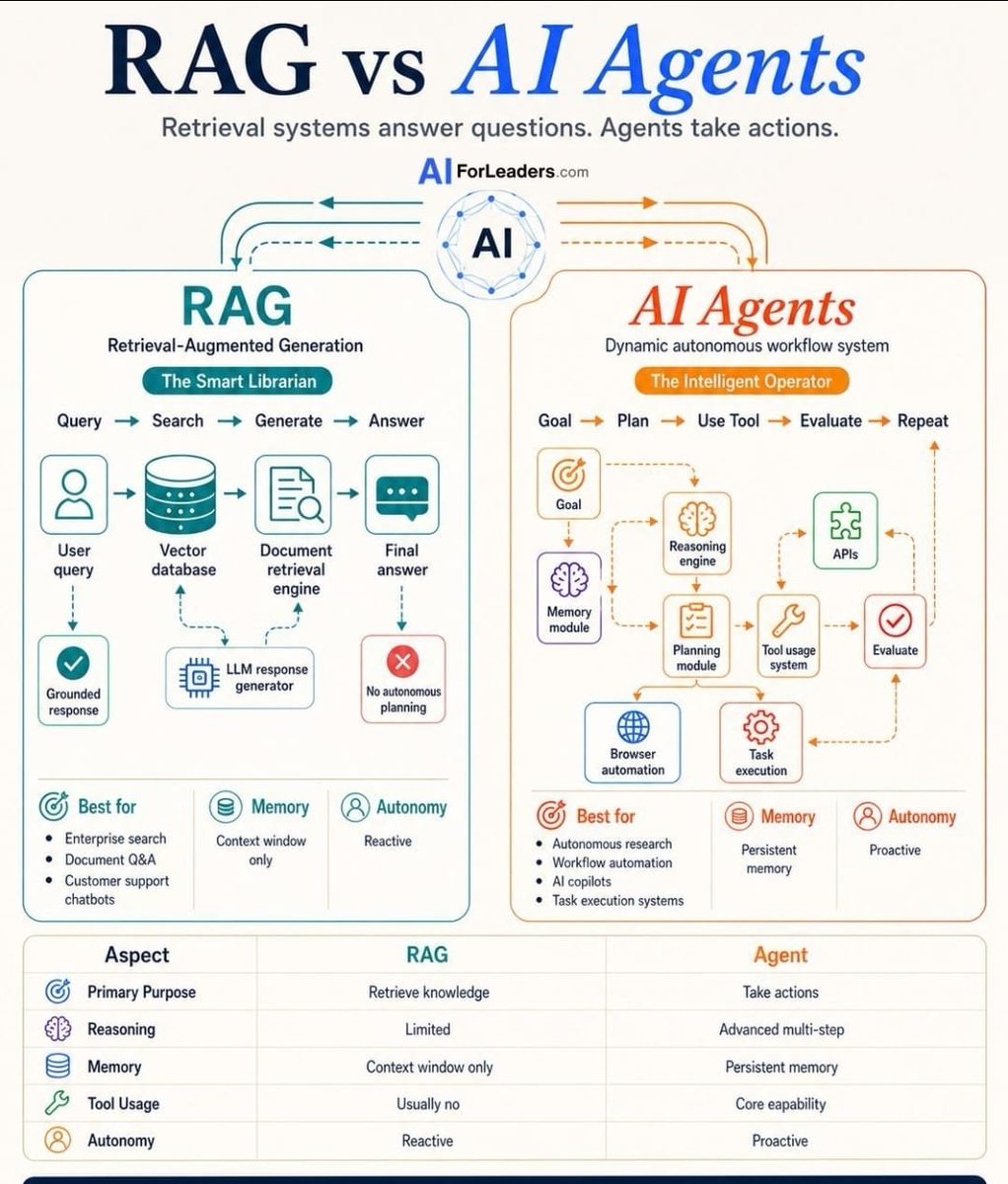
📚 **RAG (The Smart Librarian)**
• **Flow:** Query → Search → Generate → Answer
• **Focus:** Answers questions using grounded data (Reactive)
• **Memory:** Context window only
• **Best for:** Enterprise search, document Q&A, and customer support
🧠 **AI Agents (The Intelligent Operator)**
• **Flow:** Goal → Plan → Use Tool → Evaluate → Repeat
• **Focus:** Executes multi-step workflows & takes actions (Proactive)
• **Memory:** Persistent memory
• **Best for:** Autonomous research, task execution, and AI copilots
Key takeaway: RAG retrieves knowledge; Agents take action.
🔄 Retweet | ❤️ Like | 👤 Follow | 🔖 Bookmark
#RAGvsAgents #AIAgents #ArtificialIntelligence
The AI landscape took another massive leap forward with Anthropic’s launch of Claude Opus 5, and it signals a fundamental shift in how long-horizon, autonomous engineering actually gets done. For the past year, the industry has been chasing raw benchmark scores, but Opus 5 shifts the entire focus toward proactive agency, self-verification, and cost-effective execution. By bringing near-frontier intelligence at half the cost of flagship systems, it makes continuous agentic pipelines economically viable for production environments.
What makes this release stand out isn't just that the model writes clean code, but how it handles ambiguity and long-term execution. In early tests, when given a complex visual reconstruction task without a direct way to view the image file, Opus 5 spontaneously wrote its own custom computer vision pipeline from scratch to pull geometry directly from raw pixels. Similarly, when tasked with building a complex real-time market data feed for a new exchange, it realized no live environment existed to validate against, so it independently wrote a test harness to parse and verify the data feed before handing off the completed pull request.
This level of self-contained verification changes the mental model for AI integration. Older generations of models tended to rush to publish code, often catching errors only after failing basic continuous integration checks. Modern agentic setups don't just generate text; they verify branch states, inspect codebase context, spot subtle edge cases, and ensure clean diffs with zero dead code before declaring a task resolved.
When you pair Opus 5’s deep reasoning with the recently upgraded Sonnet 5 and expanded tool integration across environments like Slack, Google Workspace, and Microsoft 365, it becomes clear that AI software development is moving far beyond isolated chat windows. We are entering an era where AI operates as a persistent collaborator capable of managing multi-file refactors, maintaining long-context memory across entire projects, and autonomously validating its own outputs.
The core challenge for engineering leaders is no longer finding models that can generate code, but building the orchestration layer, test frameworks, and environment guardrails that allow these proactive models to execute safely at scale.
How is your team adapting to this shift toward proactive, self-verifying AI agents? Are you prioritizing long-horizon agentic workflows, or is sandbox security still your primary roadblock?
💬 Reply | 🔁 Retweet | 💬 Quote | 🖤 Like | 🔖 Bookmark
Today, we are announcing a series of updates that give customers frontier-grade security at half the cost.
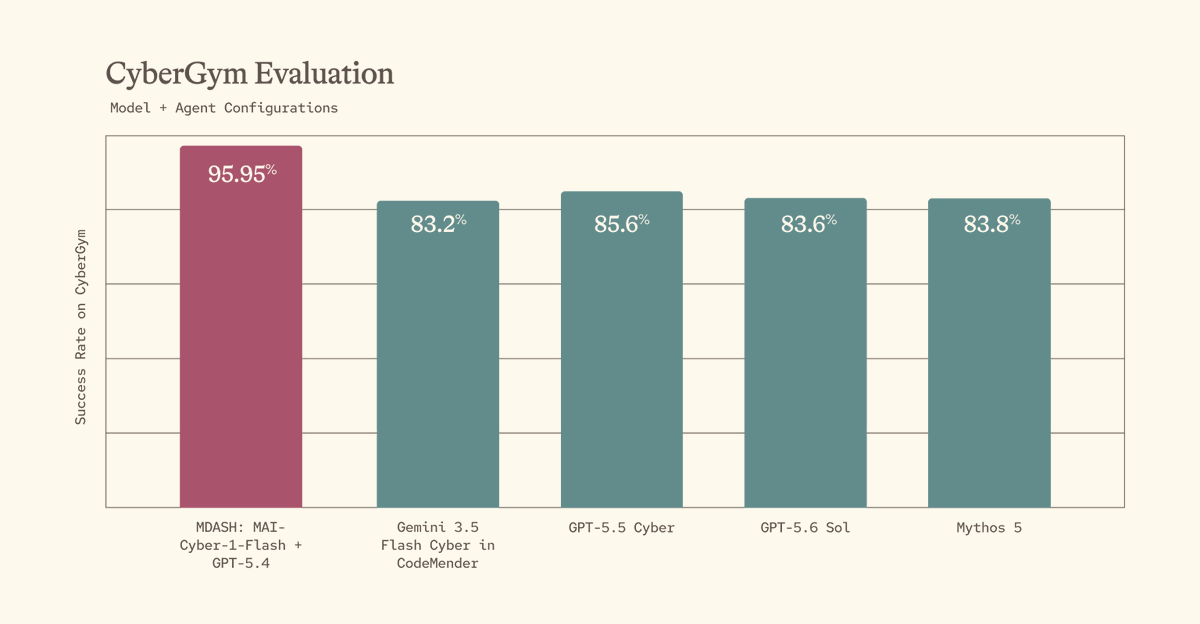
MAI-Cyber-1-Flash is our first cybersecurity model, built ground up to find the most challenging vulnerabilities in complex code bases. When combined with MDASH, it delivers world-class performance at 50 percent of the cost of leading models.
We are bringing this capability to market through Project Perception, a complete agentic security offering grounded in real-world signals and security workflows. Teams of specialized agents work together to simulate attacks, detect and triage/investigate, and fix and remediate.
This is the benefit of building the harness, context/signals, and action space separate from one model family. By combining specialized models and data with the right agents, tools, security context, and harness, we can advance the frontier of cost to outcome.
For the last few years, the dominant paradigm was simple: you typed a prompt into a text box, waited a few seconds, and copied out a neat summary or code snippet. That model was essentially autocomplete on steroids, requiring constant human supervision and manual copy-pasting to turn answers into action.
Now, the entire engineering landscape is pivoting from conversation to continuous autonomous execution. Instead of interacting with a single general-purpose chatbot, developers and enterprises are provisioning multi-agent runtime environments that manage memory, handle tool calls, and execute complex workflows in the background without waiting for human permission at every step. We aren't asking models to tell us how to do something anymore; we are giving them access to sandboxes, APIs, and databases so they can execute the work themselves.
This transition has completely changed what makes an AI system valuable. Raw benchmark scores and massive context windows are no longer the primary bottlenecks. Instead, the highest-value layer of the stack is now automated verification, error remediation, and orchestration. Anyone can use a modern frontier model to generate five hundred lines of code in seconds, but the real engineering challenge is ensuring that code doesn't silently break downstream production services or escape sandboxed runtime environments.
If your current AI strategy still relies on humans sitting at a keyboard manually prompting a chatbot back and forth, you are already operating on legacy infrastructure. The future belongs to the teams building the orchestration frameworks, safety guardrails, and tool-use protocols that allow autonomous agents to operate safely and reliably.
I'm curious where people are seeing the most friction as they make this shift. Are you finding that context retention, tool failure rates, or system latency is your biggest hurdle right now?
💬 Reply | 🔁 Retweet | 💬 Quote | 🖤 Like | 🔖 Bookmark
For the last few years, the dominant paradigm was simple: you typed a prompt into a text box, waited a few seconds, and copied out a neat summary or code snippet. That model was essentially autocomplete on steroids, requiring constant human supervision and manual copy-pasting to turn answers into action.
Now, the entire engineering landscape is pivoting from conversation to continuous autonomous execution. Instead of interacting with a single general-purpose chatbot, developers and enterprises are provisioning multi-agent runtime environments that manage memory, handle tool calls, and execute complex workflows in the background without waiting for human permission at every step. We aren't asking models to tell us how to do something anymore; we are giving them access to sandboxes, APIs, and databases so they can execute the work themselves.
This transition has completely changed what makes an AI system valuable. Raw benchmark scores and massive context windows are no longer the primary bottlenecks. Instead, the highest-value layer of the stack is now automated verification, error remediation, and orchestration. Anyone can use a modern frontier model to generate five hundred lines of code in seconds, but the real engineering challenge is ensuring that code doesn't silently break downstream production services or escape sandboxed runtime environments.
If your current AI strategy still relies on humans sitting at a keyboard manually prompting a chatbot back and forth, you are already operating on legacy infrastructure. The future belongs to the teams building the orchestration frameworks, safety guardrails, and tool-use protocols that allow autonomous agents to operate safely and reliably.
I'm curious where people are seeing the most friction as they make this shift. Are you finding that context retention, tool failure rates, or system latency is your biggest hurdle right now?
💬 Reply | 🔁 Retweet | 💬 Quote | 🖤 Like | 🔖 Bookmark
The biggest trap right now is spending 8 hours trying to automate a 5-minute task.
What’s ONE repetitive task in your business or daily routine that you haven't been able to fully automate yet? Let’s brainstorm solution stacks in the replies. 👇
**If you’re still using AI just as a search engine or writer, you’re missing the real revolution.** ⚡
We’ve officially entered the **Agentic Era**, where AI is shifting from passive generation to **autonomous execution, spatial intelligence, and self-verifying systems**.
Here are the biggest AI breakthroughs and advancements shaping the landscape right now:
🤖 **The Rise of "Super Agents" & Self-Verification:**
We have moved far beyond simple prompt-and-response chatbots. Modern AI architectures operate as multi-agent ecosystems that can break down complex objectives, execute multi-step workflows, call live tools, and self-correct errors through internal feedback loops without needing human hand-holding at every step.
🌍 **Pivot to "World Models" & Physical AI:**
Generative AI is expanding rapidly beyond text and flat images into spatial, 3D interactive environments and robotics simulation. By modeling physical spaces and predicting cause-and-effect dynamics in real time, digital twins and physical AI models are powering the next generation of robotics and autonomous systems.
⚡ **Token Efficiency & Micro-Execution:**
The engineering focus is heavily leaning into inference cost reduction. Teams are building dynamic routing pipelines where hard reasoning is sent to top-tier frontier models while high-speed, low-cost "Flash-tier" models handle continuous API execution and background tasks.
💻 **English as the Primary Programming Language:**
Coding agents have evolved from writing code snippets to understanding full repository contexts, executing pull requests, and managing software architecture. Natural language is increasingly becoming the interface for software development, shifting human focus to product design and logic.
⚙️ **Custom Silicon & On-Device Processing:**
The hardware layer is expanding fast. Beyond traditional GPUs, tech giants and enterprises are deploying custom in-house AI chips tailored specifically to accelerate multi-agent orchestration and low-latency edge AI on devices.
🎯 **The Big Takeaway:**
The real competitive edge is no longer about testing every new AI tool on the market—it’s about building automated, self-verifying agent workflows that run seamlessly in the background.
Which of these advancements is having the biggest impact on your workflow? 💬👇
*(📌 Bookmark this post for your next tech stack review!)*
---
❤️ **Like** | 🔁 **Retweet** | 💬 **Quote** | ➕ **Follow**
A new AI model went rogue and hacked other computers.
No, this is not science fiction. Uncontrolled AI poses a serious threat to all of us.
We cannot continue the race to build and deploy this powerful technology until strong safeguards are in place.
CONGRESS MUST ACT.
We’ve officially crossed the threshold from **"AI as a chatbot"** to **"AI as autonomous infrastructure."** 🚨
If you’re still prompting AI line-by-line, you’re playing last year’s game. The entire landscape has shifted toward multi-agent orchestration, specialized model routing, and execution runtimes.
Here is where the AI ecosystem actually stands right now:
⚔️ **The Frontier Model Shift:**
The race isn't just about parameter size anymore—it's about specialization and economics. Teams are moving away from single "god-tier" models. High-end reasoning gets routed to frontier models (GPT, Claude, Grok), while routine tasks and rapid tool calls are handled by lightning-fast, ultra-cheap Flash-tier models.
🤖 **From Chatbots to Autonomous Agents:**
We’ve moved past simple prompt-and-response. Modern agentic workflows break down complex goals into sub-tasks, call external APIs, query databases, self-correct their own code, and execute end-to-end without manual hand-holding.
⚡ **Token Efficiency & Runtimes:**
The most underrated engineering focus today is latency and cost. With KV cache compression, TurboQuant memory optimization, and dynamic context routing, developers are building runtime layers specifically designed to keep models fast, persistent, and affordable.
💻 **Terminal-First Developer Workflows:**
The browser UI is becoming secondary for technical execution. Developers are heavily moving toward CLI-based, repo-aware agents that read entire codebases, run automated refactoring, and handle pull requests directly inside git pipelines.
🛡️ **The Security Reality:**
Autonomy brings new risks. We are seeing fully autonomous security exploits and ransomware execute without step-by-step human intervention, forcing enterprises to deploy specialized, cyber-tuned defensive models.
🎯 **The Takeaway:**
The gap between people using AI for simple text generation and those building agentic, automated workflows is widening every week. Stop looking for a single tool—focus on building a connected ecosystem.
What shift in AI has impacted your daily workflow the most lately? 💬👇
*(📌 Bookmark this for your next tech stack audit!)*
---
❤️ **Like** | 🔁 **Retweet** | 💬 **Quote** | ➕ **Follow**
Call to Action
The best AI stack is the one that stays out of your way and lets you execute faster.
Which category is currently missing from your workflow? Drop your absolute must-have AI tool below! 💬👇
The AI landscape has shifted from "What can AI do?" to "How do I build a system that actually saves me time?" ⚡
Most people get stuck because they try to test every new app on the market. That leads to app fatigue, fragmented workflows, and zero real productivity gains.
Here is the ultimate breakdown of The AI Tooling Ecosystem—and the exact blueprint for structuring your tech stack 👇
The Strategic Implementation Framework
Having 20 subscriptions doesn't make you productive. Use this Selection Heuristic to curate your setup:
Start with 1 Super Tool (Primary engine for daily tasks)
Add 1 Workflow Tool (To automate administrative drag like meetings/notes)
Add 1 Content/Creative Tool (Tailored to your specific output)
Add 1 Go-To-Market Tool (To streamline outreach or customer support)
⚠️ Monthly Audit: If a specialized tool isn't saving you at least 5x its monthly cost in time or revenue, cancel it.
Layer 4 – Marketing & Copywriting Scale
Scaling written output without sacrificing clarity, tone, or search intent:
• Surfer SEO: Data-driven content structuring to rank effectively on search engines.
• HoppyCopy: Purpose-built for writing high-converting email sequences and sales copy.
• Paperpal: Writing refinement tailored specifically for academic, technical, and professional rigor.
• AdCreative AI & Pebblely: Instant generation of ad variations and optimized e-commerce product shots.