@remarks Scientist here.
Anecdotal evidence also suggests, that on top of environmental concerns, paper straws are also worse at being straws.
Follow me for more scientific analysis of current events.
@nypost Scientist here.
Anecdotal evidence also suggests, that paper straws are also worse at being straws.
Follow me for more scientific analysis of current events.
For details of which demographics likely voted for whom, see my analysis of polling leading up to the Toronto mayoral election.
Polls looked much more tight than how the results ended up, but the demographic data is still relevant.
https://t.co/lbVfwuw1xB
The Toronto mayoral election has concluded with Olivia Chow beating Brad Bradford by far more than expected.
What many thought would be a tight race, turned out to have a clear winner.
The question many are asking is, where did all the support for Chow come from?
The answer, according to polls, is:
Youth
Downtown
Scarborough
Those who haven't lived in the city very long.
Those renting homes or living for free with friends and family.
Those without small children.
Who opposed chow? According to polls:
North York
Etobicoke
Men
Older people
Home owners
Those with small children
Many claim that the record low alcohol consumption is due to affordability, but the data doesn't support this.
The drop in alcohol consumption is mainly coming from young Republican women. That's the same demographic that's having the most babies.
A baby boom may be on the way.
Americans are drinking less than at any point since Gallup started tracking it in 1939.
Just 54% of U.S. adults say they drink alcohol, an all time low.
That’s down from 62% in 2023.
@unusual_whales Statistics professor here.
Record low US alcohol consumption is primarily due to young Republican women drinking less.
That's also the demographic that has the most babies. The decline in drinking could be the early signs of a baby boom.
See my full analysis quoted below.
US alcohol consumption is at a record low...
But a closer look at the data shows that it's only centrists and Republicans who are drinking less, and it's primarily young Republican women.
See my full analysis in the comments.
The decline in drinking could mean the US is in the early stages of a baby boom.
1/3
My video analyzing the historical correlation between low alcohol consumption and an increasing fertility rate.
It very much looks like the US is going through such a process, with record low alcohol consumption, mainly due to young Republican women.
3/3
https://t.co/TIqyPf39oB
US alcohol consumption is at a record low...
But a closer look at the data shows that it's only centrists and Republicans who are drinking less, and it's primarily young Republican women.
See my full analysis in the comments.
The decline in drinking could mean the US is in the early stages of a baby boom.
1/3
My video on data showing that US alcohol consumption is at a record low.
Young Republican women drinking less, is the main reason for the decline. That's the same demographic having the most babies.
This could mean a baby boom is coming.
2/3
https://t.co/KgfvJPw2ee
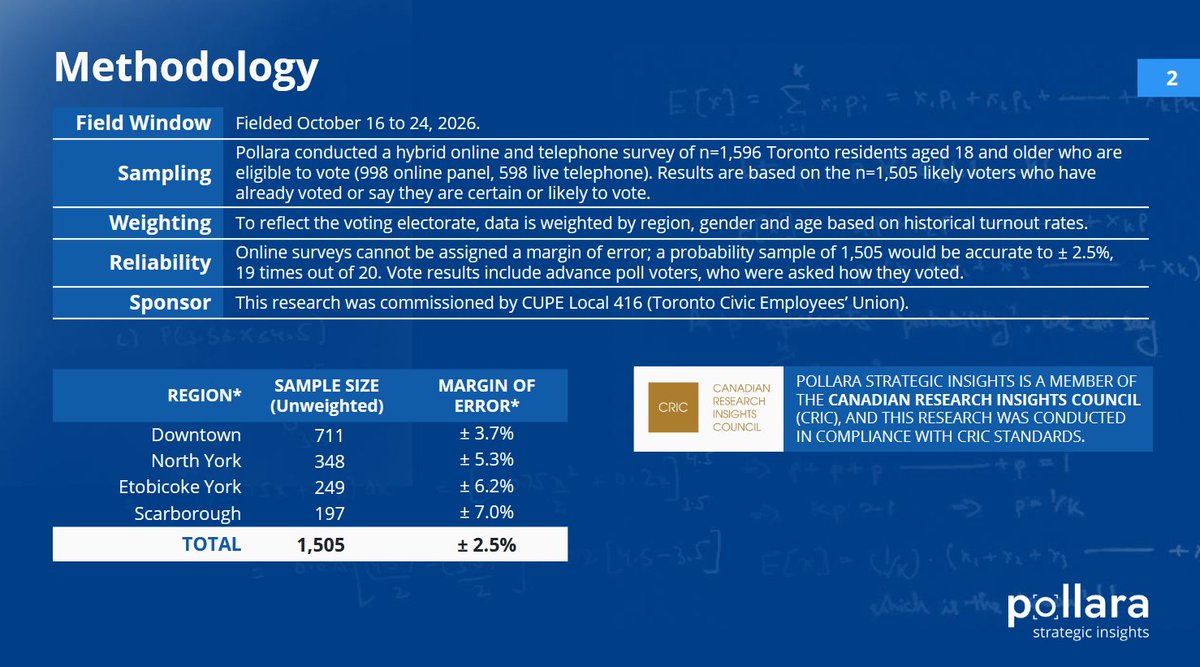
The Pollara poll on the Toronto mayoral election declares that they cannot assign a margin of error to the results, because those results are at least partially from from an online survey.
That means that they cannot predict how far off their results might be.
Even if such a sample size could have a margin of error, those margins of error are huge!
For example, only 197 people sampled in Scarborough, with a huge margin of error of 7%. And taking into consideration the fact that a margin of error cannot be assigned in such a way to an online poll, it's reasonable to assume that the real error could be even larger than that.
So, even without the suspected oversampling of downtown, there's reason to believe that this poll could be very much off.
I've long respected some of the people behind Pollara.
Their polling on Toronto's mayoral race is strange though.
Their latest poll of 1,505 people has a downtown sample of 711.
Does that make sense to anyone?
Meanwhile, North York is 348, Etobicoke 249, and Scarborough 197.
Statistics professor here.
The Pollara poll declares that they cannot assign a margin of error to the results, because it is at least partially from an online survey.
That means that they cannot predict how far off their results might be.
Even if such a sample size could have a margin of error, those margins of error are huge!
For example, only 197 people sampled in Scarborough, with a margin of error of 7%. That's a huge margin of error! And taking into consideration the fact that a margin of error cannot be assigned in such a way to an online poll, it's reasonable to assume that the real error could be even larger than that.
So, even without the suspected oversampling of downtown, this poll could be very much off.
To those interested in a thorough analysis of recent polling results, see my video quoted below.
https://t.co/hXoebX3Xyd
The Toronto mayoral election is tomorrow, with Bradford and Chow at a dead heat.
Different polls show different candidates ahead, and several show a statistical tie, but the general trend is Bradford gaining ground.
See my full analysis in the comments.
Some highlights:
1. Downtown is pro Chow
2. North York, Etobicoke, and men are pro Bradford
3. Women and Scarborough are divided.
My analysis of Toronto mayoral election polls.
Some polls favor Brad Bradford, while other polls favor Olivia Chow, but they tend to agree that it's a very tight race, and Bradford is gaining ground.
Some very interesting demographic data here.
Enjoy!
https://t.co/i69sCvFtZc
The Toronto mayoral election is tomorrow, with Bradford and Chow at a dead heat.
Different polls show different candidates ahead, and several show a statistical tie, but the general trend is Bradford gaining ground.
See my full analysis in the comments.
Some highlights:
1. Downtown is pro Chow
2. North York, Etobicoke, and men are pro Bradford
3. Women and Scarborough are divided.
My video analysis of the Alberta referendum results.
What they are, and why they are what they are.
In short, voters want to remain part of Canada, but want more autonomy from the federal government.
Enjoy!
https://t.co/OLyKEb5qBL
The Alberta referendum resulted in an overwhelming vote to remain part of Canada, but there were many other questions on the ballot.
Looking at all the answers, the general message from voters is that they want more autonomy.
See my full analysis in the comments.