Voyager 1 is 24 billion kilometers from Earth.
It communicates with us using a 23-watt transmitter.
Less than a refrigerator light bulb.
The signal takes 22 hours to reach us, traveling at the speed of light.
By the time it arrives, it's 20 billion times weaker than the power of a digital watch battery.
NASA's Deep Space Network picks it up using 70-meter dish antennas cooled to near absolute zero to reduce electronic noise.
The engineering required to hear a 23-watt signal from 24 billion km away is arguably more impressive than the spacecraft itself.
Launched 1977.
Still transmitting.
Still being heard.
We built something that works perfectly, 47 years later, in conditions no one has ever tested in.
That's what engineering for the long term looks like.
Around $3 Trillion dollars were laundered through banks in 2025 despite the warrantless surveillance regimes they facilitate for governments. And they want you to think that people making peer-to-peer transactions on chain are the problem that needs to be outlawed.
An infinite number of modern Trek writers typing for an infinite amount of time could never come up with something as great and inspiring as Kirk's 'Risk is our Business' speech.
Let me be clear.
There is no legitimate business reason for anyone to have these personal records about you.
Even government counterterrorism/crime needs would be better addressed with limited zkproof-based gating of trusted financial on and off ramps w/o mass surveillance.
🌀Tropical Cyclone Alfred 🌀
#onlyinaustralia
Don’t let a fallen tree stop you getting onto the M1.
Natural disasters either bring out the worst in humanity or the best. Everyone working together to get home safely.
.@Snowden on how he came to participate in the original Zcash ceremony:
“I was aware of it from a professor at Johns Hopkins University by the name of Matthew Green. I think he tweeted a link to a paper called Zerocash. This was before it became Zcash. And I just saw the idea of this. Of course, I had been a longtime Bitcoin user, and I was like, ‘This is amazing. This is incredible.’
It’s something very important that, frankly, should have been integrated into the actual Bitcoin network through protocol improvements at that period in time. But they hadn’t really taken privacy seriously, and unfortunately, they still don’t.
So, I was looking at this more like an academic project than some kind of—everybody makes crypto coins now to try to get a capital return on it. But this, they were going, ‘How do we get this key—construct this key—that if anybody had it, it would be harmful, and how do we make sure nobody does?’
So they created this thing called the ceremony, where they would basically do a cryptographic round among many different participants around the world—different people.
The way it was structured was such that if there was one honest person in the entire cohort, the dangerous part, the dangerous properties of this key, wouldn’t exist. You could basically ensure the network was fully safe.
And all you needed was one honest person—one person whose keys weren’t stolen, whatever. Everybody else could be against it, could be trying to exploit it, could be doing whatever, and it would work.
This was something that I got approached about. I can’t recall actually who approached me. It might have been @zooko—I believe it probably was Zooko—who might have gotten to me because I had written about this paper and my interest in it and said, ‘Hey, would you be willing to serve as a part of this ceremony?’
And I went, ‘Well, why not?’ You know, I am one person where nobody knows where I am, what I’m doing, whatever. It would be very hard to target me. I know quite a lot about computer security, but at the same time, I can at least have the honesty layer.
So my sort of vulnerability in this would be hacking, right? It would be surveillance, it would be cameras in the walls from the Russians or whatever, stealing my computer, using a bad computer, or whatever. Other people might not have a hacking risk—they might have a social risk, they might have an honesty risk, something like that.
But by being a part of this larger cohort, you could make sure that basically nobody cheated the network, and it worked, right?
Since then, there have never been any—as far as anyone knows—sort of greater emissions that should have happened on the network.
And eventually—and this is why it came out later—they moved beyond it, and that key is no longer used. It’s no longer a threat to the network. That whole sort of proving channel is gone. And they used a more modern solution that didn’t have these same risks.”
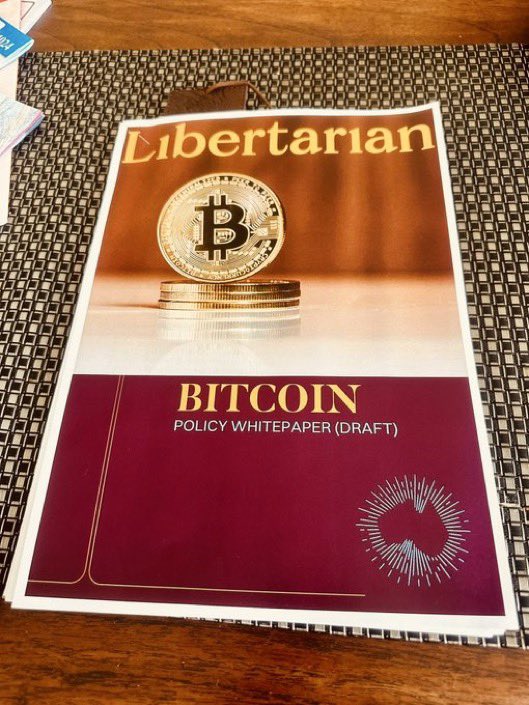
I think there is a few with us vying for the CBO roll within the party. That aside, the @LibertariansAus are absolutely 💯 committed to removing CGT from Bitcoin disposal and giving Aussies 🇦🇺 much needed currency 💵 options. The best money is born of the private market, not a manipulated product brought to you by centralised controllers.
#pow #btcismoney
I contributed to the Privacy Pools Ceremony! You can view the steps to contribute here: https://t.co/ZRfelg3sBa You can view my attestation here: https://t.co/z2wHhec8G3
The Trusted Setups project has added great value to the Ethereum and ZK ecosystems. Its legacy continues through shared tools and knowledge. Special thanks to @glamperd, @ctrlc03, @0xjei, @Chia_Tea, @kld_diagne, and @nicoserranop for their contributions over the years ❤️🙏❤️