«Sois socialistas no para amar en silencio vuestras ideas, sino para llevarlas a todas partes».
Hoy, al cerrarse la legislatura, finaliza mi etapa como diputado en el Parlamento de Andalucía. Esta frase de nuestro fundador, Pablo Iglesias Posse, cobra más sentido que nunca. 🌹
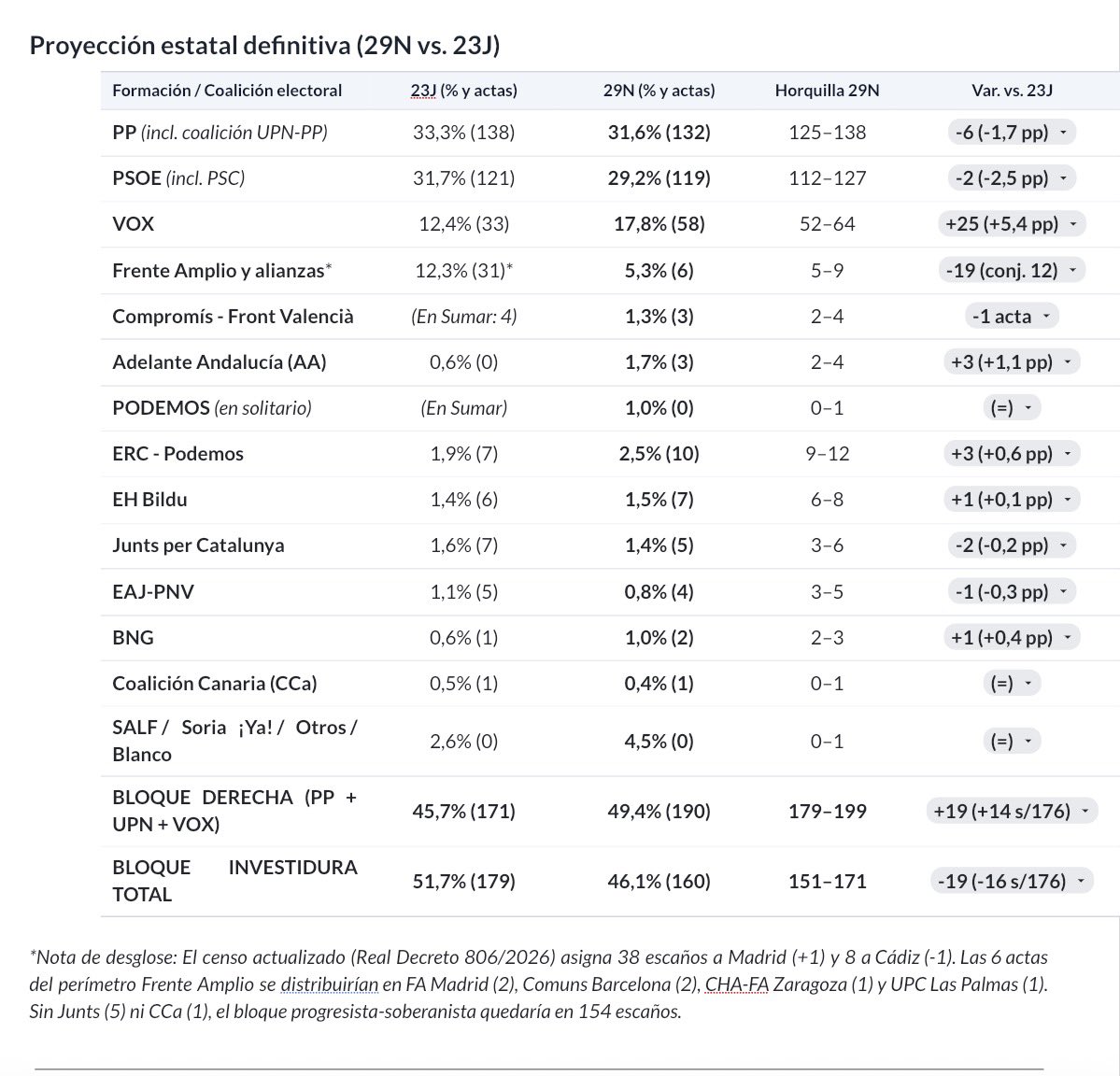
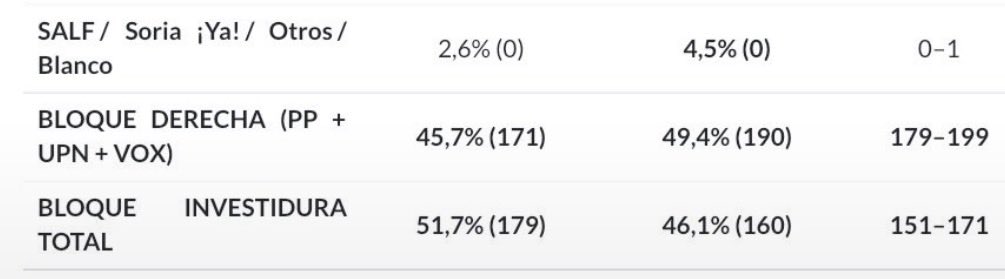
Comparto mis estimaciones de las elecciones generales del 29N para el conjunto de España. Están realizadas con un modelo econométrico sobre la base de las más de 140.000 encuestas realizadas por las diferentes encuestadoras públicas y privadas, debidamente tratadas.
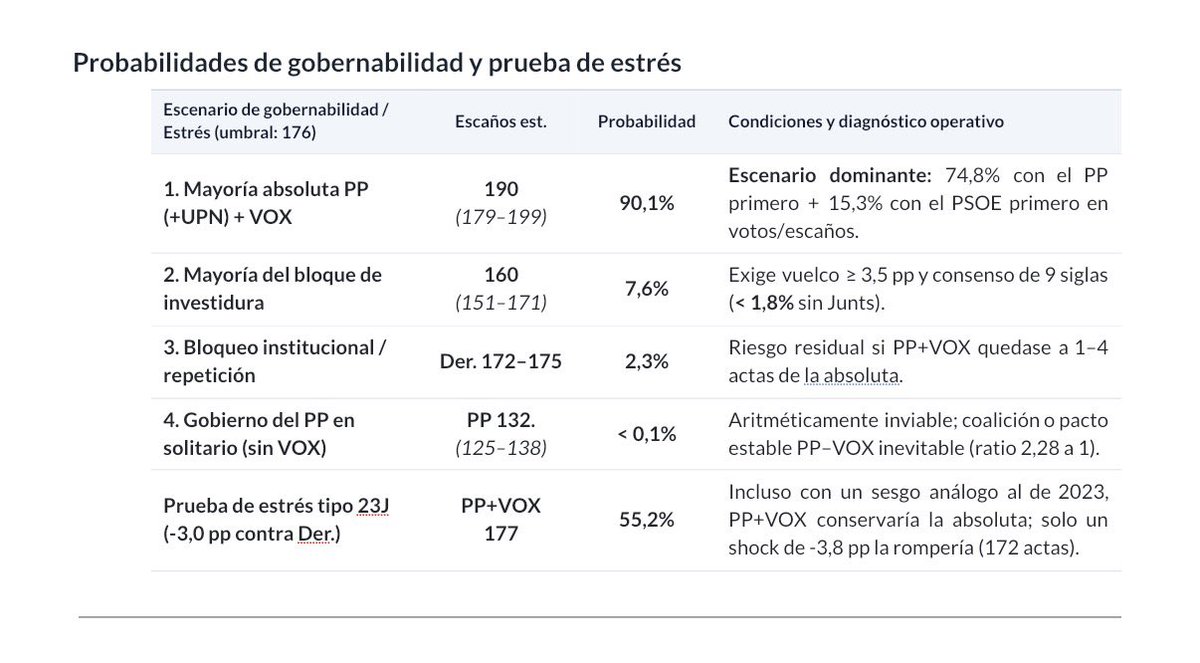
Es decir, a solo 3,8 puntos porcentuales se sitúa el Psoe del PP de poder ganar las elecciones y seguir en el gobierno de España. A sensu contrario, el Pacto PP+VOX tiene más de un 90% de probabilidad de ganarlas.
@JordiLlatzer 🔹 CIS (Estudio 3587). Reponderado por recuerdo real del 23J:
- PP 30,2%–30,9% ·
- PSOE 28,9%–29,0% ·
- VOX 18,5%–19,0%)
- Gana el PP: ~70%–75% (ventaja corta).
- Gana el PSOE: ~25%–30%.
- Gobierna PP + VOX: ~90% (48,7%–49,9% y 188–193 escaños).
- Coalición actual menos 2%
Interesante y amplia entrevista a @judith_arnal, economista cuyas opiniones son siempre dignas de tener en cuenta.
Algunas cuestiones que aborda:
• Fondos europeos: cumplieron su función de amortiguar la crisis, pero su impacto transformador sigue pendiente de evaluación. Cuestiona la centralización y atomización de las inversiones.
• Vivienda: advierte del grave déficit de oferta, con importantes consecuencias sociales y económicas. Cuestiona las medidas que estimulan la demanda sin aumentar la oferta.
• Pensiones: propone abordar su coste de oportunidad, dadas las previsiones de aumento del gasto... Reclama un debate adulto, informado y no polarizante.
• Ferrocarril: cuestiona la limitada rentabilidad socioeconómica de buena parte de las inversiones en alta velocidad y reclama evaluaciones independientes. Señala la baja intensidad de utilización de la red española respecto a otros países europeos.
• China: reconoce su capacidad de planificación estratégica y advierte del próximo desafío en IA y robótica, rechazando que pueda sustituir económicamente a EEUU para España.
• Productividad: advierte de su escaso crecimiento en España y señala el tamaño empresarial y el talento como factores fundamentales para mejorarla.
• Europa: considera que la futura emisión de deuda común deberá justificarse mejor mediante inversiones en bienes públicos europeos, como defensa e interconexiones energéticas..
https://t.co/ki0DAlPbb3
En relación con el artículo de @angel_munarriz hoy en @el_pais, publico un hilo sobre los estados de ánimo de la ciudadanía. La política es eso: hacerse cargo del estado de ánimo. ¿Cómo se sienten los españoles? ¿Y cada uno de los votantes? Abro hilo con datos de @metroscopia 👇
«Cuando se advierte que el adversario es superior y que uno no conseguirá llevar razón, personalícese, séase ofensivo, grosero.»
Autor: Arthur Schopenhauer (1788-1860)
Vivimos tiempos extraños, tiempos en los que los estrategas celebran públicamente su propia brillantez antes de comprobar si sus criaturas han tenido éxito o han fracasado.
i want to bring to the attention of people outside spain what i think is a pretty sad hijacking of a public institution, one that should serve everyone, to favour the party in government.
the CIS (centro de investigaciones sociológicas, or centre for sociological research) is spain's public polling institute. it goes back to 1963, when its predecessor was founded, and it took its current name in 1977. its president is appointed and removed by the government, but by law it must act with "objectivity and neutrality". this institution is a big provider of public goods: besides its flagship product (the monthly political barometer), it runs dozens of surveys a year on things few private firms would pay to ask about, from taxes and inequality to sexual health or love and relationships, and it makes the microdata freely available. it has resources no private pollster has, and researchers and journalists (me included) use its data all the time.
in june 2018, a few weeks after pedro sánchez became prime minister, his government appointed josé félix tezanos as president of the CIS. tezanos is a sociology professor and has been a member of the socialist party (PSOE), the party that leads the government, since 1973. when he was appointed he sat on the party's national executive (its top leadership body) as head of research and policy programmes, which put him in charge of the party's election manifestos (he left that post about ten days later, after criticism from the opposition). since then, the CIS's vote estimates have leaned systematically towards the socialists.
one can show this with a very simple exercise. for each general election, wikipedia compiles the results of every published opinion poll (for the 2026 election, they are here: https://t.co/e91jvSrjnC). using those tables, for every CIS vote estimate since 1997 i take the PSOE lead over the centre-right people's party (PP) and subtract the average lead in the private polls whose fieldwork ended within 21 days of the CIS's. i leave out polls commissioned by the parties themselves and the re-estimates that other analysts make with the CIS's own raw data. each firm counts once, even if it published several polls in the window (in that case, i take the average of its polls). from 1997 to 2018 the CIS was in line with everyone else: on average, a difference of about zero (+0.1 points). but since tezanos was appointed, the CIS has given the PSOE a lead 8.4 points larger than the average of private pollsters. in 91% of its estimates it gives the PSOE a bigger lead than every single private pollster in its window.
if i showed this chart at an economics seminar, i think most people would find it pretty convincing evidence that something changed at the CIS in 2018. but let's go through some potential objections. suppose private pollsters have drifted to the right since 2018 (it would be odd for them to jump so sharply just after tezanos was appointed, but for the sake of argument let's treat it as a real possibility). in that case, a CIS that stayed put would look more and more pro-PSOE simply because everyone else moved. or the mirror image: everyone, the CIS included, leaned to the right before 2018, and the CIS was the one that fixed it after that.
the data suggest this is not what happened. first, the gap holds no matter who you compare the CIS with. against 40dB alone, el país's pollster (el país being a centre-left newspaper), it is 7 points since march 2019, compared with 9.2 with all firms on the same dates. dropping five firms that mostly work for right-leaning outlets (sociométrica for el español, nc report for la razón, data10 for okdiario, target point for el debate and hamalgama métrica for vozpópuli), it is 7.9. second, if private pollsters had drifted right, then their final polls would miss towards the PP more often after 2018. across the 90 general, regional and european elections since 2008 for which the CIS ran a pre-election survey, that is not what we see. private final polls missed the PSOE-PP lead by 0.1 points in the PP's favour on average before 2018 and by 0.4 points in the PSOE's favour after. in both periods they erred towards the PP about half the time. the CIS's average miss, meanwhile, went from 0.8 before tezanos to 3.5 points in the PSOE's favour after. this also rules out the mirror story. before 2018 there was no right-wing bias to fix, since private polls were mostly on target, and after 2018 it is the CIS that ends up further from the results.
needless to say, the result does not depend on the time window used to pick the private polls the CIS is compared with. with 7, 15 or 30 days, or comparing with the polls of the same calendar month, the gap since 2018 stays between 8.2 and 8.4 points, and the one before 2018 stays at about zero.
so what changed? kiko llaneras (@kikollan) has looked at this in depth. since tezanos arrived, the CIS has overestimated the left in practically every election (general, regional and european). even in the two general elections where "it did well" (april 2019 and 2023), its only merit was that it overestimated the left when everyone else underestimated it (and it still missed, just in the other direction). for instance, in 2023 the PSOE and sumar (another left-wing party) won 152 seats. the polling average gave them 142, and the CIS gave them 171. that fits what i find. a large part of the bias seems to come straight from the sample, which overrepresents PSOE voters.
for example, take the CIS's huge pre-election survey for the 29 november election (45,000 interviews). among respondents who report how they voted in 2023, 41.8% say they voted PSOE, when the PSOE actually got 31.7% of the vote. PP voters, meanwhile, make up 23.6% of the sample, compared with an actual 33.1%. in other words, PSOE voters are overrepresented by 10 percentage points, and PP voters underrepresented by almost as much. until 2018 the CIS corrected this kind of imbalance in its estimate by weighting the data according to what respondents say they voted last time (you can check its own methodological notes here: https://t.co/LmeOdCC4VK). in september 2018, less than three months after tezanos arrived, it stopped doing that (compare the note on the vote estimate in july, https://t.co/vlgHCMdfsq, with the one in september, https://t.co/iWtgtdfSag). i am not a political scientist, and i don't know what tezanos's intentions are, or whether this even helps the PSOE win votes. but missing in the same direction in almost every election for eight years looks like a deliberate choice.
i hope this reaches as many people as possible. the CIS does a lot of valuable work and it should belong to all spaniards, whoever they vote for. running a public institution this way should not be acceptable, and watching its credibility erode is genuinely sad, especially because that gives people a cheap excuse to distrust every other statistical body whose work depends on being seen as independent and reliable.
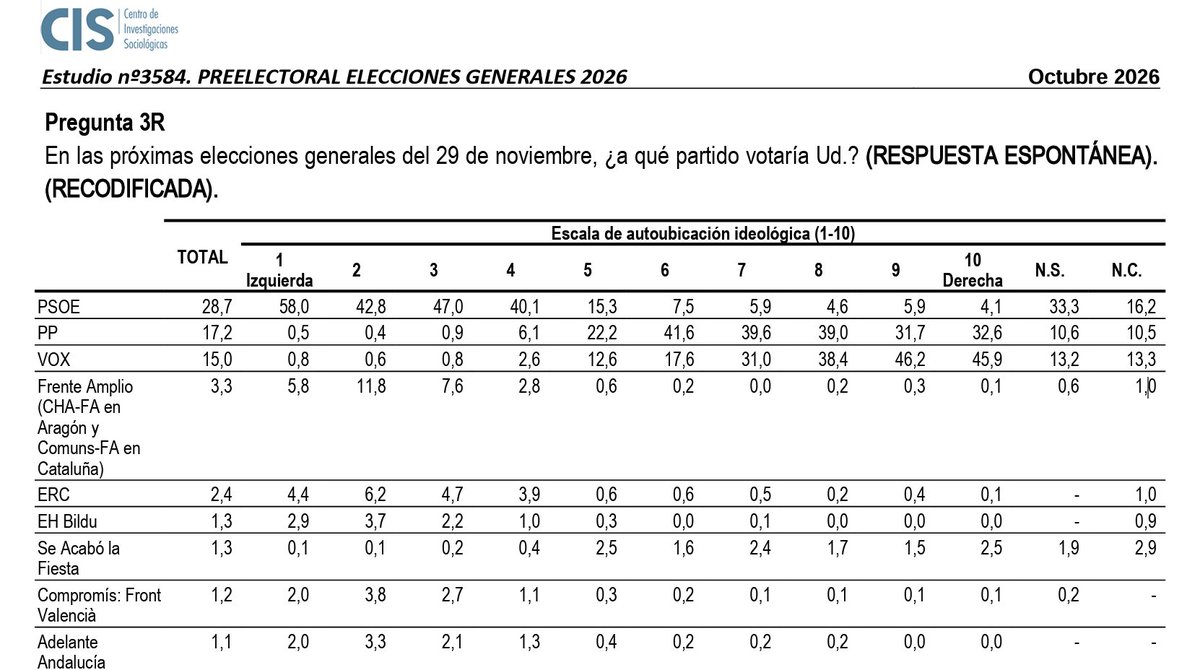
En España siempre hay una regularidad estadística: quien ganar en el centro (5 de la escala ideológica) siempre gana las elecciones. Aquí está el cruce por ideología e intención directa de voto del estudio preelectoral del CIS de hoy. Estos son los datos, saquen sus conclusiones
Me ha encantado la serie Aquel que narra la vida de Raphael. Admirable.
Me encantaría conocerle para decirlo todo lo mucho que su trayectoria ha dado a tantas generaciones.
Mi madre de 95 años dice que nunca habrá otro como él. Y yo también lo digo.
🚨CHINA ACABA DE PRESENTAR UNA PIZARRA CON IA QUE CONVIERTE DIBUJOS EN MODELOS 3D EN TIEMPO REAL
Ya está funcionando en 60.000 escuelas con 160 millones de estudiantes.
Dibujas un cubo en la pizarra.
La IA lo convierte en un modelo 3D que gira, marca los ángulos y las áreas sola, y te explica cada paso en vivo.
Lo mostraron en plena conferencia mundial de IA en Shanghai.
Esto no es un prototipo. Ya está en las aulas.
Para entender mejor el vuelco electoral esta noche en EEUU, mirad estos datos. Las encuestas explican mejor el por qué y son menos útiles para adivinar el futuro….