MINX and PDUT are the best hair growth product lines available today (im biased).
They will, however, fail to turn a slick bald scalp fully hairy.
The only way to do that today is hormonal therapy - nuke your systemic DHT to 0 and increase your estrogen to gender transitioning levels.
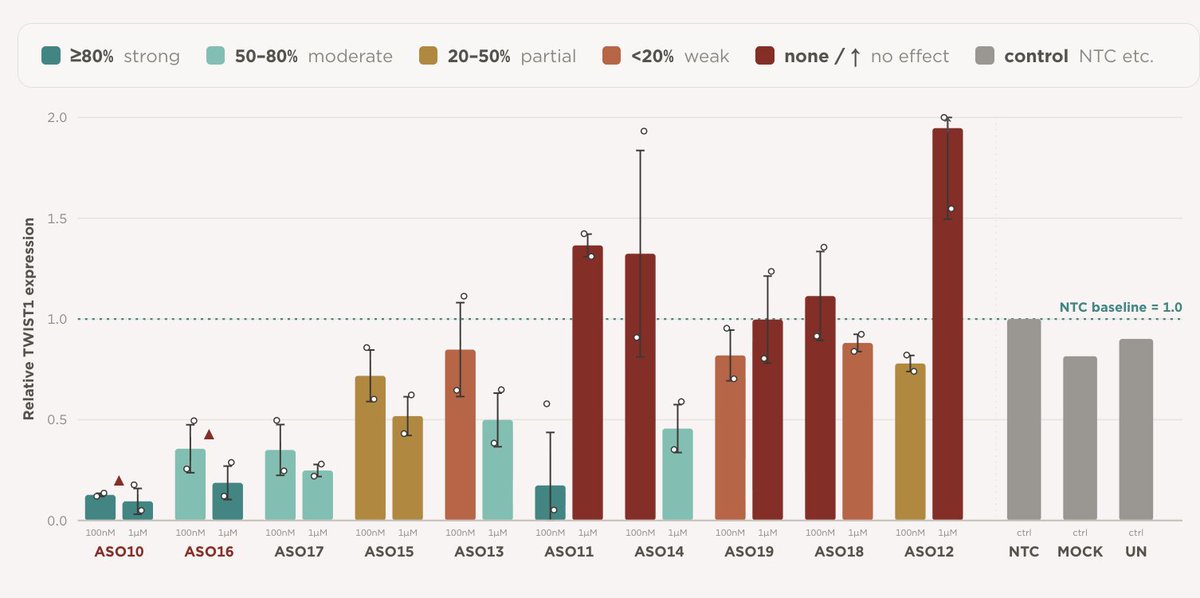
On Monday, we begin the final optimizations for TWIST1i.
The most likely hormone-free cure to hair loss today.
If successful, it will be able to achieve more gains than 5-ari’s, such as Finasteride and Dutasteride.
TWIST1i changes epigenetic state at the chromatin level, freeing genes needed to restore youthful hair to be expressed once more.
Over the next 3 weeks, we are testing 21 additional TWIST1i ASO’s to optimize knockdown strength while minimizing cellular toxicity.
This is our best chance at a cure to hair loss within the next 2 years.
Follow along to stay tuned.
Incredible credit to @hairypapasmurf, the internet’s greatest hair loss researcher, for inventing TWIST1i, designing the ASO’s, and advising every step up of the study process.
Can a glaucoma drug regrow hair?
One grows eyelashes so well it became a billion-dollar drug. The other, the less famous one, quietly has scarce but interesting hair evidence.
Here is the story of two prostaglandin analogues that reshaped glaucoma, eyelashes, and may serve as a useful adjunct to your hair loss protocol.
The biology behind them is real:
> PGE2 and PGF2a are associated with hair growth
> PGD2 blocks it, and PGD2 runs about 10x higher in bald scalp than haired scalp (Garza 2012).
So pattern baldness is, in part, a prostaglandin problem.
Bimatoprost and latanoprost both do the same thing: they mimic PGF2a and push the accelerator. Neither one touches the PGD2 brake.
For eyelashes, the evidence is strong, and bimatoprost wins.
Bimatoprost 0.03% is Latisse, FDA-approved for eyelash growth since 2008. In its pivotal trial, 78 percent grew fuller lashes versus 18 percent on vehicle (Smith 2012).
Latanoprost grows lashes too, but it was never approved for it, and head to head it is the weaker one.
For the scalp, the story is not as strong.
Latanoprost has exactly one controlled scalp study: 16 men, 24 weeks, on small patches. It did significantly beat the placebo side on hair density (P=.0004, Blume-Peytavi 2012), but only 8 of the 16 men responded.
The results have never been repeated, although there has been little incentive for it to be repeated. That is the entire human scalp evidence for latanoprost.
Bimatoprost is the drug nobody mentions for scalp hair, for reasons unknown.
Allergan, the maker of Latisse, ran a full Phase 2 scalp program in more than 1,100 men and women. The endpoint was hair count at 6 months, in terminal hairs per cm², versus a placebo vehicle, with a minoxidil arm running in the same trials.
In men, per cm² of scalp:
> bimatoprost: +13.1 hairs
> placebo vehicle: +4.1 hairs
> minoxidil, same trial: +21.9 hairs
In women:
> bimatoprost: roughly zero (arms ran from minus 3.5 to plus 4.3, worse than the placebo vehicle in one arm)
> placebo vehicle: +1.1 hairs
> minoxidil, same trial: +13.6 hairs
Minoxidil clearly worked in these studies.
Bimatoprost beat placebo by about 9 hairs per cm² in men and essentially tied placebo in women. The trials only reported these averages, never how many individuals responded, so no one can say it "worked" for any given person.
Allergan never advanced it to Phase 3 for scalp hair growth.
So after a full Phase 2, Allergan abandoned bimatoprost for scalp hair loss. The likely reason is not just the worse-than-minoxidil result. The core idea of using prostaglandins for hair has been prior art since a 1997 patent, so there was little exclusivity left to protect.
A costly Phase 3 on a pathway you cannot own, for a modest effect, was almost certainly deemed not worth it.
So where does that leave it?
The prostaglandin pathway might be the most convincing idea in hair biology that never gets a Phase 3 trial.
It grows eyelashes. It grows hair in a dish and in monkeys. It might grow hair in some men.
But the incentives and results may forever prevent serious attempt to grow scalp hair beyond off-label prescriptions.
We have an opportunity to collect more data, as we offer latanoprost today as a solo treatment and as an adjunct in Growth Maxi.
We will offer bimatoprost once it is off patent in 2027.
If you're an Anagen customer, we offer store credit and discounts to have your hair counts measured.
A hair loss company just raised $100 million from Eli Lilly.
Lilly wrote a $40 million check itself.
The drug, ABS-201, is an AI-designed antibody that blocks the prolactin receptor.
The science is real. The data underneath the hype is the problem.
Prolactin is not just a pregnancy hormone. Your scalp follicles carry its receptor, and prolactin pushes them into the regression phase early (Foitzik 2006). In mice, knock that receptor out and they grow longer hair (Craven 2001).
So blocking it is a real idea. Follicles may stay in the growth phase longer, and it never touches DHT.
But here is what should slow you down.
We have been able to lower prolactin for decades. Cabergoline does it, cheaply, in a pill. It does not grow hair, because the prolactin that matters is made inside the follicle, not in your blood.
And this is not even AbSci's idea or the first prolactin receptor antibody to enter humans.
A company called Hope Medicine built the first prolactin-receptor antibody for hair, HMI-115, years ago.
Its entire efficacy case is one Phase 1b: 12 men, open label, no placebo, about 14 more hairs per cm2 versus baseline. Worse than Minoxidil.
Then they ran the real test. 192 men, randomized, placebo-controlled, hair count as the primary endpoint. It finished in November 2024.
The results have never been released.
And it is not that the company went dark. They published the same antibody's endometriosis trial in The Lancet last month. The hair trial, finished a year earlier, has said nothing.
When a company publishes one result and buries the other, the silent one is rarely the winner.
Meanwhile, AbSci's $100 million readout was a single dose in 32 volunteers. The endpoint was side effects from one dose. It has not measured hair on a single person.
And with a half-life over 65 days, one shot blocks prolactin across your body for months. If it were a blockbuster hair drug, there could have been growth benefits by month 3.
So no, it is not a scam. The target is real.
But it is a monoclonal antibody, too large to cross skin so you have to inject it, for a condition a $20 generic already treats, riding on a placebo-controlled trial nobody will show you.
The prolactin pathway is real. The hype is the product.
Finasteride has a dose problem.
Not because people take too little.
Because people usually take way more than the DHT pathway needs.
In Drake 1999, oral finasteride lowered blood DHT by:
> 0.05 mg: 50%
> 0.2 mg: 69%
> 1 mg: 71%
> 5 mg: 72%
That means a 25x jump from 0.2 mg to 5 mg only moved blood DHT by about 3 points.
The DHT blockade saturates early.
So the real question is not “how much finasteride can you take?”
It is “how little can you use, and can you keep it in the scalp?”
That is why topical dose matters so much.
Our researchers model that about 2% of an applied topical goes systemic.
0.005% topical finasteride, in the long Mazzarella study, showed no detectable serum DHT change over 16 months.
You do not need more finasteride.
You need less finasteride, in the right place.
Sublingual minoxidil is the most overhyped product in hair care right now.
This is the post no one in hair wants to write, because everyone wants to sell you standard oral minoxidil with a fancy upcharge.
Sublingual minoxidil has the same peak timing as standard oral minoxidil:
> Standard oral minoxidil: ~30 minutes
> Sublingual minoxidil: ~30 minutes
> MINX: 8 - 10 hours
Sublingual minoxidil shows a 3x higher peak blood level as MINX:
> 5mg Standard oral minoxidil: ~37 ng/mL
> 5mg Sublingual minoxidil: ~18 ng/mL
> 5mg MINX: ~6.5 ng/mL
Only one shows signs of prolonged release. It’s not sublingual minoxidil.
For prolonged release, you want three things:
> A very delayed peak.
> A very low peak.
> The same area under the curve as a standard dose.
Sublingual minoxidil does not do that in any study or blood test published as of today.
The worst part is that standard oral minoxidil is being marketed as sublingual.
Telehealths are saying, “Just put it under your tongue.”
It does not work. Under your tongue, standard oral minoxidil takes 10 to 30 minutes to dissolve, MAX.
For sublingual to actually work as a smooth release product, you’d need it to dissolve for hours, not minutes.
That is the bar: delayed peak, lower peak, same exposure.
As far as we can tell, MINX is the only hair-loss product on the market that has shown that in human data.
Finasteride and dutasteride lower DHT.
The next wave of hair loss drugs goes after the thing DHT actually binds to: the androgen receptor (AR).
There are three ways to hit it. Block it. Destroy it. Or silence the gene that builds it.
Here is every AR molecule in development, ranked, and exactly where each one sits in human trials.
The three mechanisms, simplest to newest:
> Antagonist: sits in the receptor so DHT cannot.
> Degrader (PROTAC): tags the whole receptor for destruction.
> siRNA: stops your cells from building the receptor at all.
THE RANKING
1. Pyrilutamide (KX-826). Kintor. Phase 3.
The most clinically advanced AR drug built for hair. It has completed a US Phase 2 (0.5% twice daily, about +10 hairs/cm2 over baseline, p=0.0088) and a 666-man China Phase 3 that reached its primary endpoint. Kintor plans a China filing in 2026 and a possible launch in 2027. It is a full regulatory step closer to market than anything else here. The honest caveat: its separation over placebo has been inconsistent (an earlier China Phase 3 beat placebo at every visit but not significantly), and there is no US Phase 3 yet. Most advanced, with an asterisk.
2. Clascoterone (Breezula). Cosmo. Phase 3.
The most de-risked, just slightly behind on timeline. The same molecule is already FDA-approved as Winlevi for acne (2020), so safety and manufacturing are proven. Its Phase 2b showed a clean dose response, about +14 hairs/cm2 over placebo at 12 months, with no systemic hormonal effects. Western Phase 3 (SCALP-1 and SCALP-2) reported 6-month topline in Dec 2025, but no filing for hair endpoints yet. The cleanest dataset and the clearest US path, which is why it is a very close second.
3. GT20029. Kintor. Phase 2, advancing to Phase 3.
The most interesting mechanism on the board. It is a PROTAC: instead of blocking the receptor, it tags it for destruction. China Phase 2 met its endpoint, and the effect held with twice-weekly dosing, which is a real adherence edge over daily drugs. One phase behind the top two, but the mechanism could leapfrog them.
4. AH-001. AnHorn. Phase 1 complete.
The second PROTAC degrader in the clinic, and it was AI-designed. US Phase 1 finished in 2025 with no drug-related side effects and almost no drug reaching the bloodstream, which is exactly what you want from a topical. Heading into Phase 2. Promising, but still early.
5. MI-131. Mainova. Phase 1.
A third degrader, and a non-PROTAC one (a different route to destroying the receptor). Dosing began in early 2026. Novel and worth watching, but there is almost no public human data yet.
6. OLX104C. OliX. Phase 1 complete.
A different idea entirely: a small interfering RNA that silences the AR gene so the receptor is never made. Phase 1 is done. The catch is the route: it is injected into the scalp, not applied topically, which is a hard sell for a lifelong condition.
7. CosmeRNA (SAMiRNA-AR68). Bioneer. On sale now.
Also an AR-silencing RNA, and the only thing on this list you can actually buy (sold in Europe since 2023). It is sold as a cosmetic, not an approved drug. Unfortunately, it is widely believed to be a scam, as many in the online hair loss community purchased it and received no benefit.
8. ADA-308. Aranda. Preclinical.
A topical AR antagonist repurposed from prostate-cancer chemistry. Still preclinical, no human hair data. Last because it is the furthest from patients.
ALREADY USABLE TODAY (off-label)
Bicalutamide, spironolactone, and flutamide are real AR blockers you can be prescribed right now. They are oral, studied mostly in women (they feminize men), and none is approved for hair. Bicalutamide is the rising one, with better liver safety than flutamide. Spironolactone is the workhorse. Flutamide is held back by liver toxicity.
THE GRAVEYARD
RU58841 reached Phase 2 around 2003 and was quietly dropped. Its "as good as finasteride" reputation was never actually published. It’s believed to work very well to grow hair, but failed trials due to lack of safety – specifically heart and lung effects.
Fluridil survives only as a European cosmetic. Cyoctol, inocoterone, and others died for weak efficacy or thin penetration.
HONEST CAVEATS
> No AR blocker of any kind is FDA-approved for hair loss.
> Every purpose-built program here is from Asia or Europe. Not one is from a US company.
> Most of the strongest numbers come from company-run or China-only trials. Independent, Western, head-to-head data is thin.
> "Hit its Phase 3 endpoint" is not the same as "approved and on your shelf."
The race is about the receptor DHT talks to: block it, destroy it, or stop your body from building it.
There is still no clear winner.
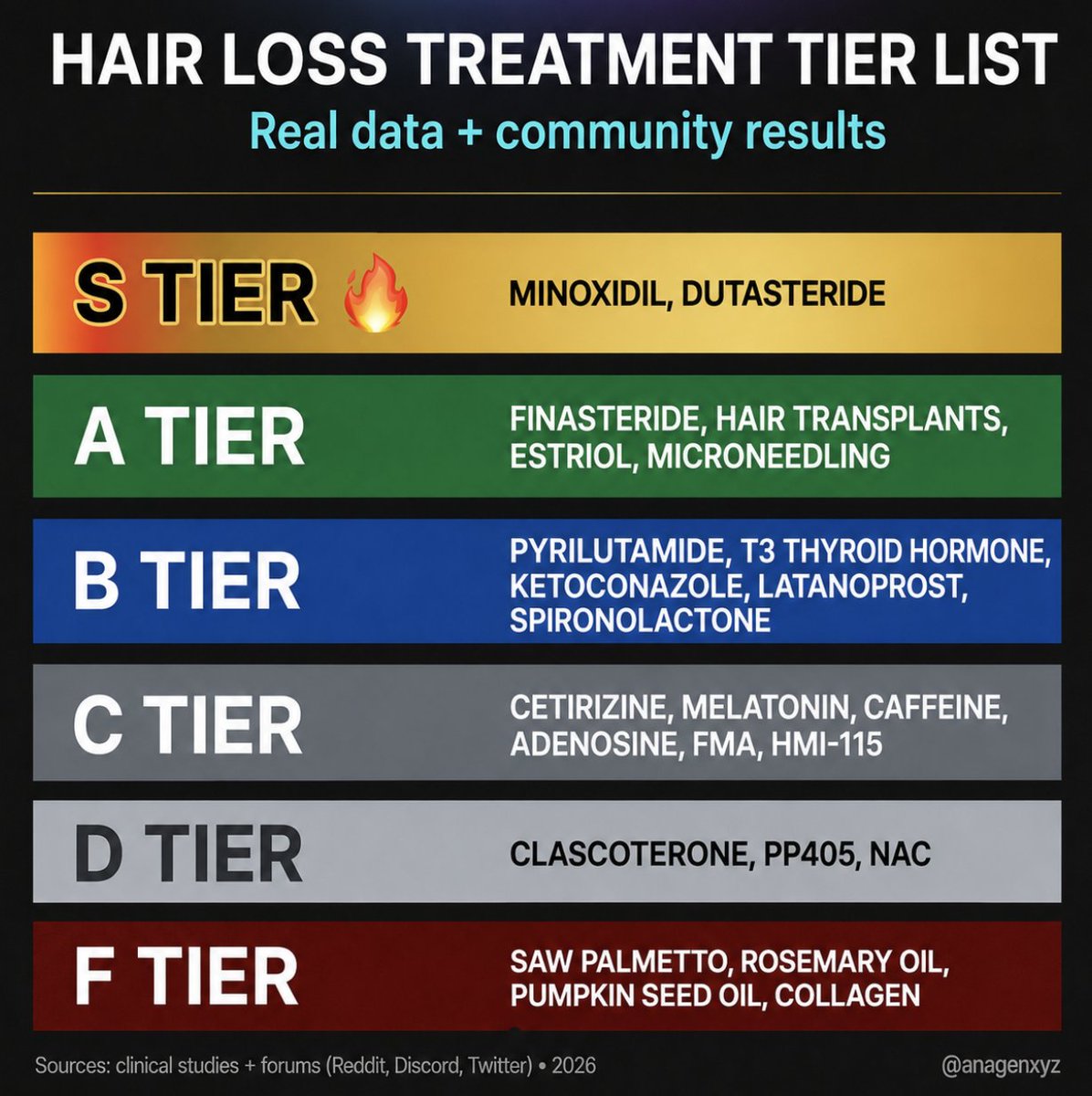
Unpopular opinion. Real data + community results.
Hair loss treatment tier list:
S TIER: MINOXIDIL, DUTASTERIDE
A TIER: FINASTERIDE, HAIR TRANSPLANTS, ESTRIOL, MICRONEEDLING
B TIER: PYRILUTAMIDE, T3 THYROID HORMONE, KETOCONAZOLE, LATANOPROST, SPIRONOLACTONE
C TIER: CETIRIZINE, MELATONIN, CAFFEINE, ADENOSINE, FMA, HMI-115
D TIER: CLASCOTERONE, PP405, NAC
F TIER: SAW PALMETTO, ROSEMARY OIL, PUMPKIN SEED OIL, COLLAGEN
Which tier is your stack in? Drop it below.
If Bitcoin going down in dollar terms still scares you, you haven’t studied it enough yet because you’re still looking at Bitcoin through the dollar’s lens
When you understand Bitcoin, you realize the dollar is the thing constantly losing value, not Bitcoin itself
So when the price in dollars goes down, that’s just temporary volatility. It doesn’t change Bitcoin’s fundamentals like it’s fixed supply
That’s why dips don’t scare people who understand Bitcoin because it’s just seen as a way to get more Bitcoin at a cheaper price in dollars
My heart aches for Bronny James. Poor kid doesn’t belong in the NBA. He can’t quit. He didn’t ask for this. His dad created an impossible situation for him. He’s a Make-A-Wish kid in the NBA. I just hope his dads insatiable ego doesn’t ruin his love for this beautiful game