@JillCastilla@Walmart@amazon@Uber@DoorDash Real time ACH settles money in hours. And First Data bought Acculynk in 2017 for real time (seconds) EFT debit rail funding. So speed of funding is not what’s being solved for here. That’s been solved.
@JillCastilla Can airline or cash-back style rewards…. Will the numbers work on stablecoin? Merchants will still have to pay some kind of interchange the cover the cash back or airline miles, but maybe it’s enough cheaper that it’s worth it for them to add the tender type?
@BradWilcoxIFS@franciscojarceo As a father of four sons, I would recommend we (1) extend way more parental leave & incentivize parents to take it and (2) make it more financially beneficial to have kids - a meager $2K tax break per kid is silly.
Comment: Romania
It’s yet unlikely that Romania, or NATO for that matter will respond kinetically to what was likely an accidental Russian drone impact on an apartment complex in eastern Romania. Barring repeated such events and/or fatalities, NATO will not be induced to respond kinetically.
Romania and prepositioned NATO air squadrons have already increased patrol sorties as a result of other Russian drone and missile overflights and it’s likely that such measures will be increased. At the time of writing, it’s highly likely that both Romania’s and NATO’s response will be largely diplomatic, with measures such as the summoning of the Russian ambassador, increased coercive economic measures, and joint denunciations being the most likely outcome.
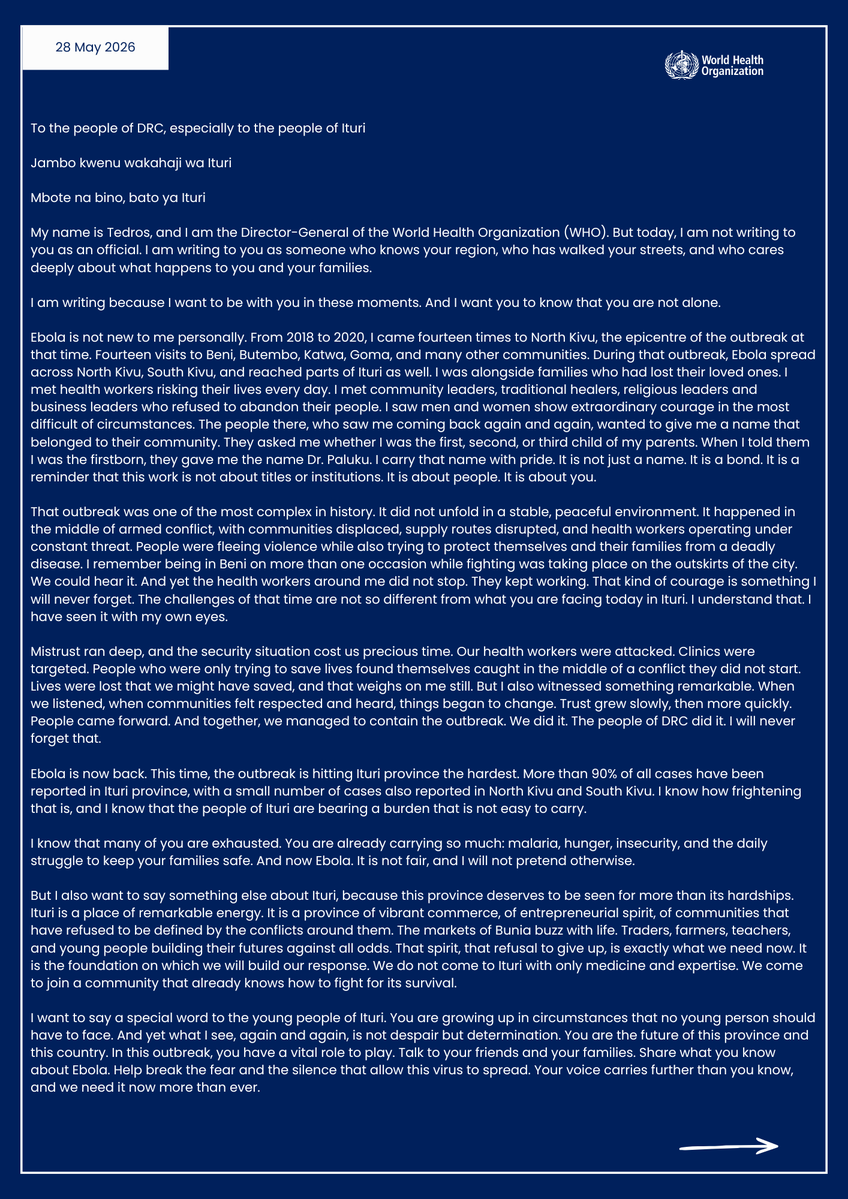
To the people of DRC, especially to the people of Ituri
Jambo kwenu wakahaji wa Ituri
Mbote na bino, bato ya Ituri
My name is Tedros, and I am the Director-General of the World Health Organization (@WHO). But today, I am not writing to you as an official. I am writing to you as someone who knows your region, who has walked your streets, and who cares deeply about what happens to you and your families.
I am writing because I want to be with you in these moments. And I want you to know that you are not alone.
#Ebola is not new to me personally. From 2018 to 2020, I came fourteen times to North Kivu, the epicentre of the outbreak at that time. Fourteen visits to Beni, Butembo, Katwa, Goma, and many other communities. During that outbreak, Ebola spread across North Kivu, South Kivu, and reached parts of Ituri as well. I was alongside families who had lost their loved ones. I met health workers risking their lives every day. I met community leaders, traditional healers, religious leaders and business leaders who refused to abandon their people. I saw men and women show extraordinary courage in the most difficult of circumstances. The people there, who saw me coming back again and again, wanted to give me a name that belonged to their community. They asked me whether I was the first, second, or third child of my parents. When I told them I was the firstborn, they gave me the name Dr. Paluku. I carry that name with pride. It is not just a name. It is a bond. It is a reminder that this work is not about titles or institutions. It is about people. It is about you.
That outbreak was one of the most complex in history. It did not unfold in a stable, peaceful environment. It happened in the middle of armed conflict, with communities displaced, supply routes disrupted, and health workers operating under constant threat. People were fleeing violence while also trying to protect themselves and their families from a deadly disease. I remember being in Beni on more than one occasion while fighting was taking place on the outskirts of the city. We could hear it. And yet the health workers around me did not stop. They kept working. That kind of courage is something I will never forget. The challenges of that time are not so different from what you are facing today in Ituri. I understand that. I have seen it with my own eyes.
Mistrust ran deep, and the security situation cost us precious time. Our health workers were attacked. Clinics were targeted. People who were only trying to save lives found themselves caught in the middle of a conflict they did not start. Lives were lost that we might have saved, and that weighs on me still. But I also witnessed something remarkable. When we listened, when communities felt respected and heard, things began to change. Trust grew slowly, then more quickly. People came forward. And together, we managed to contain the outbreak. We did it. The people of DRC did it. I will never forget that.
Ebola is now back. This time, the outbreak is hitting Ituri province the hardest. More than 90% of all cases have been reported in Ituri province, with a small number of cases also reported in North Kivu and South Kivu. I know how frightening that is, and I know that the people of Ituri are bearing a burden that is not easy to carry.
I know that many of you are exhausted. You are already carrying so much: malaria, hunger, insecurity, and the daily struggle to keep your families safe. And now Ebola. It is not fair, and I will not pretend otherwise.
But I also want to say something else about Ituri, because this province deserves to be seen for more than its hardships. Ituri is a place of remarkable energy. It is a province of vibrant commerce, of entrepreneurial spirit, of communities that have refused to be defined by the conflicts around them. The markets of Bunia buzz with life. Traders, farmers, teachers, and young people building their futures against all odds. That spirit, that refusal to give up, is exactly what we need now. It is the foundation on which we will build our response. We do not come to Ituri with only medicine and expertise. We come to join a community that already knows how to fight for its survival.
I want to say a special word to the young people of Ituri. You are growing up in circumstances that no young person should have to face. And yet what I see, again and again, is not despair but determination. You are the future of this province and this country. In this outbreak, you have a vital role to play. Talk to your friends and your families. Share what you know about Ebola. Help break the fear and the silence that allow this virus to spread. Your voice carries further than you know, and we need it now more than ever.
And to the health workers of Ituri, I want to say this: you are seen, and you are not alone. Every day you go to work knowing the risks, and you go anyway. You do it for your patients, for your communities, for your families. You are the backbone of this response. Without you, none of this is possible. I know the conditions are hard. I know the resources are often not enough. I know that fear and exhaustion are real. Please know that WHO stands with you, that we are working to get you the support you need, and that your courage and dedication are known and deeply valued far beyond the borders of this province.
I also know that the security situation in parts of this region remains very difficult. Conflict and displacement make everything harder, including reaching people who need care and keeping health workers safe. I want to be honest: this is one of our greatest challenges. We cannot do this work if those who are trying to help are prevented from doing so or put in danger. We are working closely with all relevant partners to ensure that the response can reach every community that needs it, and that no one is left behind because of where they live or what is happening around them.
That is why today I am making a direct appeal to all warring parties in this region: please, declare a ceasefire. Even briefly. Even just enough to let health workers through. People are dying from Ebola who do not have to die. Children are sick. Families are suffering. No cause, no conflict, no grievance is worth condemning innocent people to death from a preventable disease. A ceasefire, even a temporary one, would save lives. I urge you, I implore you: give us the space to help the people who need it most.
I also know that there is anger and mistrust in some communities, and I understand why. Trust must be earned, it cannot be assumed. We have not always done things correctly. But I promise you, we are here to learn as much as we are here to help.
I need to be honest with you about something important. Most previous Ebola outbreaks in DRC were caused by a virus called Ebola Zaire, for which we have vaccines and treatments. This outbreak is caused by a different virus called Ebola Bundibugyo. There are currently no approved vaccines or treatments for it. This is serious, and you deserve to hear that plainly. But I also want you to know this: while there are no specific treatments for Bundibugyo, there is much we can do together to prevent the spread of this virus and save lives. Early supportive care in our treatment centers can make a real difference. If you or someone you know falls ill, please do not wait. Coming forward early can make the difference between life and death. And everything we do, we will do with you. We will listen to you, we will share information with you, and we are here to help. And for those we cannot save, we will mourn with you. We will help you grieve your lost loved ones with safe and dignified burials.
We are working under the leadership of the Government of DRC, together with all relevant partners, united around one goal: to stop this outbreak and protect your communities. No one is working alone. No one is working at cross purposes. We are coordinated, we are committed, and we are here.
That is why I am coming to Bunia. I will be there in person, alongside my colleagues, meeting your leaders, listening to your concerns, and doing everything in my power to help you. I will not be managing this from a comfortable office far away.
This is the 17th Ebola outbreak in DRC. Together, you have overcome every single one before. That is not a small thing. That is a testament to the strength and resilience of your communities. I have seen that strength with my own eyes.
My brothers and sisters of Ituri, I want you to know that the world is watching your courage. You are not forgotten. Together, we will overcome this outbreak, as you have overcome every challenge before. Your resilience is the light that guides us all.
We will get through this one too. Not because of anyone, but because of you.
Our teams are already on the ground, and they will stay for as long as necessary. And when this outbreak is over, we will not quietly disappear. We will not forget you. We will stay, and we will keep working with you to build health systems that protect every person in every community.
I look forward to seeing you in Bunia soon. Until then, please know that you are in my thoughts.
With respect and solidarity,
Paluku
Tedros Adhanom Ghebreyesus
Director-General, World Health Organization
Today was the ceremonial push-in for a new Aircraft Rescue and Fire Fighting vehicle (ARFF) at Station 15 at the @RenoAirport!
Replacing a 20-year-old apparatus, the new ARFF brings enhanced aircraft emergency response capabilities, PFAS-free firefighting foam technology, and the tools firefighters need to help keep passengers, airport personnel, and our region safe.
This vehicle was made possible through a $911,140 Federal Aviation Administration grant secured by Senators Catherine Cortez Masto and Jacky Rosen, Congressman Mark Amodei, and nearly $214,000 in funding from the Reno-Tahoe Airport Authority.
This article says climate change is “believed to have played a role” in the UK's extreme heat this week.
As a climate scientist, let me fact-check that.
First, climate change is not a religion. No belief is required. It is about evidence.
And the evidence has been crystal clear for more than two decades: climate change is making heat waves hotter, longer, more frequent and more dangerous.
In fact, science has advanced far beyond saying climate change merely “played a role.” Today, we can quantify how much more likely and how much hotter climate change made a specific event.
Here's the bottom line:
Climate is changing. Humans are responsible. And we are experiencing the impacts now. That’s the bad news.
The good news is that solutions already exist, and the majority of people care - 89%, around the world!
But meaningful action depends on helping people understand not just what is happening: we need to know how it affects our lives (this heat wave being example A today) and what we can do about it.
That’s the opportunity this reporting missed.
https://t.co/vYfPDKcWWf
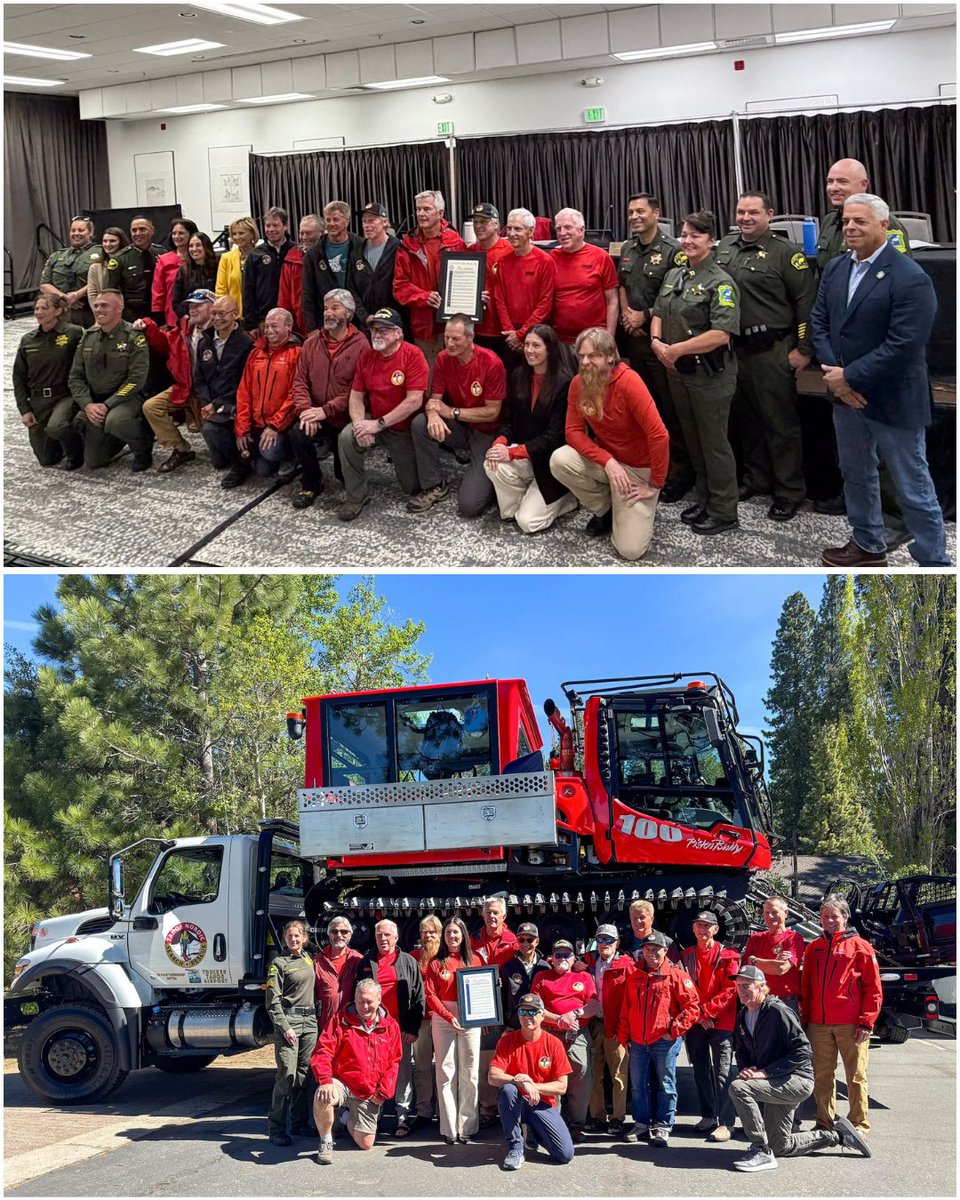
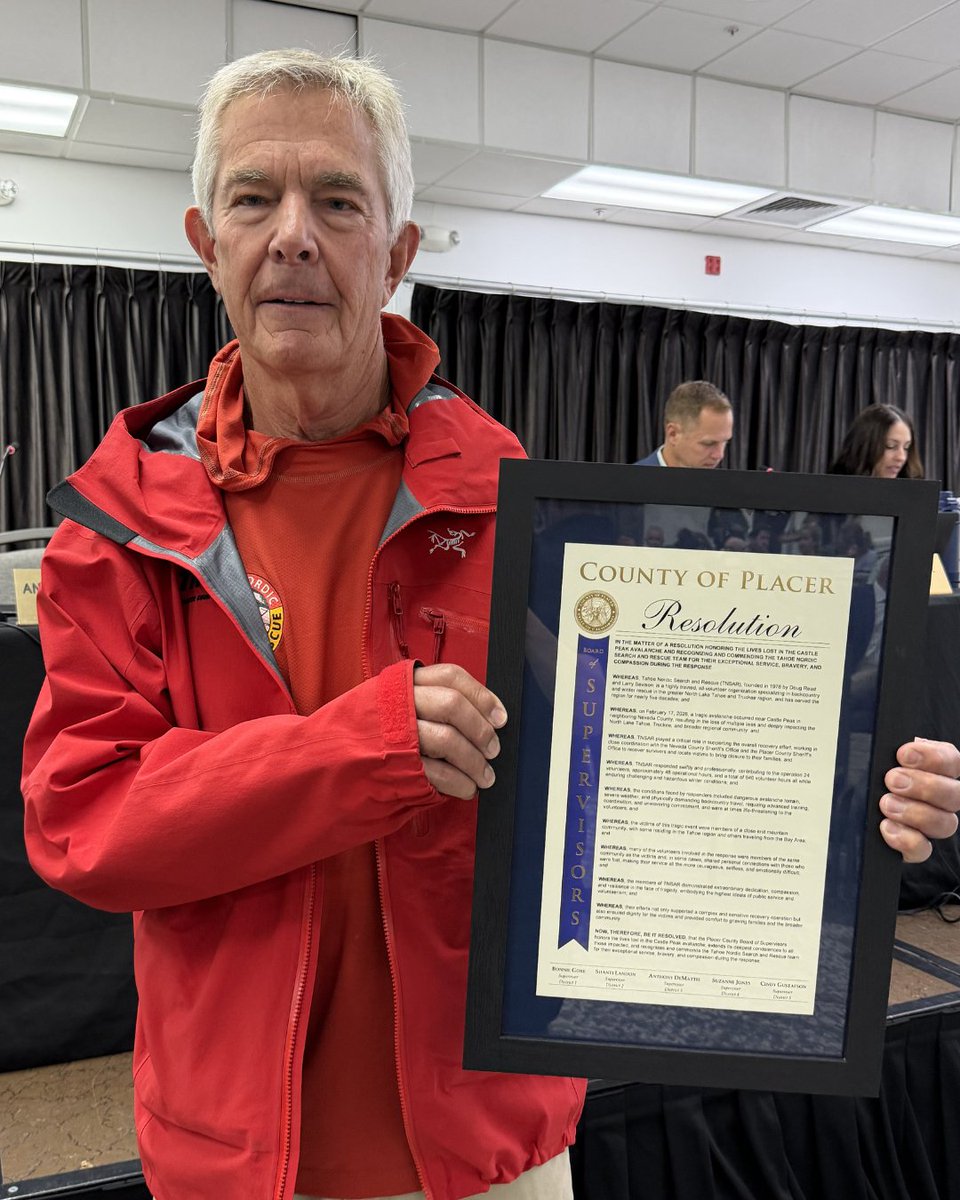
𝐂𝐚𝐬𝐭𝐥𝐞 𝐏𝐞𝐚𝐤 𝐀𝐯𝐚𝐥𝐚𝐧𝐜𝐡𝐞 𝐑𝐞𝐬𝐩𝐨𝐧𝐬𝐞 𝐇𝐨𝐧𝐨𝐫𝐞𝐝 𝐛𝐲 𝐂𝐨𝐮𝐧𝐭𝐲
Last week, the Placer County Board of Supervisors passed a resolution honoring the lives lost in the February 17 Castle Peak avalanche and formally recognized the extraordinary bravery and work of the Tahoe Nordic Search and Rescue Team, which operates under the Placer County Sheriff’s Office.
The Board also expressed its deepest condolences to all those impacted by this tragic event. In continued gratitude for the efforts of those who worked in extremely dangerous terrain, the Board will be sending a letter to Governor Newsom requesting statewide recognition for their service during the rescue and recovery operation.
The Placer County Sheriff’s Office extends our sincere appreciation to the Tahoe Nordic Search and Rescue Team for their commitment to saving lives in the most challenging conditions.
• This is the 9th-ever emergency issued since the formal declaration was created in 2005 after the SARS outbreak
• This is the 1st time it’s been declared without convening the Emergency Committee. This is unprecedented.
• No vaccines. No treatments
2/2
#Ebola#Bundibugyo
“The Ebola disease caused by Bundibugyo virus, currently in Central Africa, constitutes a public health emergency of international concern [to the rest of the world]”
- Saturday May 16, 2026, World Health Organization
1/2
#ebola#bundibugyo
2. There have only been 2 previously confirmed outbreaks of Ebola Bundibugyo, in 2007 (Uganda) & 2012 (DRC). respectively.
The 1st involved 131 cases & 42 deaths; the 2nd had 38 confirmed cases & 13 confirmed deaths.
The case fatality rate — 30% — is lower than Zaire or Sudan ebolaviruses.
@AbraarKaran@maggiemfox During SARS, we also found low spread within airplanes. Airplanes aren’t usually good at disease transmission due to HEPA filtration. So this study is confirming expectations - it isn’t saying #hantavirus is less transmissible than we thought, correct?