@ChrisO_wiki Girkin poetry is published on telegram, isn't it? Which is banned in russia? Would it thus be safe assuming that this messaging is intended for international consumption?
@GWaldmensch Ich bin mal in Berlin mit einem "spazieren gegangen". Kam am Abend aus einem Gebüsch, ich hab misstrauisch runter geguckt, er misstrauisch hoch, wir hatten aber denselben Weg. Nachdem klar war, dass wir uns nicht gegenseitig fressen wollen, sind wir den halt gemeinsam gegangen 😁
Heiraten in der Ukraine – unter russischen Terrordrohnen.
Also kommt mir nicht mit gestörter Mittagsruhe in Sankt Petersburg.
Jeder Russe sollte dieses Gefühl kennen lernen, damit er versteht, was sein Land der Ukraine seit fünf Jahren antut.
Diese beiden Ziele von gestern morgen zeigen den Schwerpunkt der UA Angriffe der letzten Tage auf die Versorgung va der Krim
- 3 Tanklager (Armawir, Ust-Labinsk, heute Lenino auf der Krim)
- 5 Schiffe im Asowschen Meer
- Mariupol
- die Angriffe auf LKW und Bahn scheinen sich stärker auf die Krim verlagert zu haben
1/2
🇸🇪 Sweden to transfer to Ukraine a vessel suspected of transporting grain from temporarily occupied territories
Sweden has decided to transfer to Ukraine a vessel suspected of illegally transporting grain from territories temporarily occupied by Russia.
The decision was made on June 4 following court proceedings related to the vessel’s arrest. The ship was detained in March off Sweden’s southern coast.
The court upheld the legality of the vessel’s seizure and authorized its transfer to the Ukrainian side. The handover may take place once the ruling enters into force.
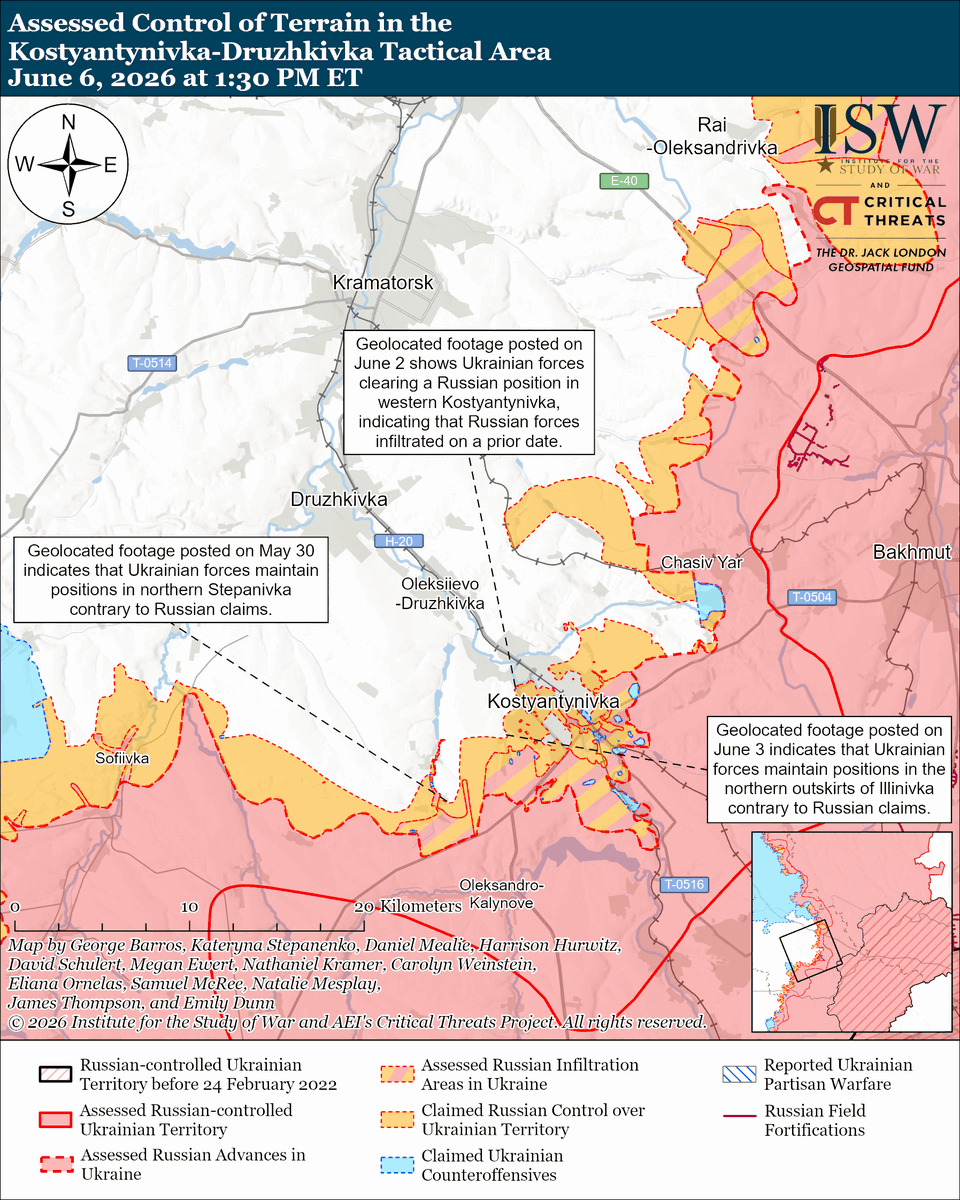
NEW: Different sources continue to conclude that the Russian military’s performance is declining, despite utilizing differing mapping methodologies to visualize the battlefield situation. (1/2)
Other Key Takeaways:
Ukrainian forces conducted a second series of strikes against St. Petersburg as the St. Petersburg International Economic Forum (SPIEF) closed on June 6, demonstrating again that Russia cannot reliably defend its major cities from Ukrainian strikes even during prominent international events.
Ukrainian strikes against St. Petersburg undermine Kremlin efforts to use SPIEF to project stability within Russia domestically and to international audiences.
Ongoing gasoline shortages in occupied Ukraine are creating long lines on the Kerch Bridge and at gas stations in nearby Russian territories.
Fuel shortages continue to spread throughout Russia as well and will likely worsen as high summertime demand continues.
Ukraine’s mid-range strike campaign against major Russian ground lines of communication (GLOCs) in occupied Ukraine continues to disrupt vehicle movement.
Kremlin officials continue to reject any negotiated settlement that fails to address its fabricated “root causes” of the war in Ukraine.
Ukrainian forces recently advanced in the Kostyantynivka direction. Russian forces recently advanced in the Slovyansk and Pokrovsk directions.
Ukrainian forces struck Russian oil infrastructure in Krasnodar Krai and Russian military assets in Russian border regions on June 6. Russian forces launched 272 drones against Ukraine overnight.
"It is clear that in order to have peace, you need at least two to want peace. It only takes one to want war. We see Putin has shown very clearly that he still wants war.
Putin has zero interest in peace, and he will not stop the war until he's forced to."
- Kaja Kallas
So sad and so true....!
Am kommenden Montag, dem 8. Juni, um 15 Uhr (NY Zeit), werden wir erneut eine Sitzung des UN-Sicherheitsrats einberufen & die russischen Lügen Stück für Stück zerlegen und entlarven. Moskau verliert nicht nur auf dem Schlachtfeld, sondern auch auf dem diplomatischen Parkett✌️
Wegen, ähem, Brückenproblemen bei Chonhar im Übergang zur Krym verlängert sich die Fahrzeit zwischen Dzhankoy um Melitopol von 2 Stunden geringfügig auf 4 Stunden.
Gar nicht schlimm - wer will bei der Sprit-Knappheit auf der Krim überhaupt da lang fahren?
Alles läuft nach Plan!
For two decades, Vladimir Putin managed to trick the world into believing he was a master geopolitical chess player.
The catastrophic invasion of Ukraine has permanently shattered that illusion, exposing him as one of the most wildly overestimated strategists in modern history.
Putin's long streak of international ”successes” was never a product of strategic brilliance. Instead, his ”victories” happened simply because he was willing to break international rules and push further than his targets expected. Many of his opponents mistakenly believed that appeasement would preserve stability, which only encouraged his aggressive behavior for years.
The moment someone finally stood up to him, the entire facade came crashing down. Ukraine refused to capitulate, and the Kremlin's supposedly unstoppable military machine failed pathetically. Putin completely miscalculated the resolve of Ukrainian people and the unity of the West, proving that his earlier triumphs were just the result of bullying weak and hesitant adversaries.
By overstretching his forces in this reckless war, he has effectively ruined the economic potential and future of Russia. His legacy is now defined by a bleeding military, crippling sanctions, and absolute isolation from the developed world. It is a pathetic end for a ruler who genuinely believed his own propaganda
The evolution of robotic warfare has already decided who controls the Black Sea.
What we are seeing now is only the beginning: aerial strikes against selected targets in Russia’s native Leningrad Military District. The burning factories, shipyards, and warships speak for themselves. More is likely to come. Step by step, a form of maritime pressure and blockade is being created around Russia.
The next stage, according to this concept, would fall within what is called Far Sea Control (FSC) — extending pressure against Russian naval infrastructure around the broader northern maritime region. The idea is to threaten naval assets based at locations such as Severomorsk, Gadzhiyevo, Severodvinsk, and other key facilities, targeting vessels and infrastructure capable of launching missiles and projecting military power.
The proposed FSC drone concept centers on underwater systems operating at significant depths, designed for long-endurance missions, low observability, efficient energy use, layered communications, and coordinated autonomous swarm operations. The concept envisions underwater communication networks, relay buoys, hybrid propulsion systems, and logistics methods inspired in part by ideas that Russian specialists themselves discussed years ago but never fully implemented.
The long-term objective is straightforward: make military fleets increasingly vulnerable, even while they remain in port.
Supporters of the concept argue that one day Russia could wake up and discover that much of its naval power has become ineffective or unsustainable. They also believe that strikes against military infrastructure could have effects extending far beyond the loss of individual ships.
Far Sea Control itself is not a new idea. Variations of advanced underwater drone programs have been under development by several countries for years. What is changing now is the scale: larger platforms, greater autonomy, more complex coordination, and a growing number of potential combat applications.
The broader message remains political as much as military: every additional day of war creates opportunities for new technologies, new tactics, and new vulnerabilities to emerge. From this perspective, continued conflict imposes mounting long-term costs, reducing future options and increasing strategic losses.
“Every day of war is another strategic loss. Every day of war is another piece of the future spent.”
Stay tuned.
Kasparov: A temporary ceasefire with Putin could make things worse. His army will not go home; it will go elsewhere.
Europe knows this, yet some still look for compromise while Poland, the Baltics and Finland are already preparing for war. 1/