When you build privacy into the architecture instead of the policy, that's when the game changes.
@loyal_hq using nilDB is much more than a secure storage pitch. It's proof that private compute and private memory can finally coexist. Without the need to rely on trust or hoping logs get deleted.
What @nillion brings to the table here is something deeper than encryption: it's verifiable blindness.
Blind storage, blind inference, blind coordination. That means your AI's context, prompts, and responses can exist without ever being seen by anyone except you.
If you've been following $NIL for a while, this is the kind of implementation that shows where the network's heading: user-owned memory, wallet-derived keys, and compute that respects boundaries.
The more projects that adopt nilDB, the closer we get to real private intelligence.
The privacy sector's getting crowded again but have you noticed how it's the same projects with the same "anon transactions" pitch recycled for the fifth time?
$XMR, $ZEC, $DASH all playing the same tune.
Then you've got @nillion, doing something actually original. They're not chasing the transaction privacy meta, they're building AI privacy through Blind Compute.
Instead of hiding money, Nillion's protecting intelligence and most importantly your data.
If the privacy sector's been missing an evolution, this is it.
If you go back and read about Tulip mania in 1637 you realize that the bubble was not in fact caused by irrational exuberance as historians have claimed, it was actually Wintermute
The line between robot and data center is blurring.
Each drone or vehicle can be a node in a cognitive network. When machines can earn, spend, and learn on their own, the industrial stack starts to resemble a blockchain.
> DeAI routes the right tasks to the right machine.
> ZK verifies task completion.
> Stablecoins settle A2A (agent to agent) payments in seconds.
Factories and fleets become APIs.
Most chains chase speed or scalability.
@nillion chose something harder: privacy.
Now anyone can promise security, but only few can make it seamless for builders.
That's why Nillion built three core layers: one for data, one for AI, one for compute.
🔹nilDB stores your data privately.
🔹nilAI runs models without exposing inputs.
🔹nilCC will soon enable private computation.
Together, they finally make privacy feel native.
I believe this is where the next wave of innovation starts: when privacy stops being a feature and becomes the foundation everything's built on.
Had this thought overnight.
If $NIL powers confidential compute on the Blind Computer, then a market could form around that idea where you pay for inference, data, or storage without revealing who you are.
Imagine builders using @nillion's network as the backend for anonymous AI marketplaces.
Compute itself turning into a tradable resource.
Would you bid on this?
Ever wondered what real adoption looks like before it trends?
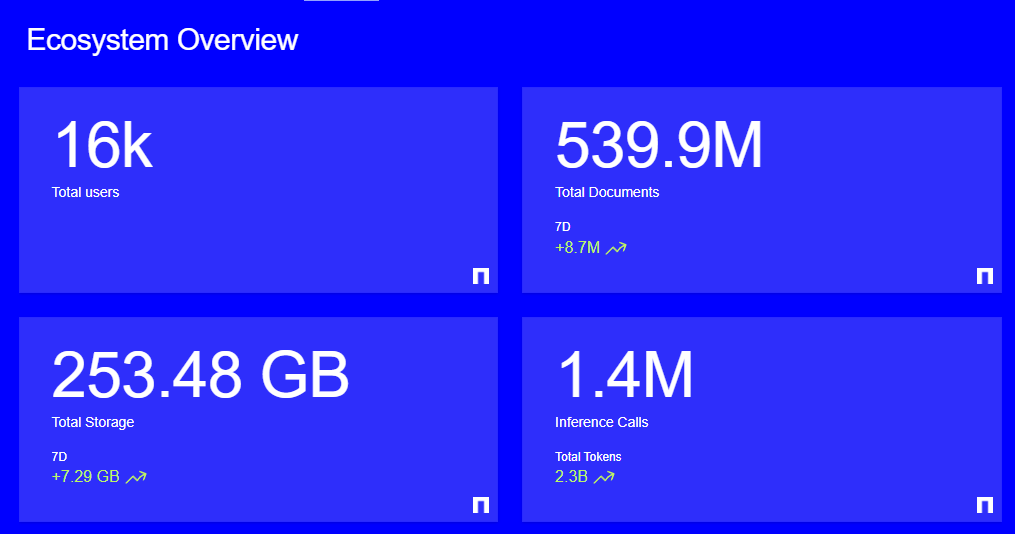
Take a look at @nillion's latest dashboard:
540M+ documents processed
1.4M inference calls
26K users and it's all on-chain, fully live.
People should pay close attention to these usage patterns forming in real time because I think this is the groundwork of something revolutionary in private data processing, where computation happens without ever exposing the data itself.
You can visibly see the demand building too.
Storage up +7GB in 7 days, millions of tokens processed, more calls flowing through as new builders plug in.