I think people don't realize why Gemini Omni is different than other video AIs. It is fully multimodal, so it can edit video natively, too
I took the famous "train " movie from 1896 & made it a bullet train, LEGO, added a time traveler, a centipede, muppets... (see reflections?)
This is the biggest deal in the history of AI so far. And it will look like a small deal at the end of the year.
I’ve spent countless hours on this problem as a PhD student. I genuinely cannot believe I’m alive to watch AI solve it.
AI generating new knowledge and accelerating science will change the trajectory of humanity.
And we are unbelievably early.
We are, indeed, living through the singularity - and it has been fascinating to watch this realization slowly permeate through society:
- People in SF and a handful of those on X (including yours truly) generally believe in the imminent singularity. This is significantly more aggressive than my views regarding AI progress were ~12 months ago.
- CEOs/management of large enterprises, various public figures and the federal government have recently come to believe in rapid AI progress - I would call this the "Mythos Moment". These views are in line with my views from ~12 months ago (now hopelessly outdated).
- Tens (hundreds?) of millions are now using AI in the workplace extensively, and probably mostly view it as a "useful tool". 12 months ago, this was limited to coding, and even the number of coders who were using AI in their day-to-day work was significantly smaller.
- Yet the public at large still seems to live in the "hallucinating stochastic parrot" Gary Marcus land. No update in beliefs regarding AI capabilities between GPT-3.5 and now.
I've spent the past few weeks reading 100s of public data sources about AI development. I now believe that recursive self-improvement has a 60% chance of happening by the end of 2028. In other words, AI systems might soon be capable of building themselves.
"Load bearing," "I keep coming back to," "Not X, but Y"
A curse of using AI a lot is that you realize how much of the writing around you is just AI, now
People who don't use AI have been unable to identify AI prose on sight, but those who use it a lot can spot the tells easily
there will this brief era where we can watch our AIs bumble around on the computer clicking things, failing sometimes, taking a ~human amount of time to write code. in the blink of an eye they’ll be manipulating computers far too quickly to monitor
@ben_j_todd Maybe it's at least partially a side effect of coming of age during Trump, Covid (with school disruption), phones and social media (with school disruption) and LLMs (with school disruption). Full-on brain f@#$ just as your brain is forming.
Google DeepMind formed a strike team to improve its coding models, with Sergey Brin directly involved.
It’s surprising to me that Google has the world’s largest internal codebase (>2B LOC), yet lags behind Anthropic and OpenAI in coding + agents.
“Google’s AI writes 50% of code, trailing Anthropic’s near 100%.” Google engineers are largely limited to internal models and tools (like Gemini CLI and Antigravity), so this makes sense.
I think Sergey in founder mode can fix it again this time.
The whole “talking about risks from frontier AI is 6d marketing chess” trope reminds me so much of the Jobs-era knock against Apple that everything they did was “just marketing,” yelled by their detractors as Apple’s superior products took over the world. “It’s just marketing” is what technology industry observers say when they do not understand what is happening but want to seem situationally aware, mistaking cynicism for savvy.
I thought this was a great piece, not least because it captured so much of my own journey into taking AI seriously. In the early days of Encode, we were squarely focused on immediate AI harms and in fact I was actively giving workshops internally about how our members should avoid being psyopped by the catastrophic risk sideshow (as I then perceived it). Friends asked me if I’d read the AI safety canon and whether it was shaping my work, and I was completely dismissive.
It wasn’t until I actually sat and reflected on why I was so averse to thinking about the most extreme AI scenarios that I realized I didn’t have very good object-level reasons - it just felt weird and uncomfortable to entertain such alien futures for more than a few seconds, and at the time there was basically no social proof for this outside Berkeley. These days I laugh when critics of AI safety say that people should stand strong against doomerism and that if you dwell on AI risk you must be a loser devoid of imagination and hope. That literally sounds like something I would say on any other topic - I am a devout, lifelong, in-my-bones optimist, and taking bad outcomes seriously has felt like a constant battle against my natural disposition.
I’m honestly pretty embarrassed by how I initially approached thinking about AI. But I’m also proud of the work Encode has done since my mind opened up, and I know a lot of smart people are on the other side of this bridge I only relatively recently crossed. If that’s you, I really implore you to use the latest models, see for yourself, and ask: “What if AI actually is world-historic? Are there specific capabilities or arguments that could convince me this is true, or am I just not open to being convinced? How would my other assumptions about the future change under the premise that AI is world-historic?” As Dylan also acknowledges, I am totally sympathetic to how hard this is (especially if others around you are still AI skeptics); but when I did this exercise, it completely reoriented my life and work.
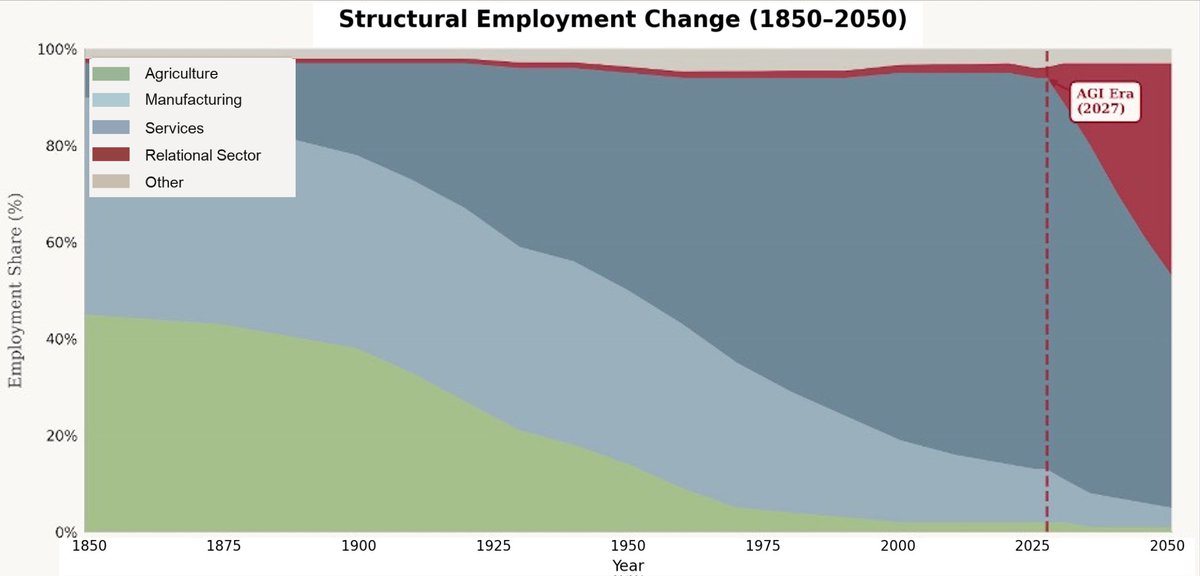
New essay on the economics of structural change and the post-commodity future of work.
1. Almost any question about the impact of advanced AI on the economy needs to start at the same place: what is still scarce? Answer that, and the analysis becomes pretty straightforward. This essay explores what becomes scarce if AI really can replicate most of what humans do in production, and what this mean for the future of jobs.
2. My conjecture, working through the economics: labor reallocates across sectors, and the sector it reallocates to has properties that keep labor a meaningful share of the economy. Ultimately this is about the structure of demand itself. For this, we have to go back to Girard, Augustine and Rousseau: once people's base needs are met, their preferences shift to comparative motives (e.g., status, exclusivity, social desirability). This motive is inherently non-satiated.
4. The key paper is Comin, Lashkari, and Mestieri (Econometrica 2021). As people get richer, they don't buy proportionally more of everything. They shift spending toward sectors with higher income elasticity. They estimate income effects account for 75%+ of observed structural change.
5. The ironic consequence: the sector that gets automated becomes a smaller share of the economy, not a larger one. Agriculture got massively more productive and its share of employment collapsed. Manufacturing too. The "stagnant" sectors absorb the spending and the jobs.
6. So the question is: which sectors have high income elasticity in a post-AGI world? I argue it's what I call the relational sector. Categories where the human isn't just an input into production, it is part of the value.
7. Why does the relational sector have high income elasticity? Because human desire has a mimetic, relational dimension. We don't just want things for their intrinsic properties. We want what others want, and we want it more when others can't have it. Girard, Rousseau, Augustine, and Hobbes all saw this.
8. In work with Kristóf Madarász, we showed this experimentally: WTP roughly doubles when a random subset of others is excluded from the good. And in new work with Graelin Mandel, AI involvement kills the premium. Human-made art gains 44% from exclusivity; AI-made art only 21%.
9. This all comes together for the core argument. The sector that absorbs spending as AI makes commodity production cheap is one where human provenance is part of the value, and demand for it grows faster than income. Exactly the profile that keeps labor meaningful.
10. To be clear about the claim: I'm NOT saying aggregate labor share must rise. It may fall. The claim is about sectoral composition, i.e., where expenditure and employment go once commodities get cheap, and the fact that the sector that will absorb reallocated labor maps to a substantial component of human preferences and desire.
11. If you're interested in the formal model, a linked companion technical note works out all the economics.
Read the essay here: https://t.co/NcjVgn2o8g