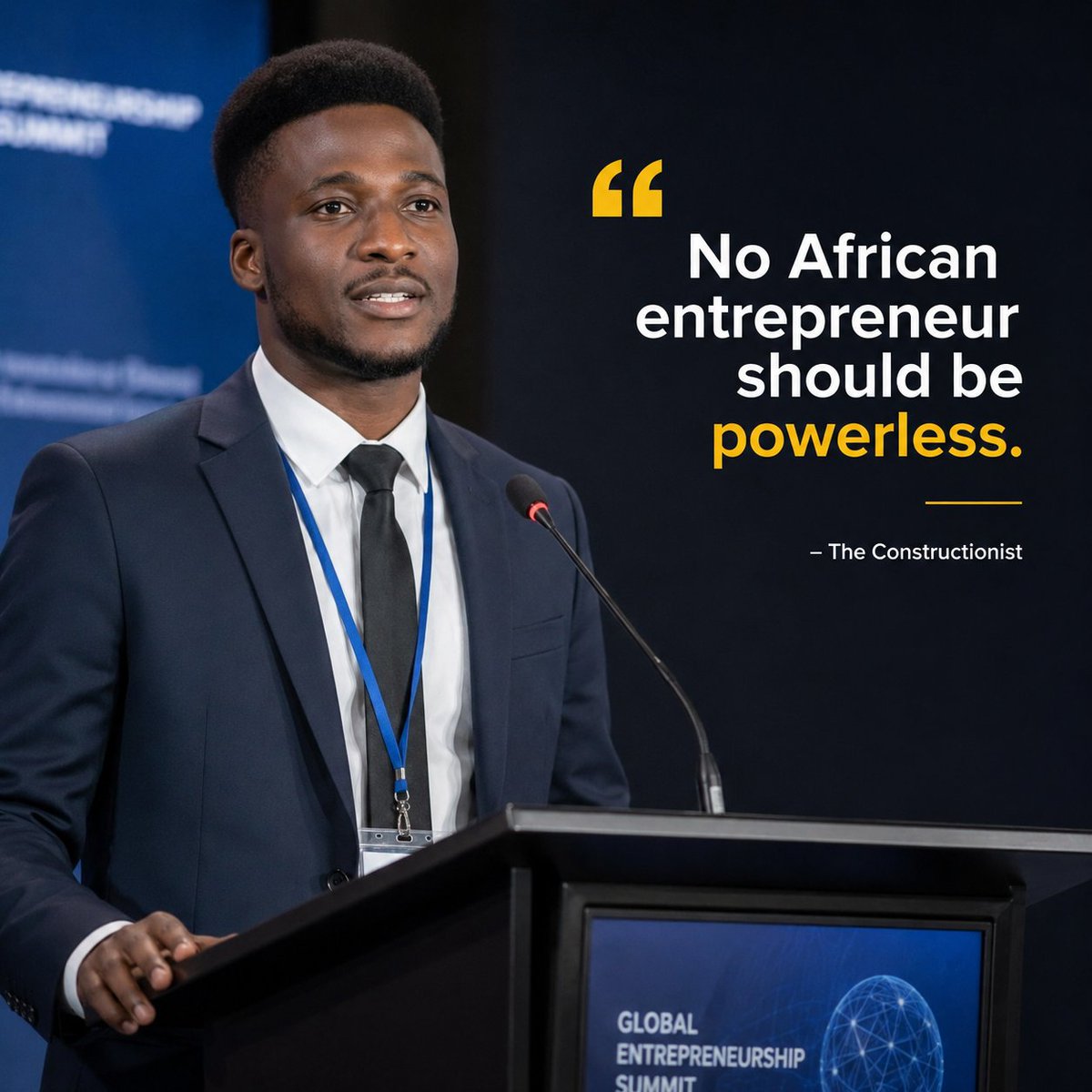
Africa is witnessing a celebrity shift.
Who truly deserves influence in society?
The Constructionist is challenging Africa’s definition of celebrity and influence.
His message is simple but powerful:
PRESIDENT TINUBU DIRECTS COMPREHENSIVE FOOTBALL REFORM
President Bola Tinubu has directed a comprehensive reform of Nigerian football to overcome repeated failures to qualify for major regional, continental and world tournaments.
“The reform must respond to a longstanding need to strengthen governance, administration, stakeholder representation, development pathways, domestic competitions and accountability across Nigerian football,” he said.
The President noted that while other sports had recorded meaningful progress since the reset of the sports sector under the re-established National Sports Commission, football has continued to struggle because of structural weaknesses within the system.
“Football, Nigeria’s most popular sport and the greatest beneficiary of public support, investment and national attention, has continued to struggle basically due to structural deficits within the system,” Tinubu said.
He stressed that Nigerian football must begin to match the country’s exceptional talent, passion and resources with stronger institutions and sustained performance.
President Tinubu directed the Chairman of the National Sports Commission to work with the NFF Secretariat and relevant football stakeholders to ensure continuity in essential football administration and facilitate a broad, consultative reform process.
The process will include appropriate engagement with FIFA and CAF while safeguarding Nigeria’s obligations within the international football framework.
The President called on football stakeholders and Nigerians to support the transition and work together to build a stronger, more accountable and successful football system.
Bayo Onanuga
Special Adviser to the President
(Information & Strategy)
August 27, 2026
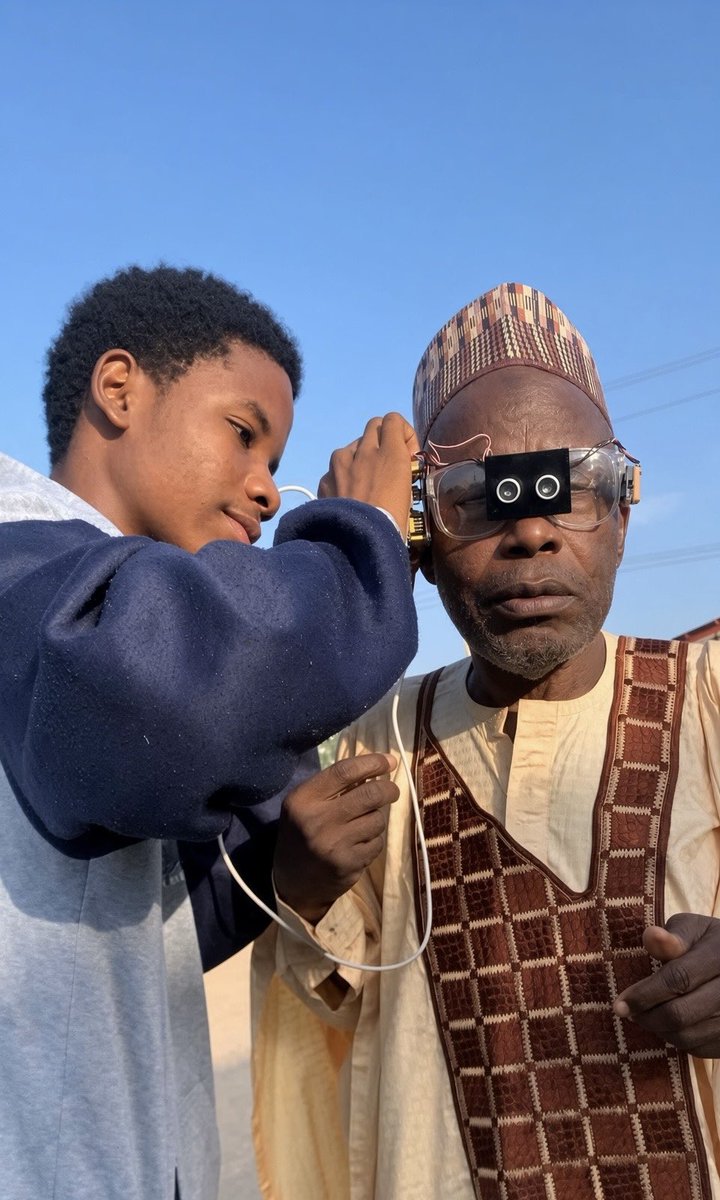
I have launched the actual test of this AI Glass that I built to help blind people and people with visual impairments
I started testing it directly on the face of a person with a visual impairment to see how it would work in real life👓
And what amazed me the most is that after the blind person wore the glass, he said that for him, it was amazing
Watch the video in English below ⤵️
This project of mine is getting close to where I want it to be
And the world wants to see it in action
I created an AI Smart Glass to help blind people walk without a cane or a guide 👓
But this is not like the smart glasses people are used to seeing
Because this Glass combines AI, sensors, and GPS to help the user detect things in front of them, avoid obstacles, and know their location
But the most amazing thing is if the user gets lost, the GPS tracking system can help locate where they are from anywhere, and then send the location to the phone of the person taking care of them via WhatsApp or Email 📲
And now I am further developing it to a new level of AI + Voice, so it can speak with the user and also help them understand their surroundings
I have put the video showing how it works completely in the comment. 🎥
SHARE this project 🤝🔥
Let the world see what a young Nigerian can build
A young Nigerian built AI smart glasses that let blind people walk without a cane or a guide.
His name is Khalifa Aminu, and what he made is not the smart glasses you've been seeing online.
So how does it work?
The glasses have sensors, GPS and AI inside them. When the person is walking, the sensors pick up anything in front of them. A wall, a pole, a car parked on the road, somebody standing there. The glasses alert them before they hit it, so they can walk around it themselves.
No stick. Nobody holding their hand.
The GPS tells them where they are at every point. But the part that got me is what happens when the person gets lost.
The glasses track their exact location and send it straight to the phone of whoever is taking care of them. WhatsApp or email. So their mother or brother or friend can find them in minutes instead of searching for hours.
If you've ever watched a blind person try to cross a road in Lagos you know that fear is real. This takes it away.
And he's not even done.
He's now adding voice to it, so the glasses can actually talk to the user and describe what's around them. Staircase ahead. Busy road coming. Someone on your left.
That's when it stops being a gadget and becomes a guide that never leaves your side.
He built this himself. No big lab, no foreign funding. Just one young guy who saw a problem and refused to ignore it.
Mr President signs the NIMC Act 2026 into law. It means the NIMC is not longer just an ID-card agency, it is now designated the Root Certification Authority for Nigeria's digital ecosystem.
The FG is positioning the NIN as the backbone of Nigeria's Digital Public Infrastructure (DPI), similar to how some countries use a single trusted identity system to access banking, government, healthcare, and other services online.
Viewed alongside the tax reform laws, the NIMC Act creates a critical enabling layer for digital governance. While the tax laws modernize how taxes are assessed, collected, and administered, the NIMC Act strengthens how individuals and businesses are identified and authenticated.
One thing that stands PBAT out is his political will to make difficult decisions that many before him either postponed or avoided.
When I was a journalist, we had a very strong debate regarding the establishment of the State Police in our newsroom.
Mr Malagu, a veteran journalist who hailed from the North but was raised in Lagos, argued strongly against the idea.
His reasons were verifiable.
He said we should go to the North and see how politicians had been deploying religious police that was largely funded by the state to disrupt legal business activities, which the Islamic religion classified as Haram.
He said we should look at how the government used the security apparatus to intimidate and manipulate election outcomes during elections. He mentioned Lagos, Port Harcourt, Ekiti, Edo and other states and reasoned that if those states had their own police forces that are under the governor, it would have led to a clash between the state forces and the federal forces, and this would lead to chaos on the street.
He also mentioned the use of such state police officers to selectively prosecute political opponents by seating governors who might target the businesses of their opposition members or their houses, relatives and friends, all in the name of ensuring such an opponent is destabilised and unable to marshal his or her strength to contest against the ruling government.
He reminded us of how the EFCC, CPC, Code of Conduct Bureau, the Judiciary and other government agencies had been deployed to harass, investigate and persecute selected politicians belonging to the opposition party by the ruling party in Nigeria's recent history.
He mentioned the then-governor Aregbesola's Social Mobilisation thugs, who were political thugs under state employment, raised to cause chaos during elections for his political party all over the southwest
He talked about the structure of such a system, which would include building police structures, creating a parallel local judiciary system, and building prisons for convicts within a state.
He talked about the proliferation of arms and weapons within the state, as the state government would have to buy weapons for these police officers, and practically make more weapons available for police to arm their armed robber friends or even commit robbery by themselves at night while pretending to be police officers by day.
He talked about the mayhem groups like the Oodua People's Congress, MEND, Bakassi boys, Egbesu boys, who were informal "security" apparatus that sprang up with democracy around 1999.
How they basically targeted members of other tribes living within their states, who they accused of being criminals and how this led to jungle justice and the death of many innocent Nigerians, including the ALUU 4 and others.
He insisted that Nigerians are too divided along ethnic and tribal lines to be given the power to have police officers who would use their powers to push their bigoted worldview on the populace
He talked about the merit of recruiting police officers and training them properly, when we all know that when the state governments funded institutions like LASTMA, LAWMA, OGROMA, OYRTMA and so on, the juicy positions were given to cronies of the state governors, members of the ruling party, friends, family members, registered members of the political party and so on.
He said meritocracy will take a back seat and nepotism will be the order of the day.
He said a lot.
When he was done, those of us who wanted to argue for it based on the American System of government in which the equivalent of local governments had local sheriffs, the states had NYPD, LAPD and so on and the federal government had the FBI, all kept quiet and silently agreed with him that our peculiar nature as a people may not be ready to embrace such an audacious idea.
The day after this discussion, the Nyanya Bombing of 2014 happened.
We watched with shock as human beings were reduced to mere body parts flung all over the street by terrorists in Abuja.
The newsroom was in a state of shock.
Mr Malagu, our Head of News, the son of a Fulani Chieftain from the North who grew up in Lagos and could speak several languages, took his teary eyes away from the TV and said, "We need state police in Nigeria. We need it right away. Security is about information and investigations. If we had state police, someone would have heard something, someone would have informed someone, a contact or an agent somewhere would have whispered something to someone, and this would have been prevented.
Crime is local. The gap here is a gap of a lack of information because the police are too cut off from the people. Policing is not about checkpoints and stop and search only; it is about "see something, say something"
We need state police!
I agree with him wholeheartedly that even in America, the systems are sometimes abused, and we have seen several cases of selective prosecution, racial profiling, political persecution, like the Russia Hoax sponsored by a political party against the candidate of another political party and so on.
Things will eventually even out.
Political cronies appointed today would be replaced by professionals tomorrow. Inasmuch as we don't have all the answers to so many questions. If indeed we want to destroy insecurity, the State Police is an apparatus that must be swiftly established and empowered to work in Nigeria.
-GSW-
Every state in Nigeria is rich in either solid minerals, fossil fuels, fresh water, or agricultural land.
The pyramids of groundnuts and plantations of palm oil, cocoa, and rubber were not built with FAAC.
A governor's job is to provide security and generate wealth. If your governor can't generate wealth to support the State, elect one that will
To each his own.
State Police: The Senate Has Done Well. Now Nigerians Must Rally Behind This Reform.
The passage of the State Police Bill by the Senate is a significant moment in the evolution of Nigerian federalism. The Senate deserves commendation for demonstrating the courage and foresight to confront one of the most important governance and security questions of our time.
For decades, Nigerians have debated the merits and risks of State Police. The arguments have been vigorous, sometimes emotional, and often shaped by legitimate concerns about abuse. Yet every serious conversation eventually returns to the same reality: a nation of Nigeria’s size, diversity, and complexity requires a security architecture that is both nationally coordinated and locally responsive.
The Senate has now taken a historic step towards achieving that balance.
Importantly, Nigeria is not venturing into uncharted territory. Virtually every successful federal democracy has recognized that local policing is an essential component of effective governance and public safety.
In the United States, state police agencies coexist with federal institutions such as the FBI and other federal law enforcement bodies. In Germany, policing is largely the responsibility of the states, while federal agencies focus on national and cross-border responsibilities. In Canada, provincial police services operate alongside federal law enforcement. These nations did not become weaker because they decentralized aspects of policing. They became stronger because they matched security responsibilities to the level of government best positioned to execute them.
The lesson is clear: effective federalism requires effective local institutions.
This is not a victory for any political party, region, governor, or administration. It is a victory for the idea that government should continually adapt its institutions to meet the needs of the people. It is an acknowledgment that communities are often best protected when those responsible for policing understand local realities, possess local intelligence, and can respond rapidly to emerging threats.
The task before us now is no longer whether State Police should exist. The task is ensuring that it succeeds.
That success will require broad national support.
The Federal Government, state governments, the House of Representatives, state assemblies, traditional institutions, civil society organizations, the private sector, and ordinary citizens must all approach this reform with a spirit of patriotism rather than partisanship. This is not the time for triumphalism or fearmongering. It is the time for careful institution-building.
Those who supported State Police must acknowledge the concerns of those who feared abuse. Those who opposed it must recognize that safeguards can and should be built into the system. Both sides have a responsibility to contribute to making the reform work.
The examples from other federations are instructive. The most successful systems are not those that simply create state police forces; they are those that create safeguards around them. Independent Police Service Commissions, legislative oversight, judicial review, professional recruitment standards, protected tenure for senior officers, and clearly defined divisions between federal and state responsibilities are what make decentralized policing work.
Nigeria must learn from these experiences.
The Federal Government should continue to lead on terrorism, border protection, organized crime, cybercrime, interstate criminal activity, and national intelligence coordination. State Police should focus on community policing, local investigations, intelligence gathering, public order, and rapid response to security threats within their jurisdictions.
Equally important, State Police must never become personal security outfits for governors or instruments of partisan politics. They must be institutions of the law, accountable to constitutional safeguards and democratic oversight
As we celebrate Democracy Day in Nigeria, we are reminded that real change is not only about who is in office, but about the culture we all uphold.
Accountability is learned at home, tested in communities, and proven in governance. That is how democracy grows.
#DemocracyDay
Accountability is the Seed of Democracy.
Democracy does not begin with elections. It begins with accountability—practiced daily in homes, communities, and government.
A true democratic society is built from the ground up.
But when accountability is practiced at every level—home, community, and government—it builds trust, strengthens institutions, and makes leadership a responsibility, not a privilege.