.@authoraid@ndorms@CHAIN_Network
Unique opportunity for early-career health researchers!
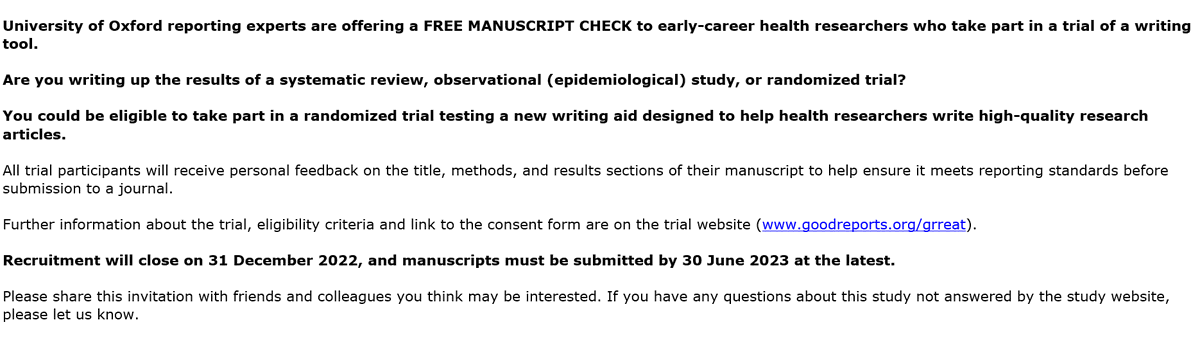
Recruitment to @Good_Reports@EQUATORNetwork Trial https://t.co/4mpDo6Xzi5 is closing soon
Please forward to colleagues & networks to reach authors currently writing up for publication
Trialblazers: putting patients in the driving seat of clinical trials
Recruiting NOW for workshops in Oxford (and online) for people with mild #psoriaticarthritis
Other ways to get involved and maybe win £25!
https://t.co/im53XVdc5C
@NIHRresearch@NIHRinvolvement@NIHRtakepart
Trialblazers: a new idea to get patients in the driving seat of clinical trial design
Recruiting NOW for workshops in Oxford (and online) in July for people with mild/suspected #psoriaticarthritis
Or simply fill in a survey to potentially win £25!
https://t.co/65DMzueQMk
Trialblazers: a new idea to get patients & the public in the driving seat trial design 🚗🚗🚗
Recruiting NOW for a workshop in Oxford in July for people with mild #psoriaticarthritis
Anyone can contribute and potentially win £25!
https://t.co/65DMzueQMk
@EQUATORNetwork@ndorms
@leeflang_m@shauntreweek Yes, I understand you see mostly DTA reviews and that's what you were talking about.
I see mostly intervention reviews (although diagnostic tests are of course interventions too!) and they usually have so many problems of both the kinds you describe they are totally useless
@leeflang_m@shauntreweek Good. It wasn't clear from your Tweet. And it needs to be spelled out. The two issues should be separate as they are two problems which both have very serious consequences which compound each other.
Why especially in DTA reviews? It happens in all reviews, surely?
@leeflang_m@shauntreweek Do you mean they don't understand the methods of systematic reviews, or they don't understand when the methods of included trials make the using the data from those trials pointless and/or positively dangerous?
Short talk on 24 April for anyone interested in getting involved in @EQUATORNetwork research
I will talk about an idea to develop a way of involving patients & the public in the design of future trials which explicitly avoid the mistakes of the past.
https://t.co/vSpLChBPwJ
If lay summaries were always written at trial protocol stage, and patients routinely involved in all aspects of trial design, including ensuring the summary was written at the right level, perhaps this appalling statistic could be improved upon for summaries of the trial results
Trial lay summaries were not fit for purpose
--> https://t.co/sqXvK0gbi5
"No lay summary met the recommended reading age for health care information of 11-12 years. None of them were considered ‘easy’ to read, in fact over 85% were considered ‘difficult’ to read"
@sharpmelk Well that's why I'm a bit confused...who is it useful for? I will check it out with the developers. Who it's for, and what it will help them do.
We believe public involvement is important to high quality research and that focusing the priorities of and involvement of patients is one the vital roles of charities.
Access guidance, tools and case studies on this topic via our website: https://t.co/HFyLqaxpY5
@jd_wilko How about saying...
"the +ve effect on [outcome] could be as big as [estimate at one end of confidence interval] or it could be as small/-ve effect as [estimate at other end of confidence interval]. The true effect could be anywhere in between, and we don't currently know where"
@jd_wilko I think it *is* down to the terms used to explain the concept of uncertainty. What terms do these studies use if they don't use "point estimate" and "confidence intervals"?
Uncertainty is difficult to explain, and people don't like it. There must be ways to explain it better
@sharpmelk Completeness assessments using two reviewers is exactly what we're doing for the the @Good_Reports randomized trial (recruitment now closed). It is literally data extraction, with forms created using reporting guidelines. Could be made standard. https://t.co/4mpDo7fIwd
@jd_wilko What would be better terms/definitions to replace "point estimate" and "confidence interval" to make the latter preferable to people without a stats background? Genuine question :-)
Maybe "guessimate" for the former?! not entirely a joke...
@sharpmelk The task of coding for completeness (and other observable characteristics of studies eg. conflict of interest) is amenable to crowd-sourcing/citizen science approach? It is not practical to have multiple assessors any other way is it?
Paper discussing poor reporting of studies evaluating reporting.
It doesn't get more depressing than that, right?
https://t.co/wjGOYibSOk
Happily, as advocated by the authors, @EQUATORNetwork is testing a strategy to help people do better @Good_Reports https://t.co/4mpDo7fIwd