Create a fun and immersive environment for Science and Math based education where Parents, Teachers, and Students alike will be able to learn and to just play!
Tacit is a primitive CSS framework for people who know nothing about graphic design but want their web services to look presentable without writing any CSS classes.
- No classes, no layouts, just plain HTML5 that looks good automatically
- Responsive and mobile-friendly with a single meta tag
- Drop-in via CDN with a single `<link>` element
- Compatible with Chrome, Firefox, Safari, Opera, Edge, and IE11
Explore it here:
https://t.co/2mkdYKjrnn
Kimi K2.7 Code is the first open-weight model you can select in the GitHub Copilot model picker. What does that mean for you?
@burkeholland explains how this low-cost, high-performance model gives you more choice and flexibility in your workflow. ▶️
This 30-min workshop by the creator of Claude Code will teach you more about vibe-coding than 100 YouTube video guides.
Bookmark it & give it 30 minutes today. This video will change the way you use Claude forever.
This 2 hour Stanford lecture will teach you more about how LLMs like ChatGPT & Claude are built than most people working at top AI companies learn in their entire careers.
Bookmark this & give 2 hours today, no matter what. It'll be the most productive thing you do this week.
If you want to work in AI or Data Science, read this.
O’Reilly published a 533-page book teaching the real analytical skills behind AI.
Topics inside:
• statistical learning
• regression models
• clustering
• Monte Carlo methods
• data visualization
Basically the foundation of modern AI systems.
I’m giving it away FREE.
To get it:
1. Follow me
2. Like + RT
3. Comment AI
I’ll DM the book.
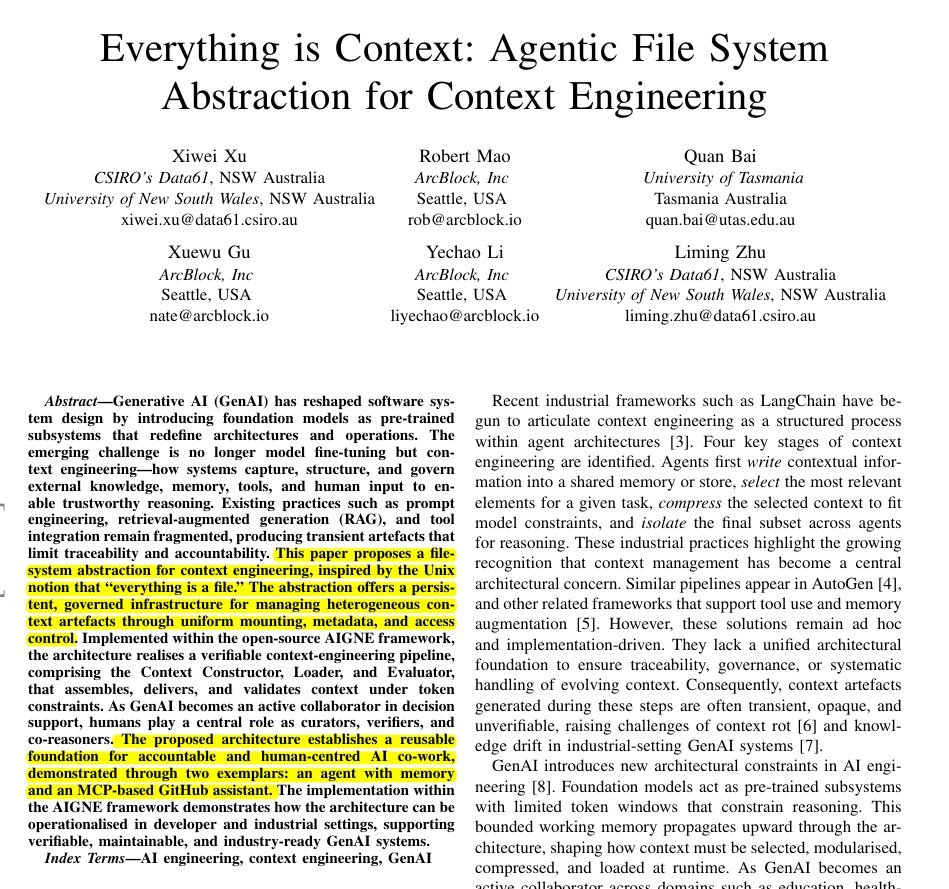
The paper says the best way to manage AI context is to treat everything like a file system.
Today, a model's knowledge sits in separate prompts, databases, tools, and logs, so context engineering pulls this into a coherent system.
The paper proposes an agentic file system where every memory, tool, external source, and human note appears as a file in a shared space.
A persistent context repository separates raw history, long term memory, and short lived scratchpads, so the model's prompt holds only the slice needed right now.
Every access and transformation is logged with timestamps and provenance, giving a trail for how information, tools, and human feedback shaped an answer.
Because large language models see only limited context each call and forget past ones, the architecture adds a constructor to shrink context, an updater to swap pieces, and an evaluator to check answers and update memory.
All of this is implemented in the AIGNE framework, where agents remember past conversations and call services like GitHub through the same file style interface, turning scattered prompts into a reusable context layer.
----
Paper Link – arxiv. org/abs/2512.05470
Paper Title: "Everything is Context: Agentic File System Abstraction for Context Engineering"
BREAKING: MIT just mass released their Al library for free. (Links included)
I went through these and honestly... this is better than most paid courses I've seen.
Here's the full list of books:
Foundations
1. Foundations of Machine Learning Core algorithms explained. Theory meets practice.
2. Understanding Deep Learning Neural networks demystified. Visual explanations included.
3. Machine Learning Systems Production-ready architecture. System design principles.
Advanced Techniques
4. Algorithms for ML Computational thinking simplified. Decision-making frameworks.
5. Deep Learning The definitive textbook. Covers everything deeply.
Reinforcement Learning
6. RL Basics (Sutton & Barto) The classic. Agent training fundamentals.
7. Distributional RL Beyond expected rewards. Advanced theory.
8. Multi-Agent Systems Agents working together. Coordination and competition.
9. Long Game Al Strategic agent design. Future-focused thinking.
Ethics & Probability
10. Fairness in ML Bias detection. Responsible Al practices.
11. Probabilistic ML (Part 1 & 2)
Links: https://t.co/AhDqm9x1QC
Most people pay thousands for bootcamps that teach half of this.
Bookmark it. Start anywhere. Just start.
Repost for others Follow for more insights on Al Agents.
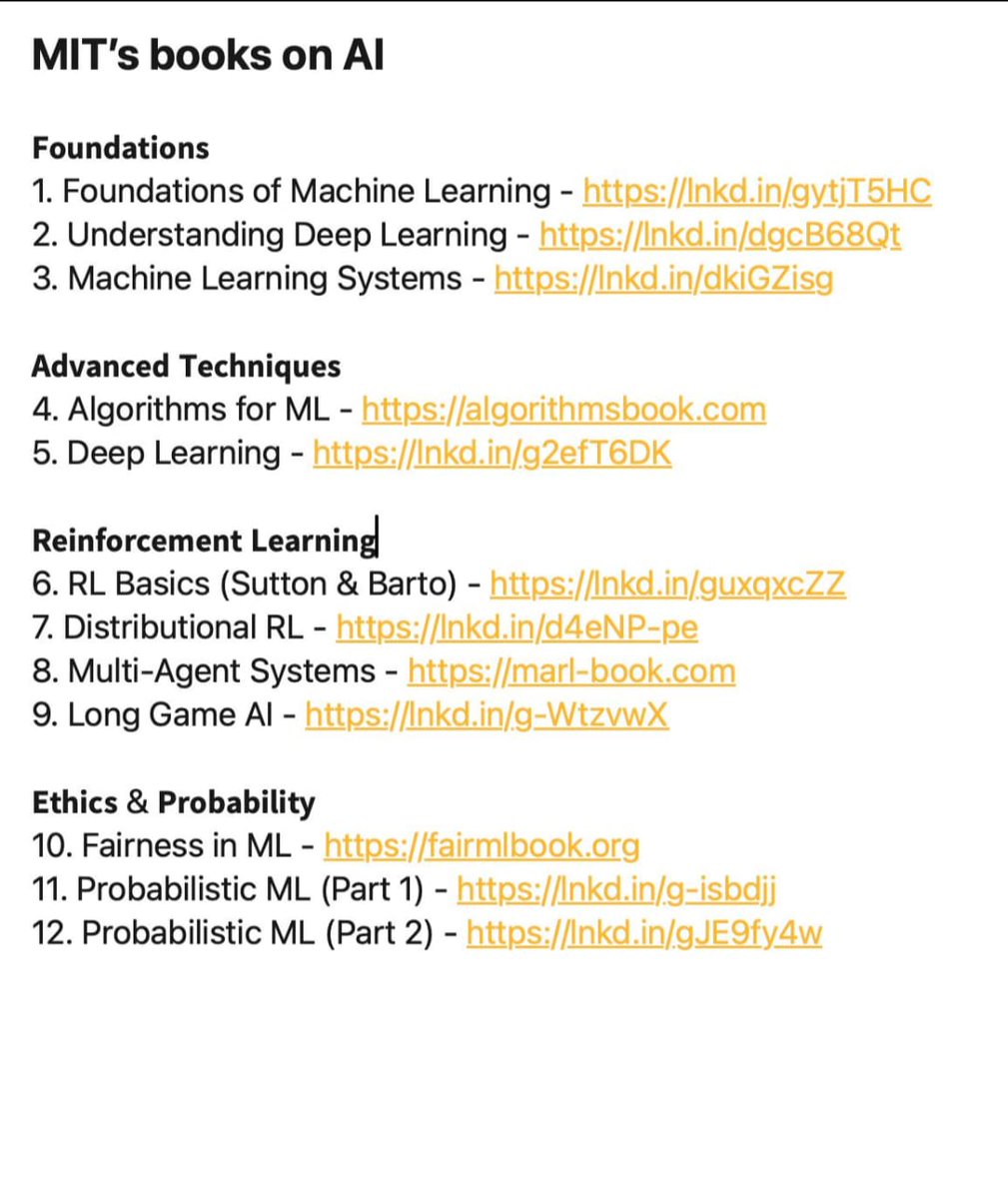
MIT's books on Al
Foundations
1. Foundations of Machine Learning - https://t.co/HxbXfsDIl6
2. Understanding Deep Learning - https://t.co/AyeQav2yzN
3. Machine Learning Systems - https://t.co/0AxGtjBFwA
Advanced Techniques
4. Algorithms for ML - https://t.co/LOjFeK1hut
5. Deep Learning - https://t.co/Ztmu7X6gNM
Reinforcement Learning
6. RL Basics (Sutton & Barto) - https://t.co/HAWxL28df1
7. Distributional RL - https://t.co/VB1zBuSzag
8. Multi-Agent Systems - https://t.co/3tWqJaimYn
9. Long Game Al - https://t.co/vYDuy1XKT2
Ethics & Probability
10. Fairness in ML - https://t.co/B4lAj2ivpF
11. Probabilistic ML (Part 1) - https://t.co/folJrX24sf
12. Probabilistic ML (Part 2) - https://t.co/BMOjc8qSqZ
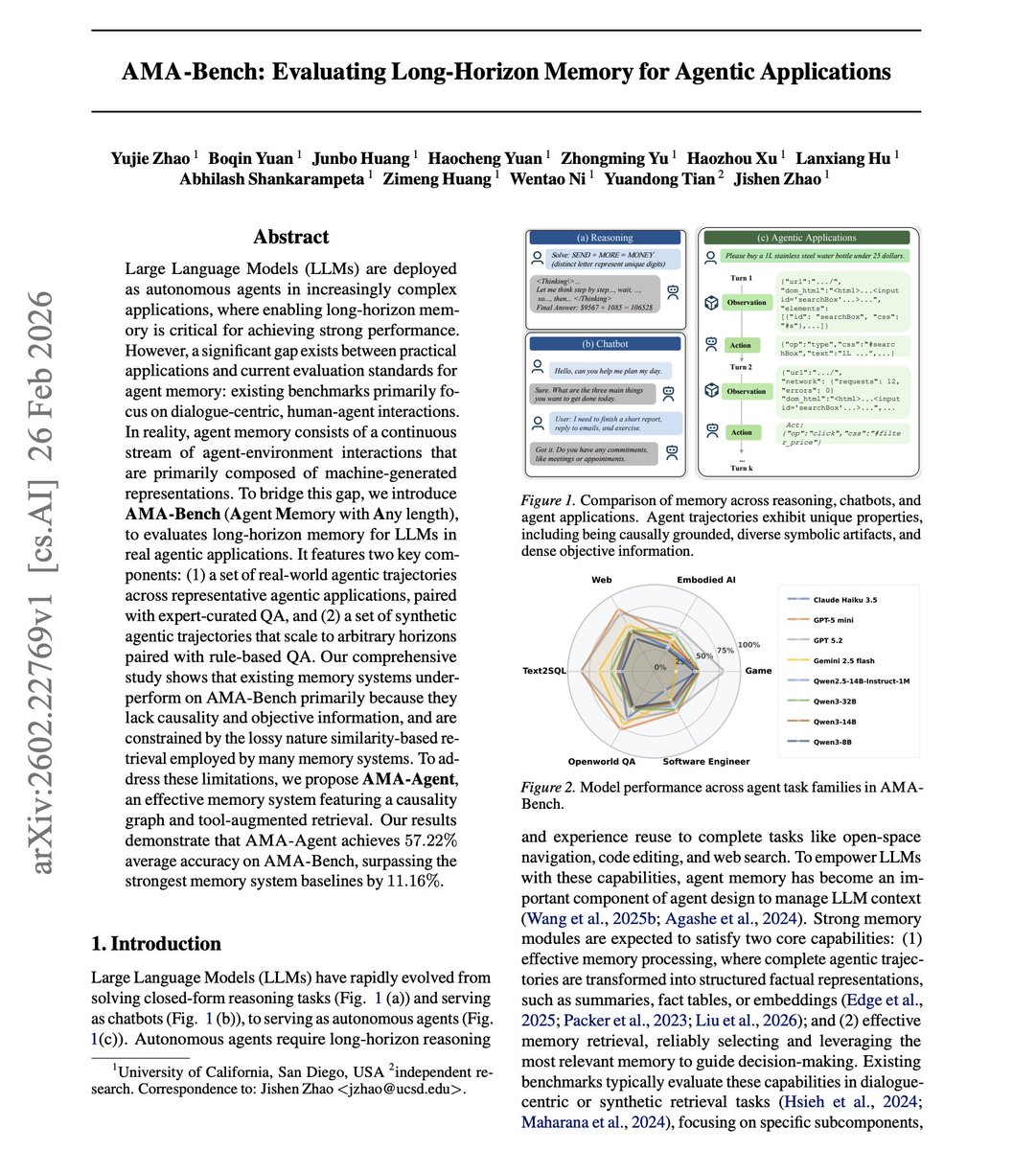
New research on agent memory.
Agent memory is evaluated on chatbot-style dialogues. But real agents don't chat. They interact with databases, code executors, and web interfaces, generating machine-readable trajectories, not conversational text.
The key to better memory is to preserve causal dependencies.
Existing memory benchmarks don't actually measure what matters for agentic applications.
This new research introduces AMA-Bench, the first benchmark built for evaluating long-horizon memory in real agentic tasks. It spans six domains including web, text-to-SQL, software engineering, gaming, and embodied AI, with both real-world trajectories and synthetic ones that scale to arbitrary lengths.
The findings are interesting.
Many existing agent memory systems that outperform baselines on dialogue benchmarks actually underperform simple long-context LLMs on agentic tasks. Even GPT 5.2 only achieves 72.26% accuracy.
To address this, they propose AMA-Agent with a causality graph and tool-augmented retrieval, achieving 57.22% average accuracy and surpassing the strongest baselines by 11.16%.
Why it matters?
Agent memory needs to preserve causal dependencies and objective information, not just similarity-based retrieval. This benchmark exposes where current memory systems actually break.
Paper: https://t.co/GX0GaHsijN
Learn to build effective AI agents in our academy: https://t.co/LRnpZN7L4c
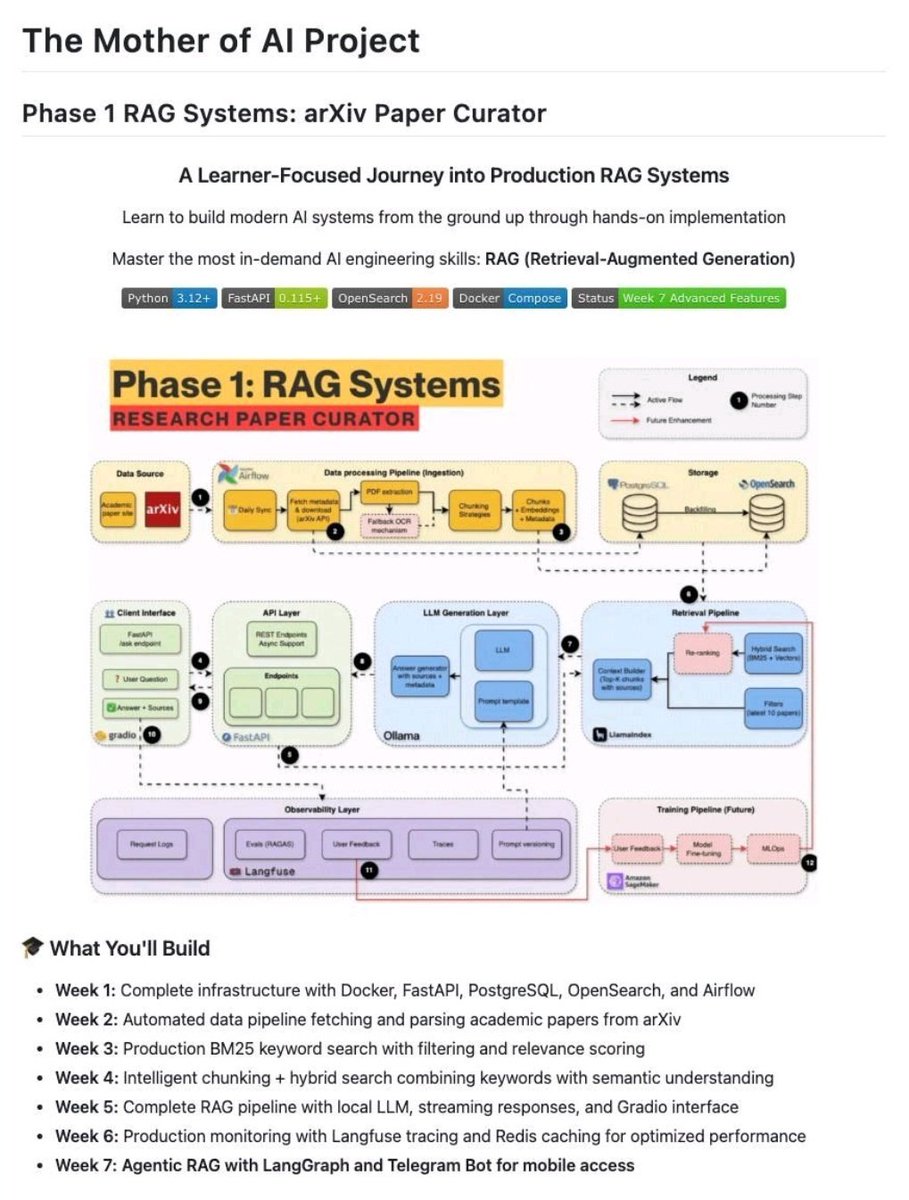
Someone literally built a free AI university - all in one repo, covering real-world AI systems step by step
Link - https://t.co/itaqmWZTBQ
Here’s what you’ll learn:
Week 1 - Setup everything
Docker, FastAPI, databases
Beginner-friendly foundation
Week 2 - Feed it real data
Automatically fetch research papers
Fully automated data pipeline
Week 3 - Teach it to search
BM25 keyword search implementation
Your own Google-like search system
Week 4 - Make it smarter
Hybrid search enabled
Understands meaning, not just keywords
Week 5 - It talks back
Complete RAG system
Ask questions, get accurate answers
Week 6 - Production ready
Caching and monitoring added
Runs like a real product
Week 7 - Give it a brain
Agentic AI with LangGraph
Even works with Telegram
AGENTS dot md files don't scale beyond modest codebases.
Lots of discussions on this lately.
If you're building serious software with Claude Code or any agentic tool, a single AGENTS dot md will eventually fail you. This paper shows what comes next.
A 1,000-line prototype can be fully described in a single prompt. A 100,000-line system cannot. The AI must be told, repeatedly and reliably, how the project works, what patterns to follow, and what mistakes to avoid.
Single-file manifests hit a ceiling fast.
This new paper, Codified Context, documents a three-tier infrastructure built during real development of a 108,000-line C# distributed system across 283 sessions over 70 days.
The system uses a three-tier memory architecture: a hot-memory constitution (660 lines, always loaded), 19 specialized domain-expert agents (9,300 lines total) invoked per task, and a cold-memory knowledge base of 34 specification documents (~16,250 lines) queried on demand via an MCP retrieval server.
Across 283 sessions, this produced 2,801 human prompts, 1,197 agent invocations, and 16,522 autonomous agent turns, roughly 6 autonomous turns per human prompt, with a knowledge-to-code ratio of 24.2%.
Crucially, none of it was designed upfront: each new agent and specification emerged from a real failure, a recurring bug, an architectural mistake, a convention forgotten, and was codified so it could never require re-explanation again, turning documentation into load-bearing infrastructure that agents depend on as memory, not reference.
Paper: https://t.co/ZXBzhhkzsq
Learn to build effective AI agents in our academy: https://t.co/1e8RZKs4uX