Hey everyone!
Here's my weekly email recap of all things money – from the stock market to real estate to personal finance – with research and actionable ideas
I'd love for you to join, and it's totally free :)
https://t.co/HqG9hswblp
How do you erase a massive national debt without raising taxes or defaulting? You quietly tax the savers.
It’s a strategy called Financial Repression. The Fed used it 70 years ago, and now they're planning to use it again. Here's how it works:
After WWII, US debt had skyrocketed to 106% of GDP. The government couldn't slash spending without crushing the post-war economy, and hiking taxes further was a political death sentence. So, they chose a third option: Shrink the debt with inflation.
Here is how the playbook worked:
1. Cap the yields: The Fed pegged long-term government bond yields at a low 2.5%.
2. Let inflation run: When post-war price controls lifted, inflation quickly peaked past 10%.
If you were a disciplined citizen holding a government bond, you got your guaranteed 2.5% interest. But because of soaring prices, your real purchasing power was eroding by roughly 6% a year.
The government effectively repaid yesterday's debt with today's dollars that were losing their value. Without this strategy, the system might have collapsed. But by 1974, this silent plan dragged the Debt-to-GDP ratio all the way down to 23%.
America's post WWII boom is often seen as an example of miraculous economic growth. But more than growth or responsible budgeting, it's the massive wealth transfer from the public that saved the system.
Why is this relevant now? For the first time since WWII, Debt-to-GDP ratios are hitting nearly the same levels. Kevin Warsh has been hinting that the new Fed will be a more disciplined one, and financial repression is always a silent but powerful tool.
In today's Substack post, I talked about how to see this coming and what you can do to protect your wealth once it kicks in. I'll drop the link in the comments.
Finally saw the movie Obession. Holy crap.
It was insane. The entire theater was completely sold out on a Tuesday night, all show times. I haven’t seen movie crowds like this since I was a kid. Incredible movie, and incredible that this was done on a $750k budget. Go and see it!
The Federal Reserve is about to stop holding the market's hand.
For 14 years, we have lived in an era of Forward Guidance, a world where the Fed tells us what they are thinking months in advance, to keep stocks stable. Kevin Warsh is about to end that.
His 4-point blueprint for a regime change is a deliberate move to make the Fed a black box again. Here is the breakdown of what is actually happening:
1. The Liquidity Withdrawal: Warsh wants to aggressively shrink the 6.7 trillion dollar balance sheet. When the Fed stops buying bonds and mortgage-backed securities, it removes the artificial floor under the housing market. It forces mortgage rates to be determined by reality instead of money printing.
2. Ending the Dot-Plot: The Fed holds eight meetings a year and releases a "Dot-plot" – a roadmap of where rates are headed. Warsh wants to cut that to 4 meetings and delete the dot-plot. By surprising the market, he hopes that investors will price risk on their own. Expect jagged, volatile swings to become the new normal.
3. The Accounting Shift: This is the most controversial move. By switching to a "Trimmed Mean" inflation gauge, the Fed can ignore extreme price spikes in energy or food. It is a way to make inflation look lower on paper, providing the cover needed to justify rate cuts even if your grocery bill is still climbing.
4. The End of Sacred Independence: Warsh believes independence must be "earned" by hitting targets. The Fed will shift from being a neutral referee to a performance-based agency. If the Fed is under pressure to hit specific goals to keep its autonomy, the temptation to prioritize short-term market wins over long-term stability becomes massive.
The bond market is already calling the bluff. Long-term yields are at 20-year highs because investors see the friction between a new Chair who wants to cut rates and an old Chair (Powell) who is still sitting at the table refusing to leave. The new blueprint isn't about lower rates, but rather about a Fed that is changing the way Americans invest for the future.
I did a deep dive into who the biggest winners and losers will be under this new regime in this week's Substack post. I'll drop the link in the comments.
This is Ferrari's new humiliation ritual.
They'll make you buy this $640k EV (that looks like a melted Cybertruck had a baby with an iPad) before you can get on the list for the real Ferraris you actually want.
Welcome to the new 'pay to play' era at Maranello.
I tend to think AI will be able to outpace human content in the very near future. People will always review things, there will always be a place where someone talks about something, and AI will be able to synthesize that information faster than a person searching. I don’t think it’ll create slop on slop. It’s just advancing too quickly for that to be an issue 3-5 years from now.
Google is now prioritizing AI results instead of user-driven websites. Most people seem to be unhappy with this. But I remember when Apple removed the headphone jack, and back then, everyone was equally upset. Today, no one bats an eye.
Genuinely curious - it seems like this was coming sooner or later. No one says “hold on let me google it” anymore…they say “hold on let me ask AI.” Google search is used less as less, it’s only a matter of time until everything is searched and found through AI.
To me, this change was going to happen at some point. It just happened to be starting now. Am I wrong to think this way? Is there something I’m missing?
@davidsirota These were just bloated businesses, though. Media is terrible when it becomes too corporate. Nimble creator businesses will absolutely dominate when overhead is low and they have the freedom to pivot as needed.
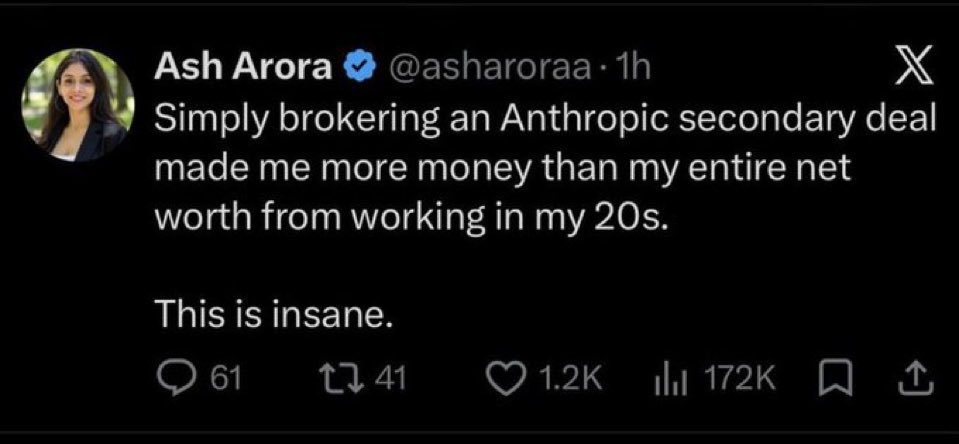
When you finalize a huge deal, tell no one. Not your spouse. Not your children. Not your friends. Not even your parents. Celebrate internally, maybe take the weekend off, and then get back to work.
This tweet single-handedly made Anthropic and OpenAI scramble and issue full statements on secondary stock deals.
$500B of paper value just got wiped out overnight.
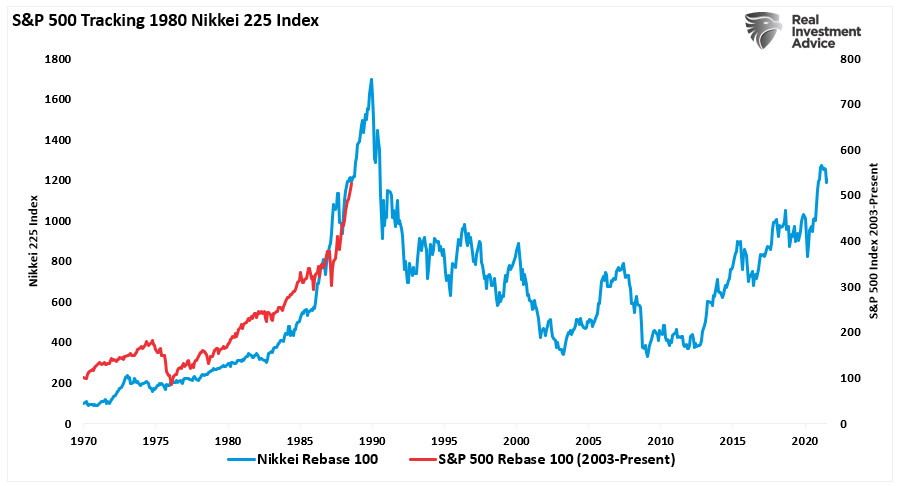
The U.S. stock market is tracking the 1989 Japan bubble. When that bubble burst, their market didn't recover for 40 years. So what's going on?
In the 1980s, Japan saw a rapid surge in stock and real estate values. It was called "The Everything Bubble."
The math was simple but dangerous:
- Low interest rates flooded the market with cheap money.
- Companies used that money to buy stocks.
- Rising stock prices increased corporate valuations.
- Higher valuations let those companies borrow even more money to buy even more stocks.
Real estate in Tokyo was so expensive that the grounds of the Imperial Palace were worth more than the entire state of California! It was a perfect circle that worked till it didn't.
In 1989, the market crashed 50 percent. Then it dropped a bit more. It did not fully recover for almost 40 years.
Today, the S&P 500's trajectory looks the same.
We see the same pattern of cheap money, massive debt, and a belief that prices can only go up. But there is one major difference this time: AI productivity and companies with real cash flows.
While Japan was fueled by a real estate frenzy, the U.S. is fueled by companies like Nvidia and Microsoft generating massive cash flow. The question is whether that productivity can grow fast enough to outrun the debt.
At the same time, we're also face a shrinking workforce and rising social costs. How will these forces work together?
The goal is not to predict a crash but to prepare for any eventuality.
I broke down the full data on the great melt-up and what it means for your portfolio on my Substack. I'll drop the link in the comments.