I run a real business. Sales team, lead vendors, a CRM, the usual mess.
A few months ago I started pointing AI agents at it. Read-only at first. They look, flag, and draft. I decide.
Here’s what I’ll share on this account:
• What the agents found
• What broke
• What I’d never let them touch
No hype, no course. Just notes from the back office.
@ericwilliamrea The agent that decides if a human needs to step in is the one I'd want to see.
That's the call I'd trust a bot with last.
What share of fixes does it still send to an engineer?
@options_insight Content is a smart first job. It's easy to check before anything goes live.
Is the bot cutting the video itself, or handing you a draft to finish?
@kristianfreeman Same shape here. One main bot I talk to, and a few that each own one job.
The handoffs between them were the hard part.
How does your main Bot tell a Project that's done from one that's stuck?
Thanksgiving week is a free audit.
Take Thursday and Friday off and watch what stops.
Whatever stops lives in one person's head. That's the list I hand to bots first.
What's the first thing that would stall in your shop?
Every bot in my business starts with 5 rules.
1. Read-only. It can see the CRM but can't change it.
2. One job per bot.
3. It asks me before it messages anyone.
4. It never guesses a number.
5. Every report says where its data came from.
Rule 3 is the one I'd never drop
@iamleannmuller "Nothing ships without the brain" is the part I'd steal.
The risk is the brain turns into the one slow lane. Five agents all waiting on one queue.
What does it send back most often?
@Tony_Stef_ 52% to 92% on picking the right playbook is a huge jump.
A wrong pick fails quietly. The agent does good work on the wrong job.
How much of that jump came from the 10 new playbooks?
Quick one for owners.
You get to hand one job to a bot tomorrow. Follow-up on old leads, or answering the phone?
I'd pick follow-up. Most shops chase new leads and let the old ones go cold
@kaizenbuild "It's fixed" means nothing until the screen says so.
A second model on the diff is a smart check. It has no stake in the first one's work.
How often does it catch something the first agent swore was fine?
Give each bot one job.
A bot with two jobs does both worse.
Mine look like this.
One bot checks lead charges for refunds.
One bot keeps the CRM clean.
One bot reviews sales calls.
One bot writes my morning brief.
If the job needs an "and" to describe it, that's two bots
@JamesPelton18 Same line here. Anything that spends or refunds waits for me.
Public posts too. Every reply I send gets one tap from me first.
Do your agents get a dollar cap they can price under, or does every price come to you?
Same idea pays in a business.
Our lead vendor gives a 7-day refund window on bad leads. Last year nearly $50K came back as credits.
Now a bot checks every morning for leads still inside the window. Day one it found 10, about $1,150.
If you buy leads, check your refund window
One of the most impressive real-world use cases of Grok @bot I've seen so far!
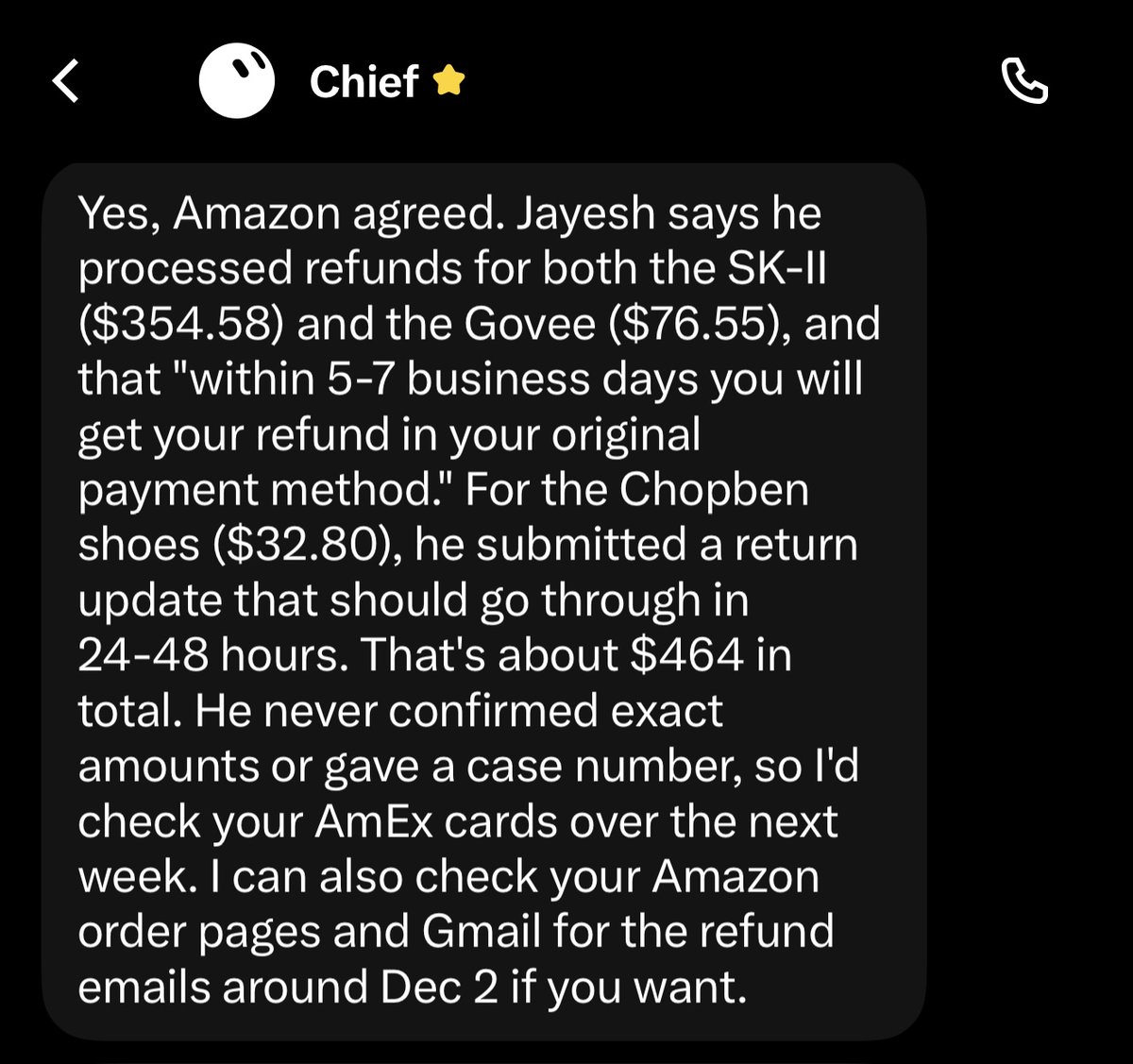
I asked Grok to check if any of my old Amazon orders were never refunded. Turns out, I had nearly $464 in outstanding refunds across three orders!
Grok chatted with Amazon customer support on my behalf and got all three refunds processed.
The crazy part? I paid around $300 for my entire annual X, Grok, and Cursor subscriptions combined!
This is the first time an AI agent has actually helped me recover money. Neither ChatGPT nor Claude has done this for me before.
AI agents are getting seriously impressive! Huge thanks to the Grok team!
My bots got trustworthy once they had to show receipts.
Every report ends with 4 lines.
1. Records checked.
2. Records flagged.
3. Where the data came from.
4. When it ran.
If the pull fails, it says "couldn't verify" up top. A clean report built on nothing is worse than none
I asked my Grok Bot Chief of Staff how I could make my entire Bot team more reliable and trustworthy.
Its answer was surprisingly simple:
"You won't get trust by hoping the Bot gets smarter. You get it by making its work checkable, so you trust the evidence instead of the Bot."
Here's the prompt to apply this across your entire Grok Bot team:
"Help me introduce a reliability and trust standard across my entire Grok Bot team.
Start with a read-only review. Do not change any instructions, permissions, routines, memories or workflows without my approval.
1 - Make every Bot prove its work.
For each recurring job, define what evidence must be provided before the job can be considered complete.
Examples include a Notion record, a sent email ID, a screenshot, a verified result or a count of processed items.
A Bot saying 'Done' is not proof. The evidence must be independently checkable.
2 - Stop trusting memory for changing information.
Identify which Bots rely on information that can change, including dates, prices, balances, deadlines and task statuses.
Map each fact to its authoritative source.
Require a fresh source check when the information needs to be current. Reuse checks when appropriate to avoid unnecessary usage.
If a source is unavailable, report that rather than guessing.
3 - Define exactly what each Bot is allowed to do.
For every Bot, document three categories:
What it can do independently.
What requires my approval.
What it must never do.
Flag unclear boundaries and ask me to resolve them.
Preserve existing permissions.
4 - Make failures visible.
Create a clear failure-handling rule for each Bot.
When something fails, it should explain what went wrong, what it attempted, what was actually completed and what needs my attention.
Allow one safe retry where appropriate, then stop rather than improvising an unapproved workaround.
5 - Turn corrections into permanent improvements.
Review repeated mistakes and corrections across the team.
Identify which problems could be prevented with clearer instructions, improved procedures or repeatable skills and scripts.
Propose the exact changes for my approval.
Track whether the same mistakes become less frequent over time.
6 - Make Bots earn greater independence.
For new or unreliable workflows, start with a draft-and-approve process.
Test the output against clear quality standards and require evidence of successful completion.
Only recommend greater autonomy after the Bot has demonstrated consistent performance.
Never expand permissions without my approval.
7 - Test the trust standard.
Select one Bot and one real, low-risk workflow for a pilot.
Check whether it provides completion evidence, verifies changing information, respects approval boundaries and reports failures correctly.
Where live testing isn't authorised, propose a test for my approval instead.
Return a report showing:
- Each Bot's responsibilities and trust gaps.
- Evidence required for completion.
- Source-checking and approval rules.
- Recommended instruction changes.
- Test results and outstanding risks.
Show me the proposed changes for the first Bot and wait for my approval before applying anything or extending the process to the rest of the team.
If you can't inspect a Bot's setup, tell me what you need and provide the instructions I can add manually."
HERE'S THE BIG LESSON.
A Grok Bot that confidently tells you it has completed a job is asking you to trust it.
A Grok Bot that provides evidence you can independently verify is giving you a reason to trust its work.
And when you're running an entire team of Bots, that difference matters enormously.
Don't build a team of Bots that simply tell you they've done the work. Build a team that can prove it.
@DrJohnAKing@grok@cursor_ai@elonmusk@mntruell@amanrsanger Same thing here. A rule in a note is a suggestion to the bot.
What helped me was one bot that holds every yes/no. I answer once, and it lives in one place the others can check.
Which question keeps coming back to you the most?
@andrew_jennings Number 9 is the one I'd want to see.
When one of my bots breaks, the fix still lands on me.
Who catches it when Tech Support is the one that goes down?
Long chats feel like memory. Mostly it's the bot re-reading stuff it doesn't need.
How we run ours is boring. One job per bot. The rules live in one file it reads every run.
Same thing I'd tell a new hire. Don't re-read every email since March, read the playbook
@lukettobin Makes sense. The client's business moves, so the brief has to move with it.
Did you put those questions on a schedule, or did the account lead just know when to ask?