Graybx is on GitHub ⭐️
We build tooling for AI engineers who want to move faster and smarter through model development.
Today we're open-sourcing the core of our product, Weightslab.
Come take a look 👇
https://t.co/FuatTqQ49x
#AI#MachineLearning#OpenSource
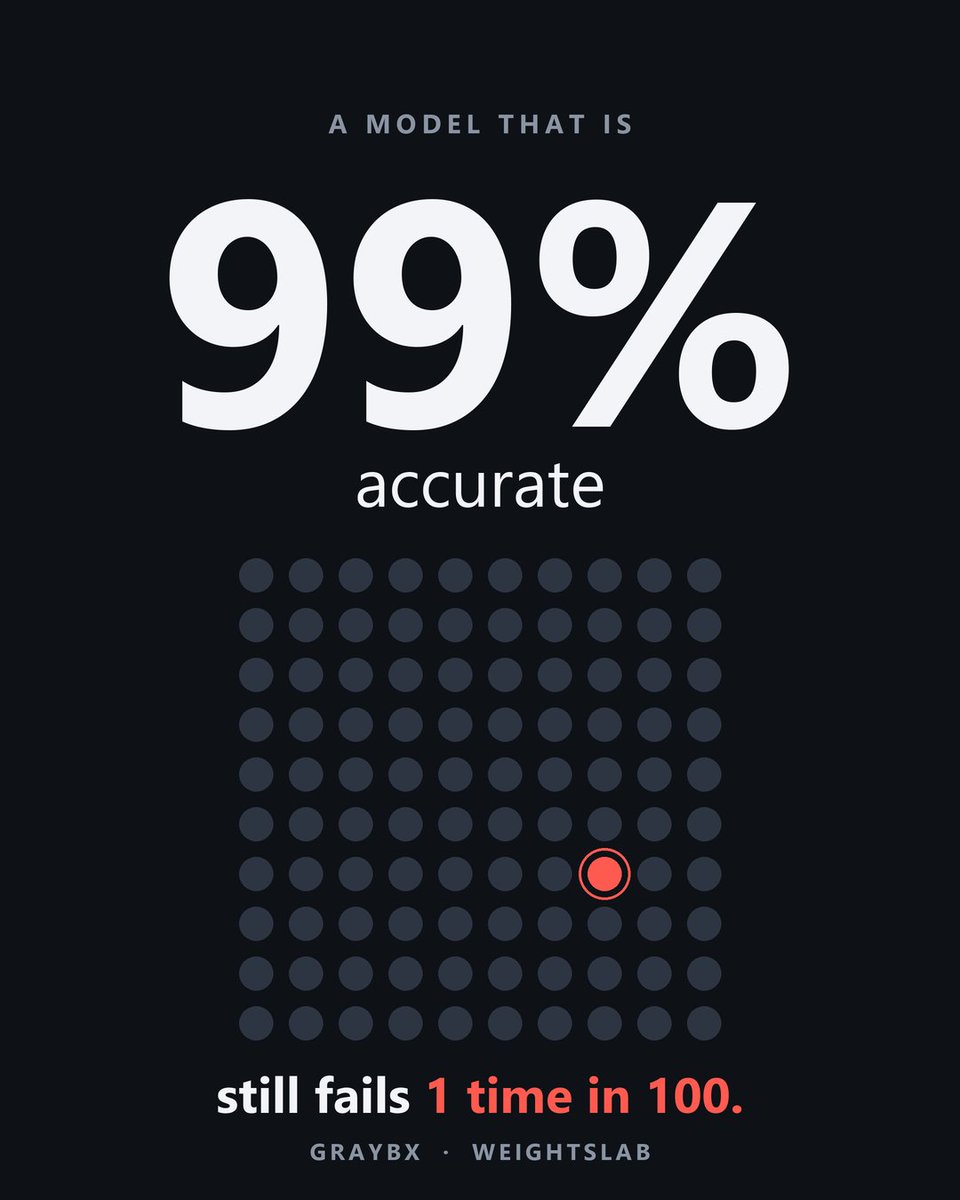
"99% accurate" is the most dangerous sentence in AI.
It means the model still fails 1 time in 100. At a million decisions, that's 10,000 failures. One year bringing my coffee, it s 11 mugs broken. And i don't have 11 mugs.
And when it fails, nobody can tell you which data caused it. Every fix means another full training run.
Going from 99% to 99.99% is mostly a data problem. Not a model problem. Most teams still try to fix it with a bigger model.
That's why Graybx, and why we built WeightsLab.
Have you ever shipped a model you couldn't explain?
Day 6 of our daily ML stories 🧵
You're 12 epochs into a run, the accuracy looks great, and 30% of your labels are wrong. Fix it, restart, or keep going? I tried all three.
Day 5 of our daily ML stories 🧵
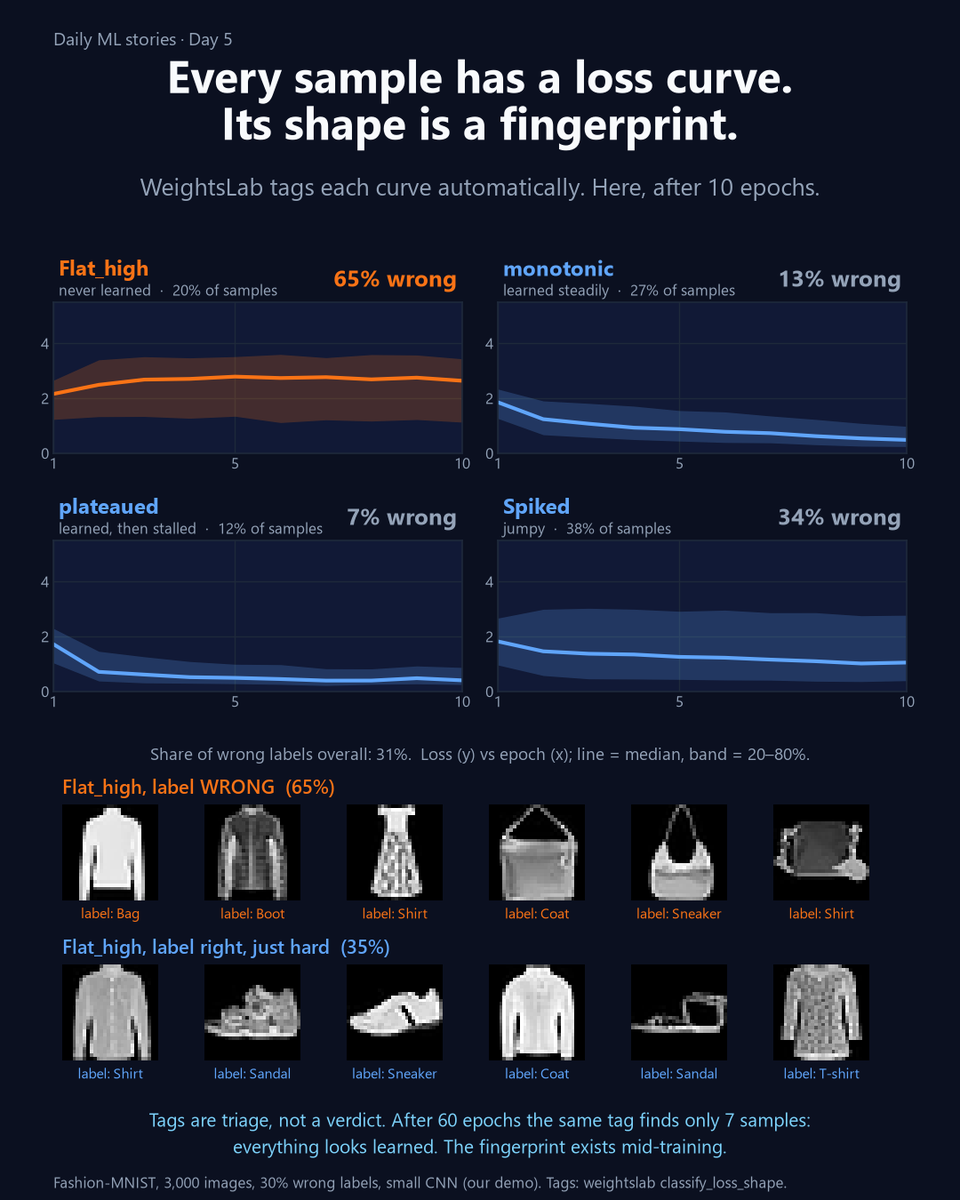
Every training sample has its own loss curve 🔥. I wanted to know if its shape says anything about the sample, so I let WeightsLab's built-in classifier tag 3,000 of them after 10 epochs. 30% of the labels were wrong.
Day 4 of our daily ML stories 🧵
After 3 epochs, 43% of my training images already had a loss below 0.1. I wondered if you could just stop showing them to the model, so I tried.
Day 1 of our daily ML stories 🧵
Your data has 1,000 columns. Your screen has 2.
How do you see what's going on? Projection: squash many dimensions into 2 without losing the plot.
PCA → t-SNE → UMAP → Parametric UMAP 👇
Day 2 ⚖️ of our daily ML stories 🧵
--------------------------------------
TL;DR: An average can look healthy while one class fails. Overall accuracy was 82%, but Coat recall was 33%. Editing a class weight mid-run, with no restart, lifted it to 48%, for a small precision cost.
82% accurate. 33% recall on one class.
Fashion-MNIST, small CNN, 300 images per class, except for Coat: 30. The average looked healthy. The slice didn't. 👇
Day 3 of our daily ML stories 🧵
I sorted my training set by loss at epoch 10, and 88% of the ~900 highest-loss samples had the wrong label. At epoch 60, the same sort gave 48%.
Same data, same model; I just looked at a different time.
It seems WeightsLab is highly infectious, especially since v2, when we upgraded our user interface, added agent integration for experiment management and improved our data monitoring to see which sample contaminated the model🦠🌍
Super thrilled to see early adopters using the platform across the world. I joined an idea, and it's now spreading 🚀.
Want to try it? pip install weightslab
Then ask your agent 🤖 to integrate WeightsLab into your experiment. You can also ask him to install weightslab and integrate it directly 😉
It seems WeightsLab is highly infectious, especially since v2, when we upgraded our user interface, added agent integration for experiment management and improved our data monitoring to see which sample contaminated the model🦠🌍
Super thrilled to see early adopters using the platform across the world. I joined an idea, and it's now spreading 🚀.
Want to try it? pip install weightslab
Then ask your agent 🤖 to integrate WeightsLab into your experiment. You can also ask him to install weightslab and integrate it directly 😉
We are an MLOps platform selling highly curated ML Engineer flow data points to companies building MLE agents. Let's connect if you are interested in more data!
#data4sell#data#AI#LLMs
Everyone is talking about model collapse.
As the web fills with AI-generated content, future models will increasingly train on the outputs of previous models rather than on genuine human knowledge and creativity (this post is not AI generated, I will not feed my own {what should I put here, master?}).
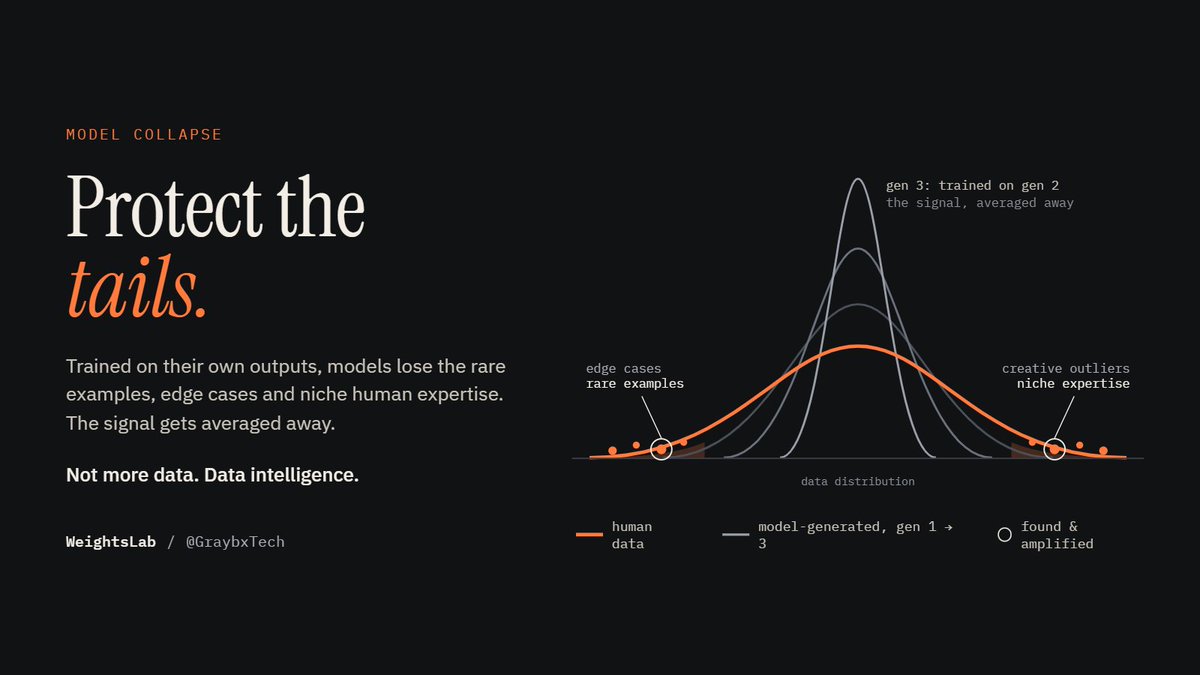
The result is not just lower quality. Research suggests models gradually lose the long tail of the data distribution: rare examples, edge cases, unconventional solutions, niche expertise, and creative perspectives.
In other words, the signal gets averaged away.
The industry's answer has largely been "collect more data."
But if a growing fraction of that data is synthetic, bigger datasets may not solve the problem.
We believe the next frontier is not data quantity. It's data intelligence❤️🔥.
At WeightsLab, we're building tools that help researchers identify, inspect, curate, and amplify the examples that matter most during training.
Rather than treating every sample equally, researchers can leverage training signals to discover high-impact examples, preserve valuable human knowledge, and iteratively build gold datasets that retain both diversity and domain expertise.
If model collapse is caused by losing the tails of the distribution, then the solution is learning how to find and protect those tails.
At @GraybxTech, we're tackling this problem head-on. We built a visual workspace that combines AI agents, embedding projections, and rich per-sample signals, allowing researchers to discover, analyze, and amplify the highest-value human data hidden inside massive datasets.
In a world flooded with AI-generated content, the most valuable asset won't be more data. It will be the ability to identify genuine human signal.
That's the problem we're building WeightsLab to solve.
The AI race won't be won by whoever has the most data. It will be won by whoever gets the best data intelligence tools. ❤️🔥