At the YC Alumni Reunion, I got lots of questions from new founders about how to build a successful company, but realized that they all had the same answer. And it’s this:
—————————————————
DO TOO MUCH
As a new founder, I’d often look at the CEOs of successful companies and wonder, “How do they do it?”
As Scale grows and as I learn on the job, I’ve come to realize that leaders of great organizations never just do it. They overdo it.
As a leader, you are the upper bound for how much anyone in your company will care. You need to do more, care more, attempt more than would seem reasonable. It will seem like overkill. But too much is the right amount.
This is true in big and small ways.
- What people say is overoptimism is just optimism.
- What people say is overcommunicating is just communicating.
- What people say is overdelivering is just delivering.
- What people say is micromanagement is just management.
- What people say is ruthless prioritization is just prioritization.
Actually living this way will seem crazy, and that’s ok. There is no Apple without Jobs’s “obsessive” attention to detail. There is no SpaceX or Tesla without Elon’s “maniacal” drive for execution. I have never seen ordinary effort lead to extraordinary results.
If we had not done too much, Scale would not be the company it is today.
When AI really started to take off in 2022 and “generative AI” became a thing, within 6 months Scale shifted the vast majority of our team to working on generating data for scaling LLMs.
Most companies would go through quarters of bureaucratic planning cycles and only move after a competitor started eating their lunch. In our case, the change was drastic and abrupt — some might say jarring or extreme.
What people might have reasonably described as overreacting was just reacting. And in hindsight, that reaction to developments in AI was what made Scale’s subsequent path possible, including growing 4X over the last year.
What we’ve accomplished to date represents the compounded results of everybody embracing the culture of overdoing. Scale will do things incumbent companies wouldn’t, because it’s simply too scary or painful, but others not going to the same lengths is a feature not a bug.
Creating something meaningful is a beautiful, and yes, scary and painful thing. And if you’re not overdoing it, you’re underdoing it.
ChatGPT "Advanced Data Analysis" (which doesn't really have anything to do with data specifically) is an awesome tool for creating diagrams. I could probably code these diagrams myself, but it's soo much better to just sit back, and iterate in English.
In this example, I was experimenting with a possible diagram to explain Supervised Finetuning in LLMs. The "document" at the origin (0,0) is the empty document, and eminating outwards are token streams. Highlighted in black are the high probability token streams of the base model. In red are the token streams corresponding to the conversational finetuning data. When we finetune, we are increasing the probabilities of the red paths and suppressing the black paths. I like this view because it emphasizes LLMs as "token simulators", with their own kind of statistical physics backed by datasets, bouncing around in the discrete token space.
The conversation where we built it in a few minutes:
https://t.co/BPYipeQWws
(Sadly I just remembered that ChatGPT sharing doesn't support images, but at least the text is there, of me iterating with the diagram in plain language, and needing to touch no code. Such a vibe of the future.)
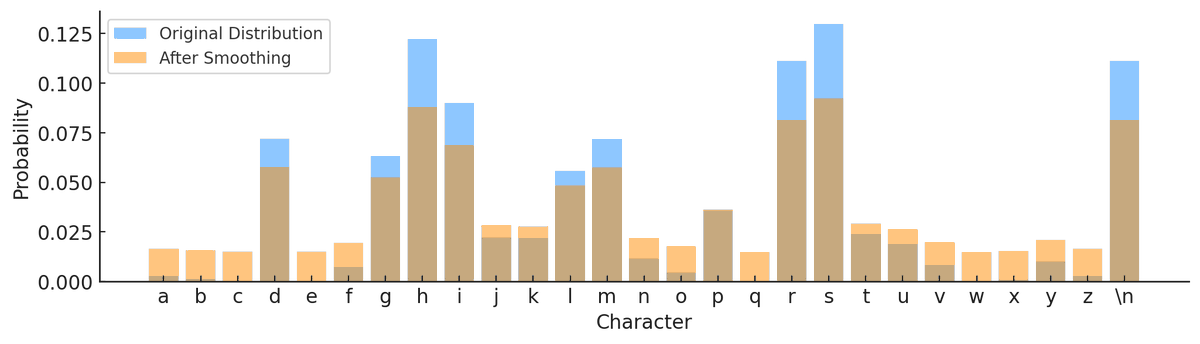
I had a similar experience yesterday, was trying to create a plot that shows smoothing in n-gram language models. Again I could just have coded this manually, but this was 10X faster and so easy.
Conversation:
https://t.co/MTxD2YH6Kv
Posting because during these chats I was struck again by that feeling of what must be the future, where you just sit back and say stuff, and the computer is doing the hard work. And in some narrow pockets of tasks, you can already get that feeling today.
One thing I like to do when reviewing PRs is flesh out comments. If I find a spot where I think "why is this here," I'll annotate it with that discovery. As a reviewer, that's one of the rare times to be unfamiliar with some code and the value of comments can be best realized.
🪩The @stateofai 2023 is now here.
Our 6th installment is one of the most exciting years I can remember. The #stateofai report covers everything you *need* to know, covering research, industry, safety and politics.
There’s lots in there, so here’s my director’s cut 🧵
I've been taking a break from work for the last few weeks, so missed much of the brouhaha over the McKinsey developer productivity article. But I'm sure that I could not write a better response than this one from @tastapod
https://t.co/3PlzZ37kgb