I am at the moment writing a lengthy indictment against our century. When my brain begins to reel from my literary labors, I make an occasional cheese dip.
@katrosenfield No one knows what you are talking about but instead of explaining now you are only going to illuminate your idiosyncratic definition of culture behind a paywall at a later date?
Excellent
You are so much smarter than the rest of us.
@katrosenfield@mattyglesias Conservatives have started crawling back cultural relevance. Camo jackets, right wing sports talk, and all the yellowstone style shows. The influence might not be as pronounced but it is certainly is influential.
@A24#Robert Pattinson
Kind of interesting he is playing the catch a predator guy, when his most famous roll was a 200 year predator old dating a vulnerable teenager?
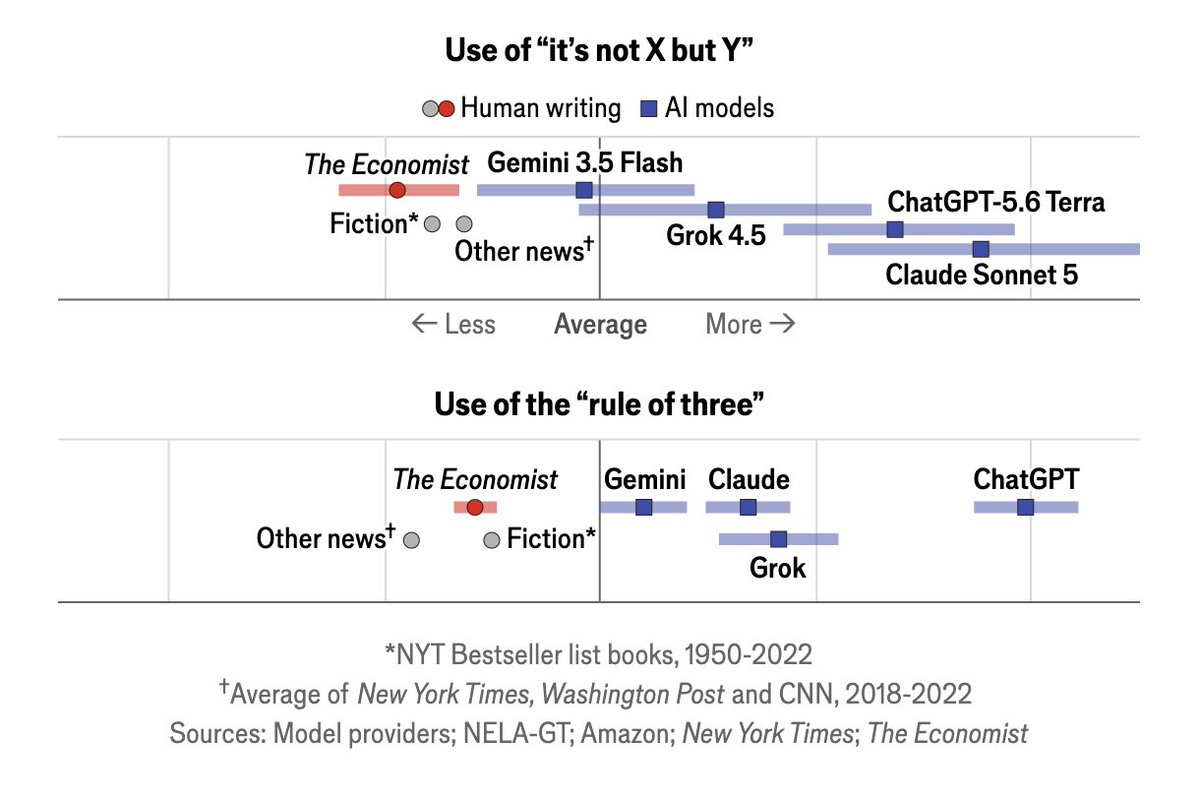
Marvelous examination of how to spot 2026-era AI writing, via the Economist
- AI likes long sentences with less punctuation; “and” is its most overused word
- relatedly, lists of three things, which drives up use of "and" as well
- polysyllabic adjectives: “significant”, “increasingly”
- scientific jargon ("rate-limiting," “parameter”)
- nominalizations (making nouns from verbs: eg, “expansion” from “expand”)
- ofc, everyone's favorite: "it's not X, it's Y"
There are more urgent matters in the world, but what frustrates me about the way that AI has contaminated certain conversations is that I think it used to be well understood that the mind isn't well understood. There was a healthy uncertainty about things like thinking, consciousness, etc. But AI's arrival, and the threat it poses to academics and word-makers, has created a tribal motivation to make extremely confident declarations about what thinking/consciousness is in order to define it as the opposite of whatever AI is up to, even though we have a perfect understanding of neither what AI is up to nor what thinking/consciousness are.
@DKThomp Starbucks fills it to the literal brim every time. I then try to poor some out and i always scald my hand horribly.
This is your worst take ever!
It's live: https://t.co/9dWvFfcaWE. 10 subjects, 3,300+ standards-aligned items, an adaptive engine, an AI tutor built to ask rather than answer. An IRB-supervised pilot is planned for this fall. Built solo, evenings and weekends, by a teacher. That's the story.
Teachers will recognize this: the kid who can't finish 10 practice questions just spent the weekend mastering a video game with a wiki, a discord, and a grind loop. The motivation exists. School software ignores it.
My bet, built after 16 years in the classroom: mastery is the toll, creation is the reward. Adaptive practice on real standards unlocks a creative studio with an audience of classmates. The license-test model, not the worksheet model.
All EdTech money went to two buckets: content delivery and admin tools. The third, student motivation, sits empty. My bet after 16 years teaching: mastery is the toll, creation is the reward. Live now, 10 subjects, IRB pilot this fall. https://t.co/9dWvFfcaWE
"Student-centered" has come to mean "centered around what we imagine the student wants." The actual student usually wants to be told what to do, helped to do it well, and respected when they finish. Try that for a week.
The most valuable thing a teacher can do for a struggling student isn't extra help. It's belief, plus structure, plus refusing to lower the bar. In that order. The lowered bar is the cruelty.
Unpopular opinion: leaderboards are good, actually. Many leaderboards on many axes is the play. When there are 12 ways to be first at something, almost every kid is first at something. Single-axis ranking is the cruelty. Multi-axis competition is the gift.
Working hypothesis from my dissertation: the strongest predictor of a teacher's AI adoption isn't tech skill or training. It's how many ed-tech promises they've watched die. Skepticism is a rational response to a track record.