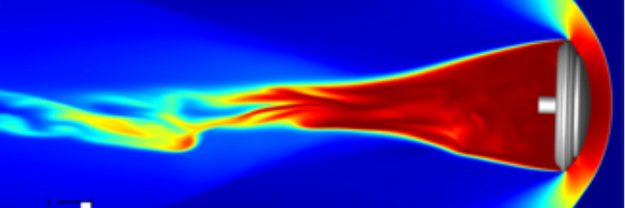
Structured multiblock meshing is essential for accurate re-entry capsule CFD.
This GridPro mesh of the Apollo Command Module captures shear-layer roll-up, base-flow separation & wake physics with high fidelity crucial for hypersonic aerodynamics and stability predictions.
Transferring CAD labels directly into your GridPro mesh cuts down manual setup time. Labels flow from CAD to topology to the final grid, making boundary assignment faster and more consistent. Check out the new tutorial!
👉 https://t.co/8kyoBNSBm7
This GridPro mesh for the Axalp UAV captures boundary layers, flow transition & separation with high fidelity.
Smart Boundary Layer Clustering = precise near-wall resolution in seconds.
More 👉 https://t.co/oCJgZE23zi
A look at a structured multi-block mesh for a ship propeller built to capture tip vortices, pressure gradients, cavitation zones & blade–hub interactions with high fidelity.
Full blog: https://t.co/WjkI2PiByf
#ThrowbackThursday
A structured CFD mesh of a hyperboloid flare, used in 1996 for ESA studies on flap deflection effects in a generic space vehicle.
Simulated shock–boundary layer interaction, recirculation & reattachment, high-energy flow behavior
High-fidelity rotor CFD starts with the right mesh.
Sharing a structured multiblock mesh of a Robin helicopter built to capture blade–wake interactions, vortices, and unsteady flow using GridPro's compact enrichment tool.
#ThrowbackThursday to the structured multi-block mesh built for the X-33 experimental spaceplane.
Using GridPro helped cut grid-generation time, improve mesh quality, and automate volume-grid updates even when geometry or angle of attack changed, thanks to a consistent topology.
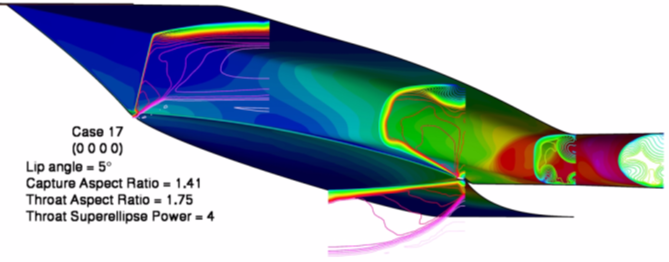
Structured multi-block mesh for a hypersonic plane capturing internal scramjet flows and external aerodynamics. Key for accurate boundary layers, shocks, and heat-flux predictions.
More: https://t.co/89VugM5FFo
Surface pressure & Mach contours for REST-class scramjet inlets built using a CFD-driven parametric design loop with GridPro + Vulcan.
High-fidelity grids (2.7M cells in ~2 min) helped NASA teams capture 3D viscous effects and cut boundary-layer buildup by 20%.