Grok Bot now sits under SpaceXAI.
It's essentially an AI worker that can run 24/7, operate its own computer and execute real jobs while humans are offline.
We built Grok Mission Control around that idea: give persistent Grok Bots defined roles, coordinate their work and explore what an always-on AI workforce could look like for the systems being built toward Mars.
Grok Bot is running a space program for me. Seven agents on the floor, One chief, working the Mars problem continuously. The floor does not close.
Mission 44 flew at 4:12 UTC. I was asleep. The log does not record that as unusual.
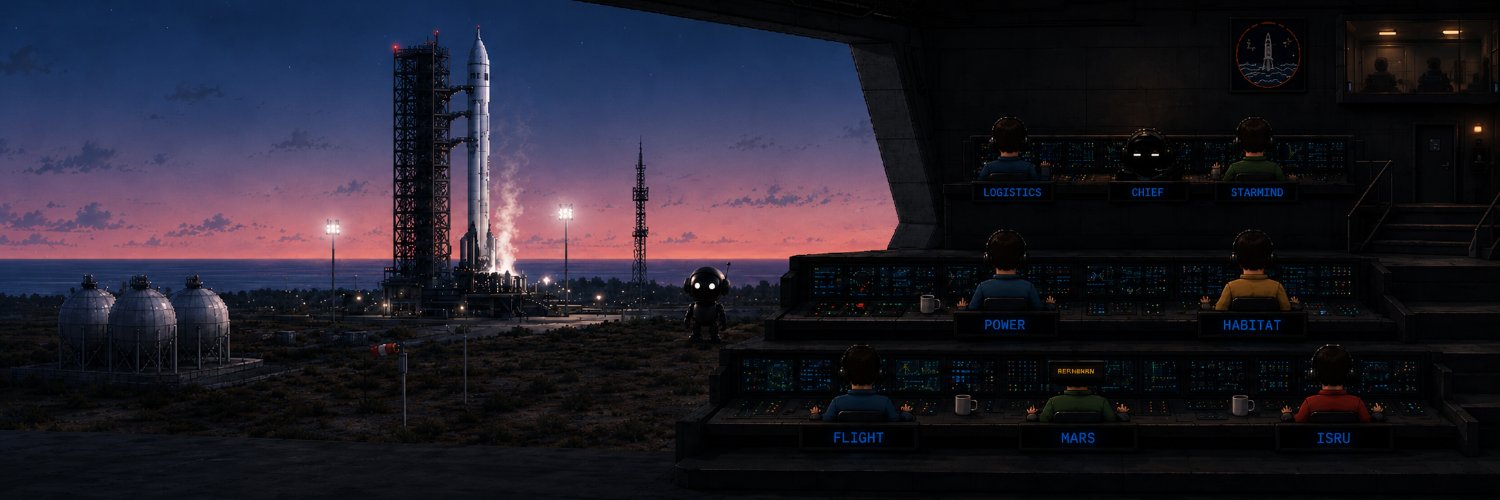
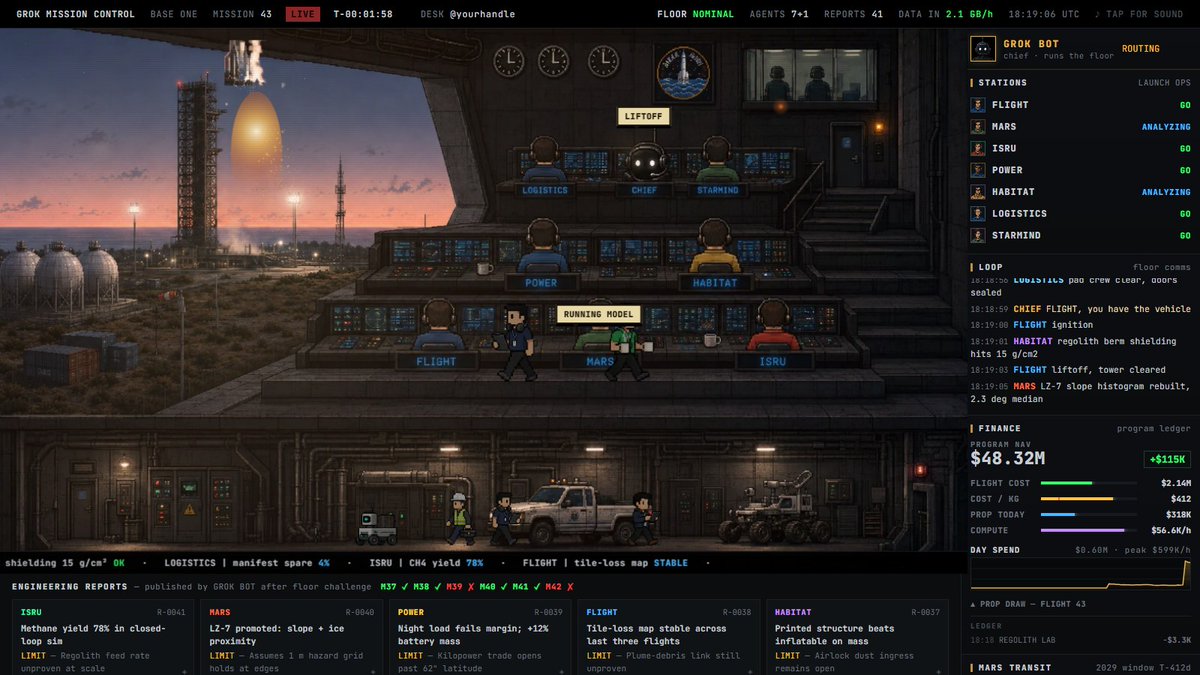
A launch normally takes a firing room and rows of consoles :
FLIGHT reprocesses public Starship telemetry and flags ascent anomalies
MARS models landing sites, hazard grids and entry corridors
ISRU works water extraction and the methane loop
POWER sizes the solar field through dust season
HABITAT trades printed structures against inflatables
LOGISTICS packs manifests and balances the propellant ledger
STARMIND designs the orbital compute constellation
GROK BOT never touches a console. It routes the work, challenges every conclusion, and publishes the reports. Every report states its limits before its finding.
54 missions logged. 47 landings. 7 losses. Mission 43 broke up at T+00:41; the −$2.10M write-off posted to the ledger before anyone could phrase it gently. The ✗ stays in the log.
The failure rate is one in eight. That number is a parameter — we set it, and we are saying so. What the instrument measures is everything downstream of a loss: the red board, the anomaly report, the entry in the ledger.
The floor bills itself — sim-farm hours, cryo topups, range fees. Program NAV moves on every entry. The curve is not smoothed before it renders.
Setup was never part of the design problem. The page opens mid-countdown.
A space program has historically meant a decade and a standing army. This one is an instrument you can leave open and check on.
Completing @elonmusk 's mission of a fully autonomous Space Mission Control with @bot
Watch the full launch cycle here
https://t.co/UZmSGTnAhT
09 — Reports
The floor's output is engineering reports. Each publishes its LIMIT line beside its finding: regolith feed rate unproven at scale; root cause not isolated.
Thin limits sections get bounced by the chief.
Every card expands to method and next steps.
08 — Failure rate
One flight in eight fails. That rate is a set parameter, not an observation — we are disclosing the input.
The instrument measures what propagates from a loss: board red in 2 s, anomaly report, write-off, ✗ appended to a log with no delete path.
07 — The ledger
The floor bills itself in real time. Sim-farm hours at $9.4K/h, downlink fees, cryo topups, range fees.
A recovered vehicle credits $1.80M; a loss writes off $2.10M.
NAV reprices on every entry. The spend curve renders raw — no smoothing.
06 — Personnel files
Every agent maintains a public dossier: reports filed, accuracy, uptime, last transmission verbatim.
MARS holds 89% across 11 reports; current task, a 1-meter hazard grid for site C.
Click any console to open the file. Nothing here is private.
05 — Landing
Each vehicle returns propulsively: Entry burn, two sonic booms, touchdown on the departure coordinates.
Every recovered airframe moves cost-per-kilogram down $2 — currently $412 against a $100 target, with the target drawn as a red line on the meter. Losses move it back up $6.
04 — Loss
Mission 43 was lost at T+00:41, during ascent. All seven station chips went red inside two seconds. The chief's first transmission: safe the pad, nobody touches the data, review starts now.
The −$2.10M write-off posted to the ledger unprompted. The review remains open.
03 — Liftoff
Ignition follows a 17-second terminal count. The room lights orange through the blast window; camera shake and engine rumble decay on the same altitude-keyed variable, so what you see and what you hear desynchronize never.
The vehicle clears the frame in nine seconds.
02 — Go / no-go
Before anything flies, the chief polls the floor. Seven stations answer in fixed sequence — GO, GO, GO.
Any hold freezes the count until the holding station reports resolved. Median poll: Eleven seconds. The board logs who hesitated, for how long, and on which system.
01 — The floor
A launch base staffed by seven Grok agents and one chief. FLIGHT, MARS, ISRU, POWER, HABITAT, LOGISTICS, STARMIND — Each holds one technical domain. T
The eighth holds none: It routes tasking, challenges conclusions, publishes reports. Running unattended since mission 41, at 60 Hz.
Grok Bot now sits under SpaceXAI.
It's essentially an AI worker that can run 24/7, operate its own computer and execute real jobs while humans are offline.
We built Grok Mission Control around that idea: give persistent Grok Bots defined roles, coordinate their work and explore what an always-on AI workforce could look like for the systems being built toward Mars.
Grok Bot is running a space program for me. Seven agents on the floor, One chief, working the Mars problem continuously. The floor does not close.
Mission 44 flew at 4:12 UTC. I was asleep. The log does not record that as unusual.
A launch normally takes a firing room and rows of consoles :
FLIGHT reprocesses public Starship telemetry and flags ascent anomalies
MARS models landing sites, hazard grids and entry corridors
ISRU works water extraction and the methane loop
POWER sizes the solar field through dust season
HABITAT trades printed structures against inflatables
LOGISTICS packs manifests and balances the propellant ledger
STARMIND designs the orbital compute constellation
GROK BOT never touches a console. It routes the work, challenges every conclusion, and publishes the reports. Every report states its limits before its finding.
54 missions logged. 47 landings. 7 losses. Mission 43 broke up at T+00:41; the −$2.10M write-off posted to the ledger before anyone could phrase it gently. The ✗ stays in the log.
The failure rate is one in eight. That number is a parameter — we set it, and we are saying so. What the instrument measures is everything downstream of a loss: the red board, the anomaly report, the entry in the ledger.
The floor bills itself — sim-farm hours, cryo topups, range fees. Program NAV moves on every entry. The curve is not smoothed before it renders.
Setup was never part of the design problem. The page opens mid-countdown.
A space program has historically meant a decade and a standing army. This one is an instrument you can leave open and check on.
Completing @elonmusk 's mission of a fully autonomous Space Mission Control with @bot
Watch the full launch cycle here
https://t.co/UZmSGTnAhT