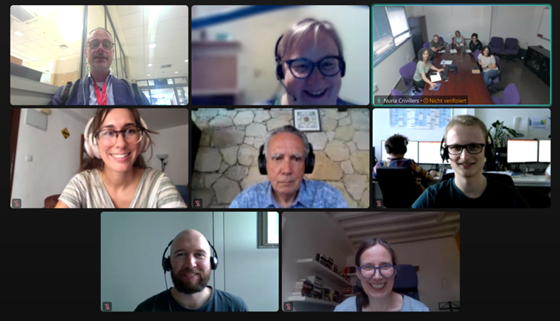
The installation of our new X/Q-band pulsed #EPR spectrometer is now complete. Thanks to the installation team! Now let's do some science @bruker@Bridge12Tech. Thanks to @dfg_public and @Uni_Stuttgart for funding!
HFEPR and XAS studies of chromium-based catalysts for ethylene oligomerization. Solution measurements, MAO-activation and interaction with ethylene: Alex' work is now online. https://t.co/xCOuQ27nSl @allgaier_alex@crc1333@Uni_Stuttgart@dfg_public
PhD possibility in 2D materials for quantum sensing with Dr Fabrizio Moro @unimib, with secondment in my group @Uni_Stuttgart. Applications due 17 April. https://t.co/Zkzm4lLEeg
Two EPR focused PhD positions are available at Manchester University in the UK’s EPR National Research Facility. One is quantum focused: https://t.co/NqG71gnBrH and one biological: https://t.co/chnkGJH1gl
UK and Overseas applications welcome
Application deadline: 31/01/26
Alex' SQUID and EPR measurements on cobalt catalysts were now published in Org. Chem. Front. Our first paper in an org chem journal! https://t.co/Z8csVMjKCq Class-II-aldolase-mimicking Lewis acid/azolium–aryloxide catalysts in direct enantioselective nitro-aldol additions
!!! PostDoc position (2 years) available in my group. The person must have a PhD in Physics, Engineering or similar to work on an experimental setup building. https://t.co/SSPEtYgmYa If interested contact me with CV ([email protected]). Deadline Dec 24th! @ERC_Research
We are looking for postdoctoral candidates in the areas of organic electronics, operando spectroscopy in catalysis, advanced EPR. CV and cover letter to [email protected], stating what complementary expertise you bring and why our group interests you.
Senat und Universitätsrat der #UniStuttgart haben Prof. Peter Middendorf zum neuen #Rektor gewählt. Er tritt zum 1. Oktober 2024 die Nachfolge von Prof. Wolfram Ressel an. Wir gratulieren herzlich zur Wahl! 💐 👏 👉 https://t.co/E2U1Yzbokx
Foto: Uni Stuttgart/Maxim Kovalenko
It is with profound sadness that IOCB Prague announces the sudden passing of Prof. Josef Michl, a globally esteemed Czech chemist, on Monday, 13 May, at the age of 85. Prof. Michl led research groups at @IOCBPrague and @CUBoulder.
"He was one of the few true geniuses I have had the honor to meet," says Prof. @konvalinka_jan, director of IOCB Prague. "He mastered several world languages, had extensive knowledge of history and culture, and a deep understanding of the natural sciences. The science he did was not only brilliant but also beautiful, playful, and witty. Besides that, and above all, he was a kind and generous man. We will miss him dearly."
Dr. Zdeněk Havlas, Vice President of the @CzechAcademy and a long-time friend and colleague of Josef Michl, responded to the news of his passing: "The passing of Prof. Michl is a great loss both professionally and personally. He knew everything there was to know about chemistry and science in general. It was a joy to discuss with him. For the past 20 years, I traveled to Boulder annually for a month, not because of a lack of computing technology, but for discussions about work and life in general. This often took place while enjoying a plum cake, which he loved and which I baked for him at their home."
Prof. Josef Michl, Ph.D. (12 March 1939 in Prague – 13 May 2024 in Prague), was a distinguished figure in the field of chemistry with an extremely wide range of professional interests in which he achieved significant results and worldwide renown. He excelled as both a theoretician and an experimentalist, devoted, among other things, to macromolecular chemistry, photochemistry, molecular electronics, research towards the development of efficient solar cells, and the creation of molecular "building blocks" enabling, for example, the creation of nanorotors and nanomotors.
Josef Michl studied chemistry at @science_charles and completed his dissertation under the supervision of quantum chemist Rudolf Zahradník at the Institute of Physical Chemistry of the Czechoslovak Academy of Sciences. He earned his doctorate in 1965 and subsequently worked at the Universities of Houston and Austin. After a brief return to Czechoslovakia, he attended a summer school in quantum chemistry in Norway in 1968, from which he did not return following the Warsaw Pact invasion of Czechoslovakia in August 1968. He then served as an assistant professor in Denmark before moving to the United States, where he held positions at the University of Utah in Salt Lake City and the University of Texas at Austin. In 1991, he joined the University of Colorado at Boulder, where he led a research group until his death. From 2006, he also worked at IOCB Prague, where he received the prestigious ERC Advanced Grant in 2009.
In 1986, he was elected to @theNASciences, and in 1988, he became a member of the International Academy of Quantum Molecular Science and served as its president from 2012 to 2018. In 1995, he became a member of the Learned Society of the Czech Republic @ucena_spol. In 1999, he was elected to @americanacad. He authored over 600 scientific papers, several books, and numerous patents.
Throughout his illustrious career, Josef Michl received many prestigious awards, including the Alexander von Humboldt Award (1980), the Schrödinger Medal (1993), the Hammond Award (2015), the Neuron Award for Contribution to World Science (2016), the Medal of the Learned Society of the Czech Republic for Merit in the Development of Science (2019), and others. He also received honorary doctorates from @Georgetown University, @UniPardubice, and @MasarykUni.
https://t.co/lDqEje84lf
You can still register for the #CRC1333 Minisymposium on May 16, 2024 - more details here: 🔗https://t.co/6UwMbQQOTN.
Registration closes on April 25, 2024 - so get your tickets now! #sfb1333#catalysis
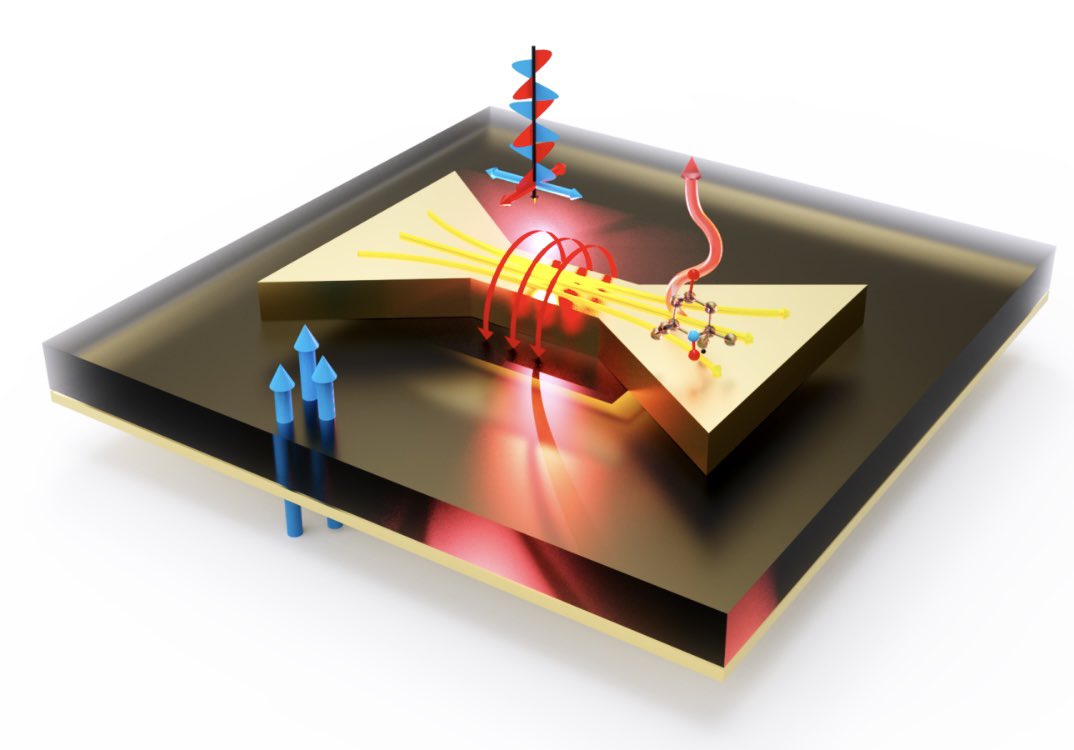
🚀💫 Fully funded PhD position available in my group to work on Terahertz Magnetic Metasurfaces. Looking for physics or materials science students interested in an international and multidisciplinary environment. More info in the comments. #PhD#Research#Emmy@Uni_Stuttgart
David and Simon's work on strongly exchange coupled, radical bridged dimeric metal complexes, part of our long-standing collaboration with @SarkarAg , just made it into Inorg. Chem. https://t.co/L7MUnjvbEB Thanks Koehn group & @dfg_public
Please consider joining the MRS Fall Meeting in Boston this year for an excellent symposium on Molecular Quantum Systems. RTs appreciated.
https://t.co/LF2r1eBijo
Come study at Stuttgart! Our new english-language study program Chemical Sciences now open for applications
#Chemistry#MSc Follow @Chem_Sci_MSc https://t.co/ZXNPxwCiAn
Du bist Doktorand*in an der #UniStuttgart und willst dich fachübergreifend austauschen und stärker vernetzen? Mach mit beim #PeerMentoring. Das Motto: Erfahrungen teilen, Erfolg sichern, Perspektiven erweitern. 📅Infoveranstaltung am 29. Februar 👉 https://t.co/lFVsNr7eX2