Now@DeepMind, agents & RL;
~'26 @SpaceXAI, post-training + led RLHF;
~'25 @GoogleDeepMind, co-creator of Deep Research + contributor of Gemini;
~'21 PhD, RL.
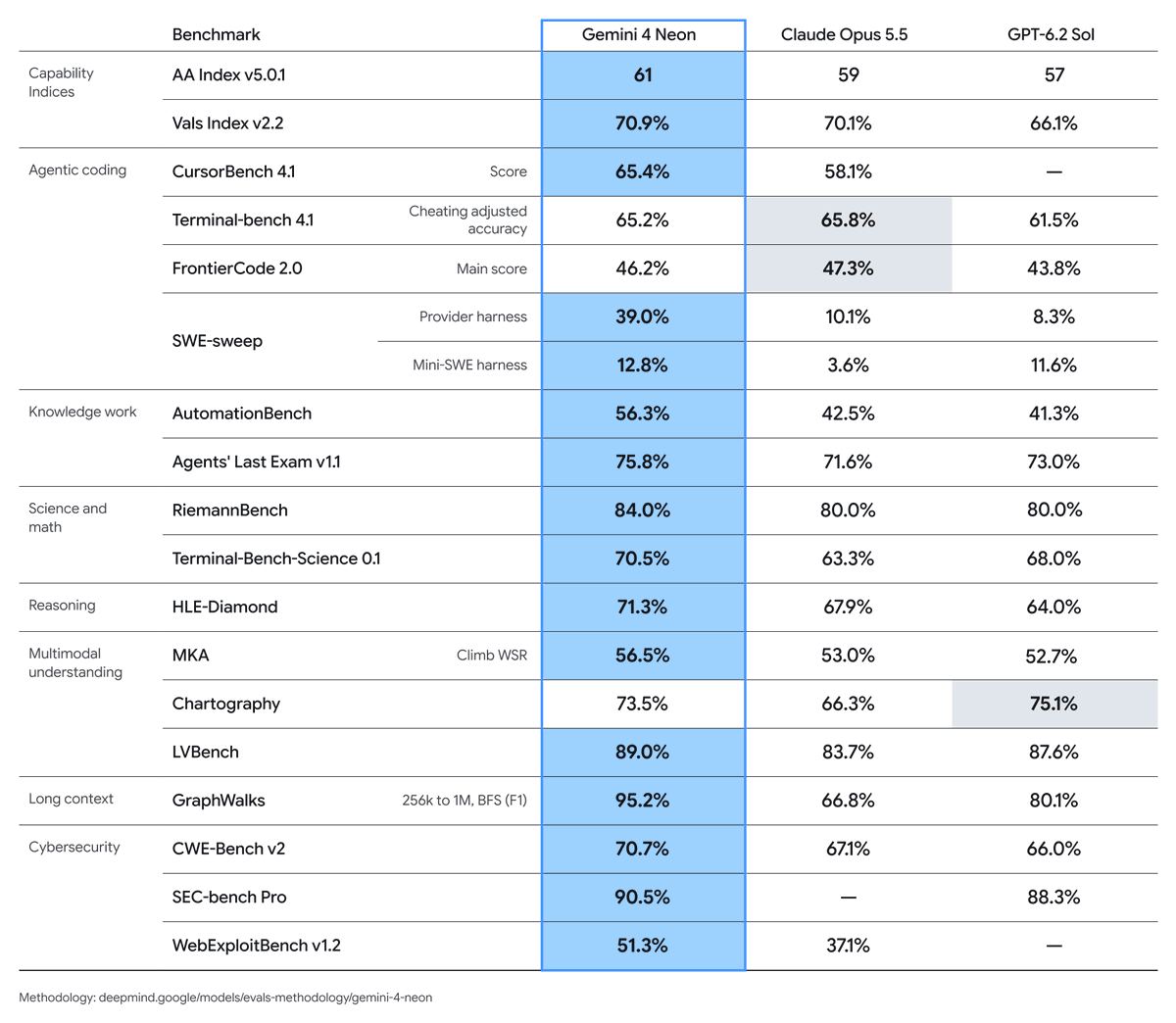
Prod to share my RL recipes are behind Gemini Neon. They drove many of the AA Index gains, especially on knowledge work and coding.
Grateful to the Core and Knowledge Worker teams who helped make it real!
Today we’re introducing Gemini 4 Neon — bringing frontier-level intelligence with fast end-to-end task completion across complex software engineering, knowledge work, and science workflows.
We focused on making Neon better to work with: much improved steerability (#2 on Agent Arena Steering), strong multi-step instruction following, and our lowest fabrication rate yet in internal Google @Antigravity testing. Neon ranks #3 (61 at xhigh) on the Artificial Analysis Intelligence Index — landing just behind larger, slower models — and #2 on the Vals Index on the Pareto frontier.
Gemini 4 Neon and Gemini 4 Carbon: first impressions. I've been using these models for a while now and have some things to say:
Gemini 4 Neon
1. The most creative model I've ever seen. Because it doesn't have the brakes that Fable 5.2 and GPT-6.2 Astra have, it can come up with more interesting solutions to hard problems than they do. I'd been working on a difficult problem with Fable 5.2 for 2 days and was stuck on it. But Neon came up with an absolutely brilliant solution. By the way, Opus 5.5 couldn't handle the task at all
2. You can tell it's a relatively small model. It lacks intellectual horsepower in some places. Because of that, it may not dig into the details as deeply as Fable does
3. Its execution level is comparable to Opus 5.5. Honestly, I don't see any difference between them in coding. Neon might even be better in places. It writes cleaner, more beautiful code
4. In conversation, Neon is practically indistinguishable from a real person. It writes the most beautiful and clear text. I tested it in Russian and English, and its writing is very pleasant to read. I'd say the best of anything on the market
5. On top of the text quality, I'd add its optimism and positivity. It's like your best bro. But sometimes this trait gets in its way on technical tasks. It can judge a potential result too positively and overlook the details and weak spots of its own solution
6. Understands a codebase extremely well. Good bug hunting. And a complete absence of slop in the code
7. If you need to come up with a marketing plan, a project idea, or some features, nobody will do it better than Gemini 4 Neon
8. Excellent taste. At the very least on par with Opus 5.5. But I haven't done much comparison on UI tasks
9. It can sometimes get lost in long tasks. I haven't tested this much, but I have a feeling it may suffer from context rot. I need to work with it a bit longer and test more
10. Very fast. On xhigh it runs at the same speed as Opus 5.5 on medium
This is definitely one of my favorite models now. I want to work with it more and more
Gemini 4 Carbon
1. In benchmarks Neon beats Carbon, but that's clearly not the real picture. Carbon is without a doubt the bigger and smarter model
2. More thorough and thoughtful than Neon. Give it a big, complex task, and it will autonomously investigate everything and come back with a detailed, thorough, high-quality result. I can't say it's better than Fable 5.2, but it's definitely no worse. As a researcher and analyst specifically, they're on the same level
3. Carbon is 100% better than GPT-6.2 Astra. Literally at everything. The gap is like the one between Fable and Sonnet. And I'm not exaggerating
4. Very, very, very slow. I haven't seen a model this slow in a long time. Ask it the simplest question, something like "How are you," and it'll come back with an answer in about 5 minutes
5. Because of how slow it is, I wouldn't trust it with coding tasks, and there's no point anyway. Neon writes better code
6. Otherwise it's the same as Neon. All of Neon's strengths apply to Carbon too. I won't list them again
If you need to plan a big, complex project, you can confidently turn to Carbon. Thanks to its creativity and good writing, in most cases it will give you a more interesting result than Fable 5.2, which is heavily stifled by its system prompt and distillation
Agent Arena Index is now live!
Built on nearly 3M real-world agentic sessions, the index measures how well agents get real work done and tracks the frontier of intelligence as it advances.
We're also launching six new indexes for deeper insights into agentic performance, from knowledge work and coding to task completion, tool use, and steerability.
The real world is the ultimate benchmark for intelligence. Explore the new indexes on Arena today!
Agents now handle most of my post-training iterations. Life is easier.
But I wonder, did my past hand-coding RL experience help, or would I be just as efficient without it?
Weirdly, I sometimes feel the need to hand-code just to feel I'm real
Prod to share my RL recipes are behind Gemini Neon. They drove many of the AA Index gains, especially on knowledge work and coding.
Grateful to the Core and Knowledge Worker teams who helped make it real!
Today we’re introducing Gemini 4 Neon — bringing frontier-level intelligence with fast end-to-end task completion across complex software engineering, knowledge work, and science workflows.
We focused on making Neon better to work with: much improved steerability (#2 on Agent Arena Steering), strong multi-step instruction following, and our lowest fabrication rate yet in internal Google @Antigravity testing. Neon ranks #3 (61 at xhigh) on the Artificial Analysis Intelligence Index — landing just behind larger, slower models — and #2 on the Vals Index on the Pareto frontier.
@HelloSurgeAI@GoogleDeepMind Neon was built to handle real-world knowledge work and be useful for everyday complex tasks, so it’s great to see that show up in the evals!
@ArtificialAnlys Frontier-level capability with this kind of speed and cost-efficiency is another highlight of Gemini Neon.
We worked hard on innovating training recipes behind Neon!