🇺🇸 A historic day on Wall Street!
Yesterday, Gunnison Copper debuted on the NYSE American under $GUNN! Our team celebrated this milestone at the NYSE, marking a new chapter in American copper production and expanded U.S. investor access.
NYSE-A: GUNN | TSX: GCU
#GUNN #AmericanCopper #Mining #MiningNews $GCU.TO
NYSE AMERICAN: $GUNN — WE'RE OFFICIALLY TRADING! 🔔
A defining moment for Gunnison and an exciting new chapter in our mission to strengthen America's domestic copper supply chain.
Today, October 26, 2026, Gunnison Copper officially begins trading on the NYSE American under the ticker symbol GUNN, expanding access to U.S. institutional and retail investors.
NYSE American: GUNN | TSX: GCU | OTCQB: GCUMF | FSE: 3XS0
#GUNN #NYSEAmerican #GunnisonCopper #AmericanCopper #CriticalMinerals #MadeInAmerica $GCU.TO $GCUMF
CIBC Capital Markets cut its 2027 average gold forecast to $5,200 an ounce from $6,500.
• 2028, $5,500 (from $6,000)
• Q4 2026, about $4,500 (from $6,500 at the start of the year)
CIBC says geopolitical uncertainty, government debt, central bank diversification and strong investment demand remain the long-term drivers.
It noted a record $30.7 billion of Q3 gold ETF inflows, about 211 metric tons.
Source: CIBC Capital Markets via GuruFocus
Copper will be in deficit by 2028. $332 BILLION in new mines is required to close the gap. But, a new copper mine takes, on average, 17 YEARS to develop. Supply can't catch up.
STAY LONG COPPER.
🇺🇸 Gunnison Copper proudly welcomed U.S. Interior Secretary @DougBurgum and Congressman @JuanCiscomani to Johnson Camp Mine!
Celebrating American copper production, employee awards and our anticipated NYSE American debut under $GUNN on Oct. 26.
https://t.co/kNNDJ78pVO
#NYSE #Copper #Mining #MiningNews #AmericanCopper #Gunnison $GCU.TO $GCUMF
Copper needs $ 332bn of new mines.
Each one takes about 17 years to build.
Bloomberg new outlook sees a deficit starting in 2028 and widening to 20 million tonnes by 2050.
That’s about 44% of demand.
9 of the 10 transition metals it tracks now look covered. Copper is the odd one out.
Demand rises 61% to almost 46 million tonnes by 2050. Electric transport alone needs 11.4 million.
You can print money.... You can’t print a mine.
🚨 BREAKING: 🇺🇸 Gunnison Copper expects to begin trading on NYSE American under $GUNN on October 26, 2026!
A major milestone for American copper production, U.S. supply chains and national security.
🔗 https://t.co/btMDHnReGV
#GUNN#NYSEAmerican $GCU.TO $GCUMF
A data centre takes 9 months to build...a copper mine can take 20 years.
Teck CEO Jonathan Price says copper demand is on track to double by 2035, while supply ends up 30% short of what the market needs.
The IEA flagged the same 30% gap last December.
Supply is already close to its peak.
Teck expects output from existing mines to start falling in 2027 and total supply, including committed projects, to peak in 2029.
Demand keeps coming from grids, EVs, solar and the AI build-out.
The 18 biggest US AI campuses alone are planned at 30 GW, and every gigawatt needs transformers, cables and substations full of copper.
LME copper hit a record $14,700/t in September.
Higher prices can’t speed up geology.
New supply takes a decade, so in the meantime price has to cut demand at the margin, through aluminium substitution, delayed grid projects and more recycling.
The question for 2027 is who gets the copper first: grid builders or data centres.
Source: S&P Global, Teck, IEA
We need to mine as much copper in the next 18 years as we have mined in the past 10,000 years, which is 700-800 million tonnes... and that's without the AI demand.
Including AI demand, @BMO estimates we need ~35,000 tonnes of copper per gigawatt of installed data centre capacity... And according to S&P, by 2030, installed data centre capacity in the US is expected to reach 152 GW (~62 GW today).
What is happening between copper and silver is remarkable.
Copper’s resilience while other metals sell off is too important to ignore.
There is plenty of skepticism around metals right now, and I think this is a very important window of opportunity.
https://t.co/dbja65kklr
Copper is plunging as the AI bubble starts popping.
People seem to believe AI is the main driver of copper demand... They are wrong.
The main drivers are electrification and renewables, both of which continue to grow.
With or without AI, there is no way we can close the copper supply deficits over the next 5 years.
We don't own enough copper for what's coming.
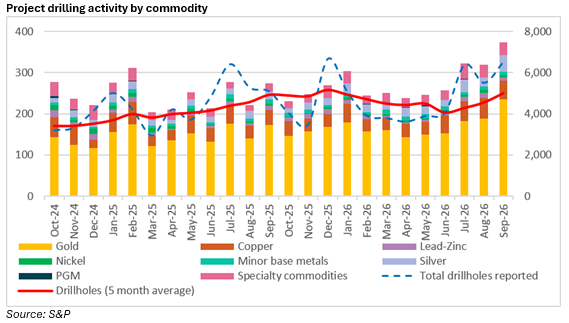
This chart, courtesy of Alex Topouzoglou at @Stifel, shows that drilling activity has noticeably recovered in the past 3 months, which is GOOD...
However, over the past two years, the share of drilling dedicated to copper exploration, arguably the most important of the metals listed in the chart, has remained largely unchanged... which is BAD.
Despite copper prices having risen >50% since October 2024, the incentive price is clearly not high enough to encourage others... whereas it seems to be high enough for precious metals, which dominate drilling activity.
No matter the copper price, our dedicated team of geologists at @IvanhoeMines_ and @ivanhoeelectric continue to drill for the next tier-one copper discovery... and it's only a matter of time before they find one.
Morgan Stanley is the latest sell-side bank to raise its copper price forecasts, citing persistent long-term deficits and capex failing to translate into higher volumes. Its new long-term price (i.e. 2030 onwards) is now up 15% to $5.73/lb.
They warn that even at these new estimates, incentive prices may still not be high enough to support development of several brownfield and greenfield projects. They cite a whirlwind of escalating cost headwinds, such as a sulphur squeeze, diesel export bans, grade declines, royalty changes, a super El Niño and strategic stockpiling, all driving further cost pressures.
We think that, given all these factors, the copper price should be even higher… So which will be the straw that breaks the camel’s back?
@MgnStnlyIdeas