Discovering underfollowed companies in the Goldilocks Zone (GZ) - where the right conditions exist for alpha.
I have nothing to sell you. I just love the game.
Bought some $UBER calls today for the public portfolio.
The setup is exactly what I look for: excellent fundamentals, a stock tightening up near a breakout, and a valuation that still looks cheap.
Why is it cheap? The market is pricing in the idea that autonomous vehicles eventually disintermediate Uber.
I fundamentally disagree and the numbers aren’t exactly screaming “disruption.” Gross bookings grew 24% YoY.
The best opportunities are often high-quality businesses sitting underneath storm clouds you think the market is misreading.
Here’s the reality: autonomous vehicles don’t eliminate the need for a massive demand network, payments infrastructure, routing, insurance, customer acquisition and fleet utilization. If anything, Uber could become the distribution layer autonomous fleets need.
If that thesis is right, you’re getting a high-quality compounder at a valuation that assumes a much worse future.
At my 2031 (5 year) estimates, even a 20x P/E gets you ~$203/share. 25x gets you ~$254.
Meanwhile the chart looks ready to break out of this base.
Fundamentals + growth + valuation + technicals.
Hindsight is 20/20 but $LQDA getting beat up pretty good - feeling good about my sale. Starts to get interesting if it can establish a new base around $63 a share.
Sadly closed my $LQDA trade for a ~125% gain. Today’s report really wasn’t terrible but it wasn’t good enough to justify the run up into earnings.
This likely needs some time to set up again as I think it’s going to test the 50 day MA and probably drop below there in the near term (especially with the litigation overhang still looming).
This isn’t a goodbye, it is a see you later. Thx $LQDA you’ve been a great one.
Should the lawsuit resolve in their favor wouldn’t be surprised to see it rip back in which case there is a high likelihood I’ll tag back along.
Posted this in 2022.
Today the 30-year hit ~5.3% and the government stepped in to push long-term yields back down.
Call it whatever you want. Sure looks like they found the pain threshold.
At some point I believe there will be a complete capitulation then Fed will reverse course and fix rates (YCC) - let inflation run rampant and inflate away the debt screwing avg. man with no real assets.
I’ve been trying to formalize how I think about GARP investing.
To me, long-term returns are driven by two turbines:
1. EPS growth
2. Multiple expansion/contraction
A company can compound EPS at 20%+ and still produce mediocre returns if you buy it at 35x earnings and it eventually trades at 15x. On the other hand, strong EPS growth combined with even modest multiple expansion can produce exceptional returns.
That’s pushed me toward looking for companies with:
- 20%+ expected EPS growth over the next 3–5 years
- Positive 1M / 3M / 6M estimate revisions. It doesn’t need to be perfect across every period, but positive revisions in aggregate over the past six months are a major bonus in my experience. At minimum, it suggests the earnings trajectory is improving and creates a higher probability we get multiple expansion.
- A strong history of beating quarterly estimates. If a company consistently beats and raises, it is often a sign the Street is still underestimating the business.
- 10%+ operating margins. I use this as a rough business-quality filter. Companies with healthy operating margins generally have a much better chance of becoming strong cash-generating machines.
- A clean balance sheet. Another quality filter, but also often a reflection of capable capital allocation and management discipline. I can write more about what I consider a “clean” balance sheet if there is interest.
- Minimal dilution. Some dilution is fine if it is being used to fund attractive investments or align management incentives, but persistent dilution can be an absolute killer of per-share returns.
- Non-cyclical businesses. I generally find it much harder to identify durable compounders in highly cyclical industries like oil, mining, and other commodity businesses.
- A reasonable starting valuation. Staying below roughly 40x forward earnings dramatically improves the odds that future EPS growth actually translates into strong shareholder returns. Hard to get multiple expansion in most cases when the multiple is already ~80x
The ideal setup is where earnings estimates are still moving higher while the market has not yet fully rewarded the business with a premium multiple.
If you can identify these characteristics probability of outsized returns are heavily skewed in your favor (but never guaranteed). The rerating catalyst is almost always is triggered by large new contract, earnings beat or guidance.
I tend to find these situations more often in small- and micro-cap names, (for example, stocks I’ve written about in the past, $DBOXF / $DBO.TO, or $LQDA) where the Street may simply not be paying close enough attention yet or overly pessimistic about some stormy cloud you have the conviction & foresight to see through.
For this exercise, though, I used a few larger-cap companies I like: $UBER, $RDDT and $ABNB - mostly because they have enough analyst coverage to give us reasonably robust forward estimates through 2031.
I then looked at what the five-year return profile could look like under different terminal P/E assumptions.
The results were pretty interesting.
Does anyone else use a similar framework?
Any companies are you seeing today that fit most of these criteria?
Any critiques on where this framework breaks down?
The doom loop:
Yen weakens → import inflation rises → BOJ is forced to hike → JGB yields rise → Japan’s massive debt pile becomes increasingly expensive to service → pressure builds for the BOJ to support the bond market → renewed bond buying / monetary easing → yen weakens further → inflation rises again.
Japan is effectively caught between defending its currency and defending its bond market.
And if they choose the bond market, they risk feeding the exact currency/inflation problem they were trying to solve.
If they choose the currency and tighten aggressively, they risk a JGB shock and a potentially violent unwind of the yen carry trade.
A looming macro risk worth keeping an eye on:
The Japanese yen + potential unwind of the yen carry trade.
This doesn’t mean a crash is imminent. But the setup has the ingredients for a potentially violent deleveraging event if Japan is forced to tighten more aggressively.
For years, the yen has been one of the world’s primary funding currencies.
The basic trade:
Borrow cheaply in yen → convert to dollars → buy higher-yielding / higher-return assets.
U.S. Treasurys. Credit. Equities. Tech. EM.
Leverage makes the trade even more attractive.
The problem is that Japan is increasingly boxed in.
A persistently weak yen raises the cost of imported energy, food and raw materials, contributing to inflation and squeezing Japanese consumers.
At some point, policymakers have to push back against excessive yen weakness.
That can happen through FX intervention, higher BOJ rates, or both.
And here’s where things get interesting:
The weak yen itself isn’t necessarily what causes the global deleveraging.
A violent reversal higher in the yen is.
If you borrowed in yen to buy dollar assets, a rapidly strengthening yen makes your liability more expensive.
Suddenly the economics of the trade deteriorate.
Leveraged players start reducing exposure, selling assets and buying yen to repay funding.
That creates a potentially reflexive loop:
BOJ tightens → yen strengthens
→ carry trades lose money
→ risk assets get sold
→ yen gets bought to repay funding
→ yen strengthens further
→ more deleveraging
That’s the tail risk.
We got a glimpse of this dynamic in August 2024.
A rapid repricing of Japanese monetary policy and the yen helped trigger a sharp carry-trade unwind, with major volatility across global equity markets.
The concern today is what happens if the unwind occurs on a much larger scale.
The BOJ therefore has an incredibly difficult balancing act.
Let the yen keep collapsing → imported inflation worsens.
Tighten too aggressively → potentially destabilize one of the largest leveraged funding trades in global markets.
They want an orderly adjustment. Markets don’t always cooperate.
So the signal I’m watching isn’t simply:
“USD/JPY keeps going higher.”
The more concerning combination would be:
USD/JPY suddenly falling hard + Japanese yields ripping higher + VIX expanding + high-beta U.S. equities selling off.
That starts to look like forced deleveraging.
Again, this isn’t a prediction that markets are about to implode.
It’s a macro risk worth having on the radar, particularly while positioning and leverage remain elevated across risk assets.
Sometimes the catalyst isn’t where everyone is looking.
Japan may be one of the more important charts on the screen right now.
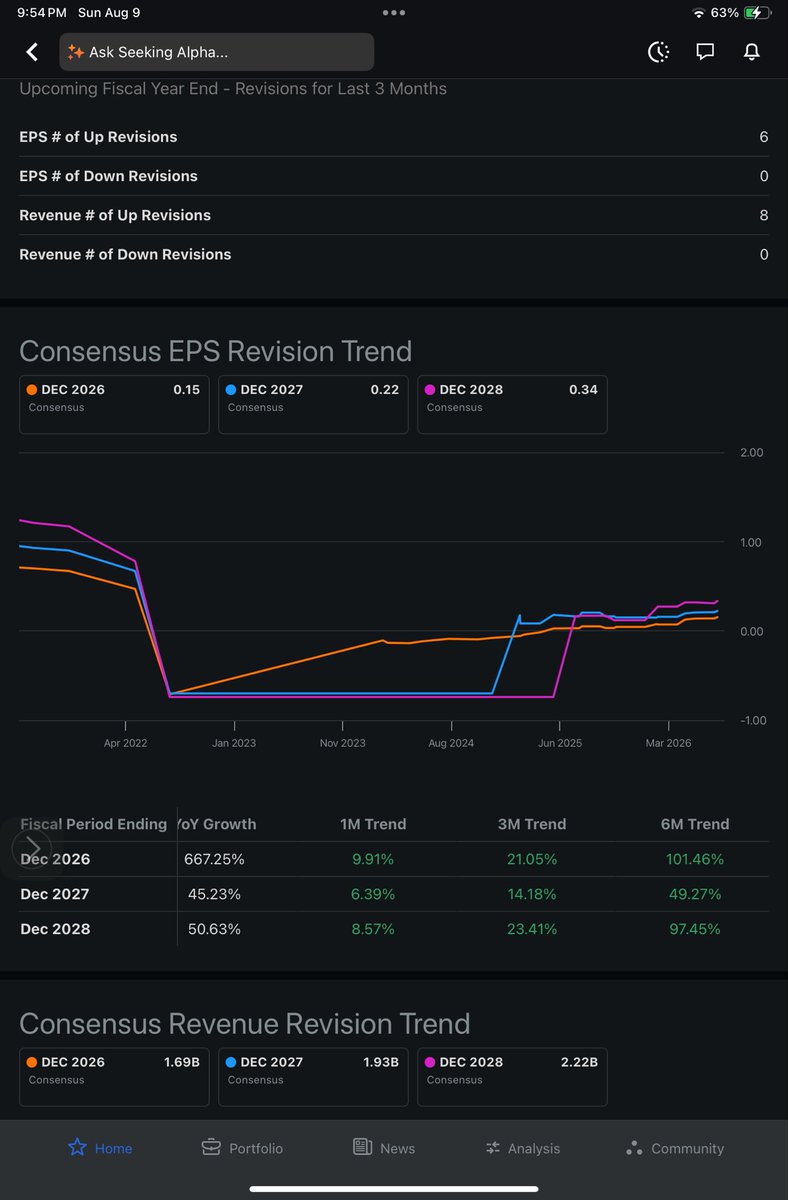
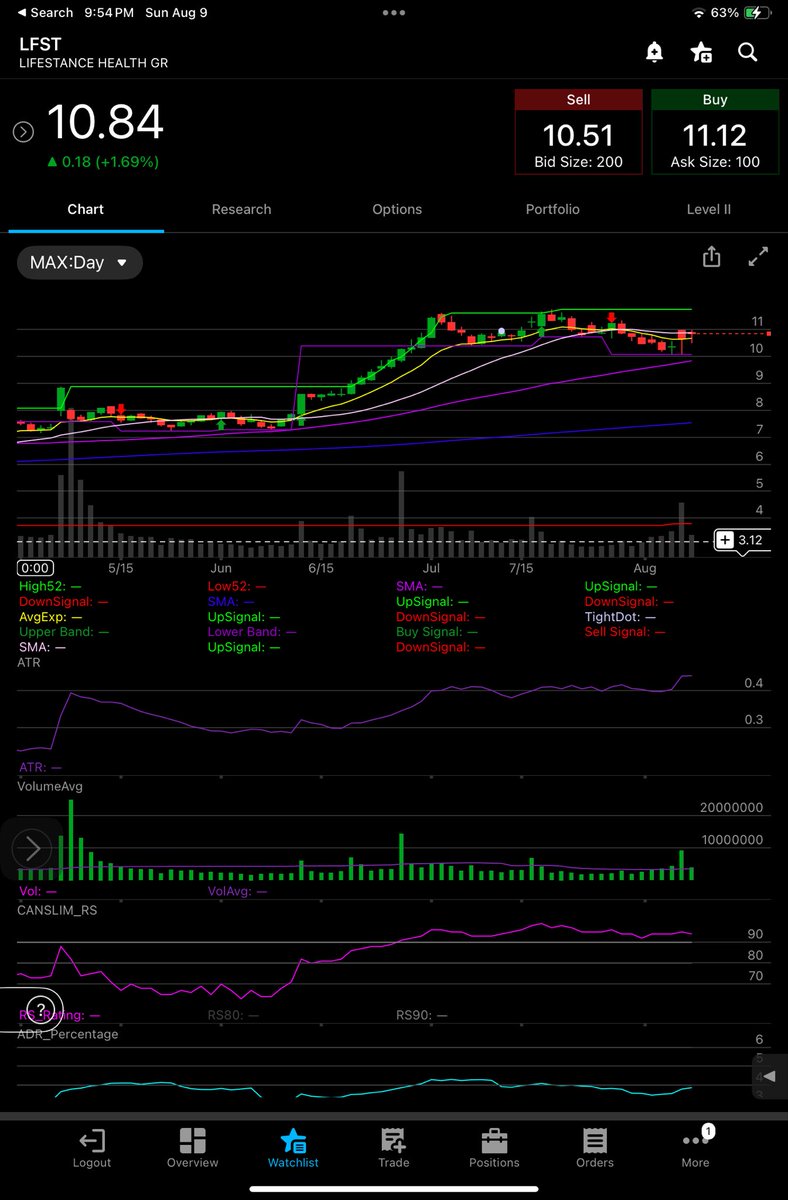
$LFST is a little richer than I typically like, but 600%+ expected EPS growth in a year tends to do that to a stock.
Looks like it hit a real profitability inflection around Q2 ’25. Margins have continued expanding, estimates are moving higher, revisions are strong and there’s still a solid growth runway.
Reminds me a bit of $LQDA and $HNGE — different businesses, but a similar profile: fundamental inflection + positive revisions + improving technicals. Both have been great trades for me.
Chart is interesting too. It’s been building a base since early July and ~$11 looks like the level.
Could probably be more patient here, but I like the profile. May take a stab on a clean break.
Not financial advice. Do you own DD.
Sadly closed my $LQDA trade for a ~125% gain. Today’s report really wasn’t terrible but it wasn’t good enough to justify the run up into earnings.
This likely needs some time to set up again as I think it’s going to test the 50 day MA and probably drop below there in the near term (especially with the litigation overhang still looming).
This isn’t a goodbye, it is a see you later. Thx $LQDA you’ve been a great one.
Should the lawsuit resolve in their favor wouldn’t be surprised to see it rip back in which case there is a high likelihood I’ll tag back along.
Finally looks like $SMCI could catch a bid. The concerns are understandably given all the controversy and history of mgmt being shady. That said, this this is so damn cheap compared to peers and they have a real business.
If this does get back into the good graces of institutions, look out the move could be MASSIVE and aggressive.
$ONTO bounced almost perfectly off its 200-day during the recent AI selloff and has recovered nicely since.
Reported a ~15% EPS beat on August 7th, followed by a fresh wave of positive EPS revisions.
Forward estimates are particularly interesting — strong projected EPS growth with the multiple compressing quickly as earnings scale. Very GARP-ish profile with solid margins.
Definitely thinking hard about this one. Could emerge as a leader if the AI trade starts catching a bid again.
Fundamentally reminds me quite a bit of $MRVL.
$DBO.TO $DBOXF Q1 results out. First look:
➡️ Excellent royalty performance, up 25% YoY!
➡️ Hardware sales down slightly YoY, which I was kind of expecting given the language in the last earnings PR around historical patterns of seasonality. Nothing negative to read into this except that seat installs will continue to be lumpy.
➡️ Operating leverage is clearly showing, with higher gross margins due to the higher royalty mix + tight expense control. Adjusted EBITDA is up 28% on 3% total revenue growth.
➡️ 32 net new screens added during the quarter, bringing the total screen count to 1,233.
➡️ The company made it clear it is now increasingly using its balance sheet to finance new seat installs for its customers, which should foster further adoption.
Overall, the quarter continues to validate the long-term thesis for D-BOX, but I view it as short-term neutral.
Given the recent run-up in the stock price, I'm not sure this is the blowout quarter the market was expecting.
Hard to tell what the expectations were, since there's (still!) no analyst coverage.
We'll find out tomorrow!
Disclaimer: The Rivemont MicroCap Fund is long D-BOX Technologies (TSX: DBO). I am the portfolio manager and a unitholder of the fund. This isn't investment advice; please do your own research.
$DBO.TO $DBOXF just reported their Q1 2027 financials this afternoon, and the operating leverage is on full display. 🔥🚀
D-BOX Technologies dropped their numbers for the quarter ended June 30, and the shift toward high-margin recurring revenue is driving serious bottom-line growth.
Here are the critical takeaways from the release:Record Royalties:
➡️Royalty revenues hit an all-time high of $5.0 million, jumping 25% year-over-year.
➡️Margin Expansion: That higher royalty mix expanded gross margins by 3 percentage points, driving a massive 28% increase in Adjusted EBITDA to $4.3 million (locking in a 32% margin). This occurred even as total revenue grew just 3% to $13.4 million.
➡️The Flywheel Effect: The installed screen base grew nearly 18% over the last year. Management emphasized that every new screen added strengthens the foundation to turn box office momentum into high-margin recurring royalties.
Net profit before income taxes surged 51% to $2.9 million, further strengthening their balance sheet and financial flexibility.